Keyword Density Checker
Spot uneven keyword placement and risky repetition before you publish so readers get natural copy and your page still signals clear topical focus.
使用された公式
このキーワード密度チェッカーの使い方
監査する全文下書きを貼り付け、最適化するプライマリフレーズを設定し、オプションのセカンダリフレーズを追加し、プロミネンスウィンドウを調整し、オプションでAIディープレビューを実行する前にKPIとチャートを確認。
フィールドとコントロール
本文のみを貼り付けてください。ターゲット言語を含む見出しは含めてください。サイトchrome、Cookieバナー、重複フッターは除外し、合計が読者に見えるコンテンツを反映するようにしてください。
1単位として測定したいフレーズにマッチ — マルチワードフレーズはバウンダリ対応カウントを使用し、部分トークンマッチが合計を膨らませないようにします。
カンマ区切りのサポートフレーズ(最大3つまでチャート化)。エンティティ、シノニム、またはトピック近くにあると期待される証拠ポイントを使用。
通常の英語編集ではオフに。正確なブランド大文字やコードライクな文字列を監査する場合はオンに。
貼り付けの先頭から単語をカウント。ヒーローとイントロがCommercial約束を運ぶ場合は150–250に向けて増加。ヘッドラインのみのプロミネンスが欲しい場合は縮小。
任意。推定された黙読時間(238 WPM)にレートを掛けて、概算のレビューコストを算出 — SEOランキング価値とは別。
KPI行の読み方
- 語数と出現回数プライマリフレーズの基本頻度を確立。
- 密度 vs 冒頭密度全体ドキュメントの強調と、最初のN語内でのフレーズの出現強さを比較。
- バンドチェックマルチワードフレーズに対して1–2.5%の簡単な基準で異常に低いか高い密度をフラグ付け。
- 読書時間の価値時間単位のレート設定時に表示。
チャート
- バンドチャート — 現在の密度 vs プランニングバンドを視覚化。
- 三分割チャート — 言及が1つのセグメントにクラスターするかどうかを表示。
- セカンダリチャート — 記載されたフレーズのヒット数を比較。
AIディープレビュー
ANALYZEをクリックした場合のみ実行 — 現在のメトリクスをGeminiに送信し、構造化された編集フィードバックを取得。
数値を信頼する前に確認すべき重要なチェック
- ハイフネーションとスマート句読点は人間が1フレーズと読むものを分割する場合があります — CMSが奇数文字列をエクスポートする場合は正規化。
- 引用された音声や例は教育のためにフレーズを繰り返す場合があります — マーケティング密度のためにそれらのブロックを除外するかどうかを判断。
- 密度は補完的 — 検索意図の適合、内部リンク、ページ体験、事実の深さの代替ではありません。
ワークフロー例
コピーを貼り付けるかURLを取得。プライマリとセカンダリのキーワードはURLからロードした場合にページに従います。
- クリアはテキスト、URLフィールド、ロード状態、キーワードフィールドをクリア。
- 空テキストまたは未取得URLはキーワード入力を自動クリア。
- プロミネンスウィンドウと大文字小文字の区別を監査ルールに合わせて調整。
Why keyword density still matters as a diagnostic—not a target score
This keyword density checker measures how often your primary phrase appears relative to total word length, how concentrated it is in the opening segment, and how hits distribute across the first, middle, and final thirds of the draft—so you can spot awkward repetition, thin usage, or uneven placement before you publish.
Modern search systems reward helpful, specific answers and trustworthy pages. Raw repetition alone does not guarantee rankings, and extreme repetition can harm readability. Density is best used as a sanity check alongside structure, intent alignment, and experience signals—exactly how experienced editors treat it in professional workflows.
Pair this analysis with a full word counter pass when you need token-level totals and sentence rhythm, then use our reading time calculator to translate length into minutes for realistic scheduling. When spacing or export quirks distort counts, normalize text with remove extra spaces before you trust density math.
A practical workflow is triage first: confirm the page answers the question, then review headings and intros for intent, then check whether primary language sounds natural in context. Density and prominence help you catch outliers—sections that mention the topic too rarely to feel authoritative, or paragraphs that hammer the same phrase until the prose feels mechanical.
Secondary phrases deserve their own lane. Supporting terms should reinforce meaning without competing for the same sentence slots. The on-page charts let you compare a small set of secondary phrases so you can see whether synonyms and related entities appear where readers expect them, not only whether one string repeats.
Editorial teams also align density with accessibility and mobile reading. Short paragraphs and clear headings reduce cognitive load; keyword placement that respects those structures tends to read as helpful rather than manipulative. If your density looks fine but the page still feels thin, the issue is usually depth and examples—not another repetition of the same token.
Think of topical coverage in layers: headings promise what the sections deliver, body copy supplies proof and steps, and closing paragraphs tie outcomes back to the reader’s job to be done. A sort text lines pass can help when you are restructuring outlines imported from messy docs, while remove duplicate lines keeps pasted research notes from inflating counts before you measure density on the final narrative.
Experienced SEO editors still watch density because it surfaces repetition patterns that automated grammar tools miss: the same two-word stem in every paragraph opener, or a branded phrase that appears only in the hero and footer but never in the substantive middle. Those patterns are editorial problems first—readers notice them before algorithms do.
Inputs, matching rules, and what each metric means
Primary keyword or phrase should match how you want to measure focus: single word, two-word head term, or a short phrase. Multi-word matching respects word boundaries so you do not accidentally count substrings inside unrelated tokens.
Case sensitivity is usually off for English editorial work so you capture natural capitalization in headings and body copy. Turn it on when you must audit branded casing or code-like tokens precisely.
Prominence window limits density to the first N words—often the lead and hero copy where search snippets and readers focus first. A healthy page can show slightly higher prominence than whole-document density when the topic is introduced clearly up front; the gap becomes a problem when the opening is stuffed while the rest of the article under-delivers substance.
Optional hourly editorial rate converts estimated reading time into a rough dollar signal for review cost. It is a planning aid for teams that trade editor hours against launch windows—not a valuation of SEO outcomes.
Semantic coverage without stuffing
Strong pages answer questions with varied vocabulary: synonyms, entities, related tasks, and concrete examples. Density on one string does not capture that breadth, which is why secondary phrases are charted separately. When supporting language lags behind the primary phrase, readers may feel the page is narrow even if the head term is repeated “enough” by percentage.
KPI dashboard, charts, and how to read them
The KPI row summarizes totals, occurrences, whole-document density, opening-segment density, a simple band check against a conservative 1–2.5% reference range, and optional read-time value. Charts visualize density against that band, placement by thirds, and secondary phrase hits.
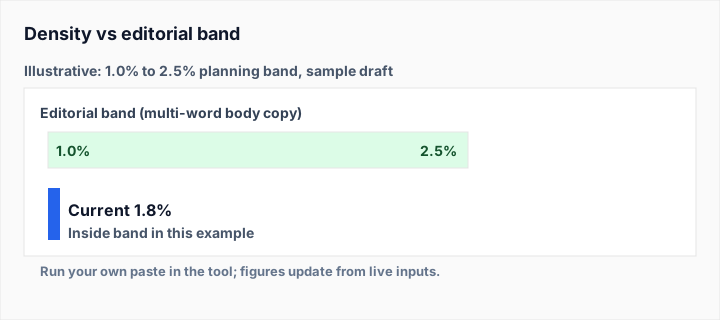
What this shows: where your whole-document density sits relative to a conservative planning band.
Assumptions: illustrative band 1.0%–2.5%; your live numbers come from the tool inputs.
Representative outputs: verify density in the widget before citing in client-facing audits.
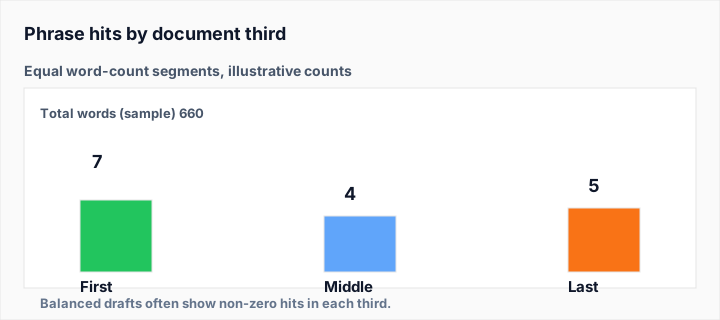
What this shows: whether mentions cluster in one section instead of supporting the full narrative arc.
Assumptions: document split into three equal word-count segments.
Representative outputs: compare hit counts across segments in your live run.
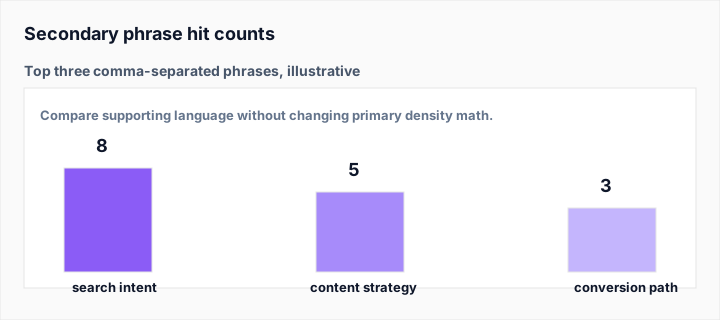
What this shows: relative visibility of supporting phrases you list as secondary keywords.
Assumptions: up to three secondary phrases displayed from your comma-separated list.
Representative outputs: raw hit counts—pair with editorial judgment for intent fit.
Depth, limitations, and how experts interpret the numbers
Density cannot measure relevance to query intent, E-E-A-T, or technical health. It also cannot see semantic variants unless you add them as secondary phrases or run separate checks. Treat the output as structured feedback for editors, not a score to maximize.
Search engines also weigh page experience signals: clarity of navigation, mobile legibility, and whether the page loads meaningful content quickly. A paragraph that reads well on a phone at 16px body size often needs fewer forced repeats than one written as a dense wall of text—because readers skim, headings carry more of the topical signal, and lists break complex ideas into scannable units.
If you localize pages, remember that tokenization and compounding differ by language; this implementation follows whitespace word boundaries suited to English drafts. For multilingual programs, re-run analysis per locale rather than translating density figures directly.
When you need structural experiments—line order, mirrored strings, or QA on reversed copy—use reverse text modes as a sandbox, then return here after substantive edits so measurements reflect the final draft.
A practical QA checklist before sign-off
Read the intro aloud: does the primary phrase sound like it belongs, or does it fight the sentence rhythm? Scan the middle third for proof—data, steps, or examples—that justifies the claim in the headline. Confirm the closing section ties back to the reader’s next step without reintroducing the same phrase in every sentence. If those checks pass, density metrics are more likely to reflect disciplined writing rather than accidental repetition.
Related tools and internal resources
- Word Counter — rhythm, sentence mix, and richer text metrics alongside density.
- Reading Time Calculator — translate length into reader and narrator minutes.
- Remove Extra Spaces — stabilize exports before counting.
- Sort Text Lines — reorganize outline lists while iterating on structure.