Log Base 2 Calculator
Free Log Base 2 Calculator: compute log₂(N) instantly with step-by-step solutions, change-of-base formula, inverse (2^x), and a comprehensive reference...
Formula used
Log Base 2 Calculator
Binary Logarithm · Step-by-Step · 4 Modes
Compute log₂(N) — the binary logarithm of any positive real number, with step-by-step solution and reference table.
What Is Log Base 2? Definition and Formula
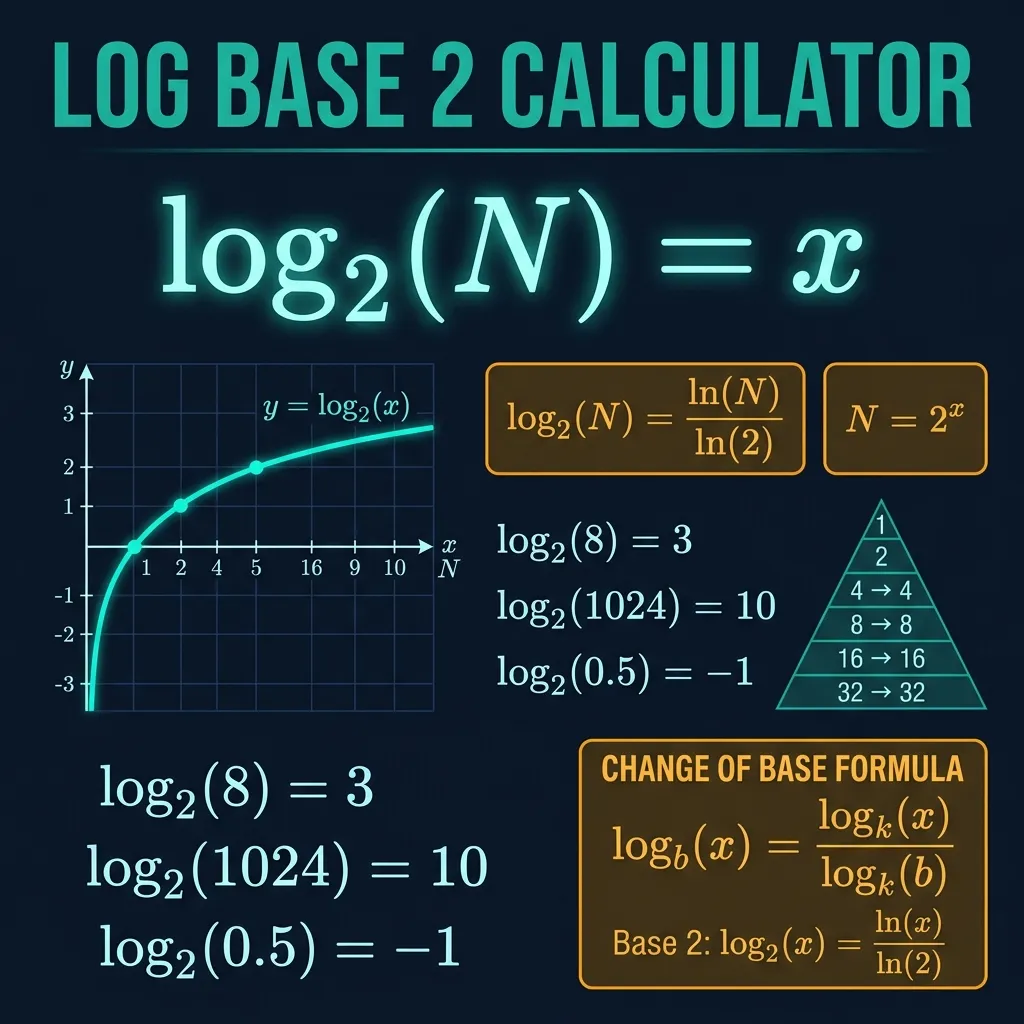
The logarithm base 2 (also called the binary logarithm) answers the fundamental question: "To what power must 2 be raised to obtain N?" Formally:
- log2(N) = x means 2x = N (for N > 0)
- The binary logarithm is the inverse of the exponential function 2x
- It is the most natural logarithm for all binary (base-2) and digital systems
The log base 2 formula using the change of base identity:
- log₂(N) = ln(N) / ln(2) — using natural logarithm (most computationally efficient)
- log₂(N) = log₁₀(N) / log₁₀(2) = log₁₀(N) / 0.30103 — using common logarithm
- log₂(N) = logb(N) / logb(2) — generalized change-of-base form
Key special values every student and programmer should memorize:
- log₂(1) = 0 (because 20 = 1)
- log₂(2) = 1 (because 21 = 2)
- log₂(4) = 2 (because 22 = 4)
- log₂(8) = 3 (because 23 = 8)
- log₂(16) = 4 (because 24 = 16)
- log₂(32) = 5 (because 25 = 32)
- log₂(64) = 6 (because 26 = 64)
- log₂(128) = 7 (because 27 = 128)
- log₂(256) = 8 (because 28 = 256, the number of values in one byte)
- log₂(512) = 9 (because 29 = 512)
- log₂(1024) = 10 (because 210 = 1024 = 1 KiB)
How to Use the Log Base 2 Calculator
Our calculator provides four powerful computation modes to cover every use case:
- log₂(N): The primary mode — enter any positive real number N and get log₂(N) instantly, with full step-by-step working, verification, and a reference table
- Inverse (2x): Enter the logarithm value x (an exponent) and compute N = 2x. This is the antilogarithm base 2. Useful for converting known exponents to their values
- Batch: Enter multiple values, one per line, and compute log₂ for all of them simultaneously — ideal for data analysis, algorithm complexity comparison, and table generation
- Compare Bases: Enter N and compare log₂(N) against loge(N), log10(N), and any custom base — side by side in one step
All modes produce results to selectable precision (4–12 significant digits), scientific notation, and a one-click copy button.
Log Base 2 Formula and Step-by-Step Calculation
To calculate log₂(N) by hand or verify the calculator's output:
- Step 1: Confirm that N > 0 (logarithm is only defined for positive real numbers)
- Step 2: Apply the change-of-base formula: log₂(N) = ln(N) ÷ ln(2) = ln(N) ÷ 0.693147…
- Step 3: Compute ln(N) using your calculator's natural log function
- Step 4: Divide by ln(2) ≈ 0.693147180559945…
- Step 5: Verify: raise 2 to your computed power and check you get N back
Worked example — log₂(100):
- ln(100) = 4.60517018598809
- ln(2) = 0.693147180559945
- log₂(100) = 4.60517… ÷ 0.69315… = 6.64385618977472
- Verification: 26.64386 ≈ 100.00 ✓
Worked example — log₂(0.25):
- Note: 0.25 = 1/4 = 2−2, so log₂(0.25) = −2 exactly
- ln(0.25) = −1.38629436… and −1.38629… ÷ 0.69315… = −2 ✓
For power-of-2 integers, the result is always an exact integer. For other numbers, use our Significant Figures Calculator to control precision.
Log Base 2 in Computer Science
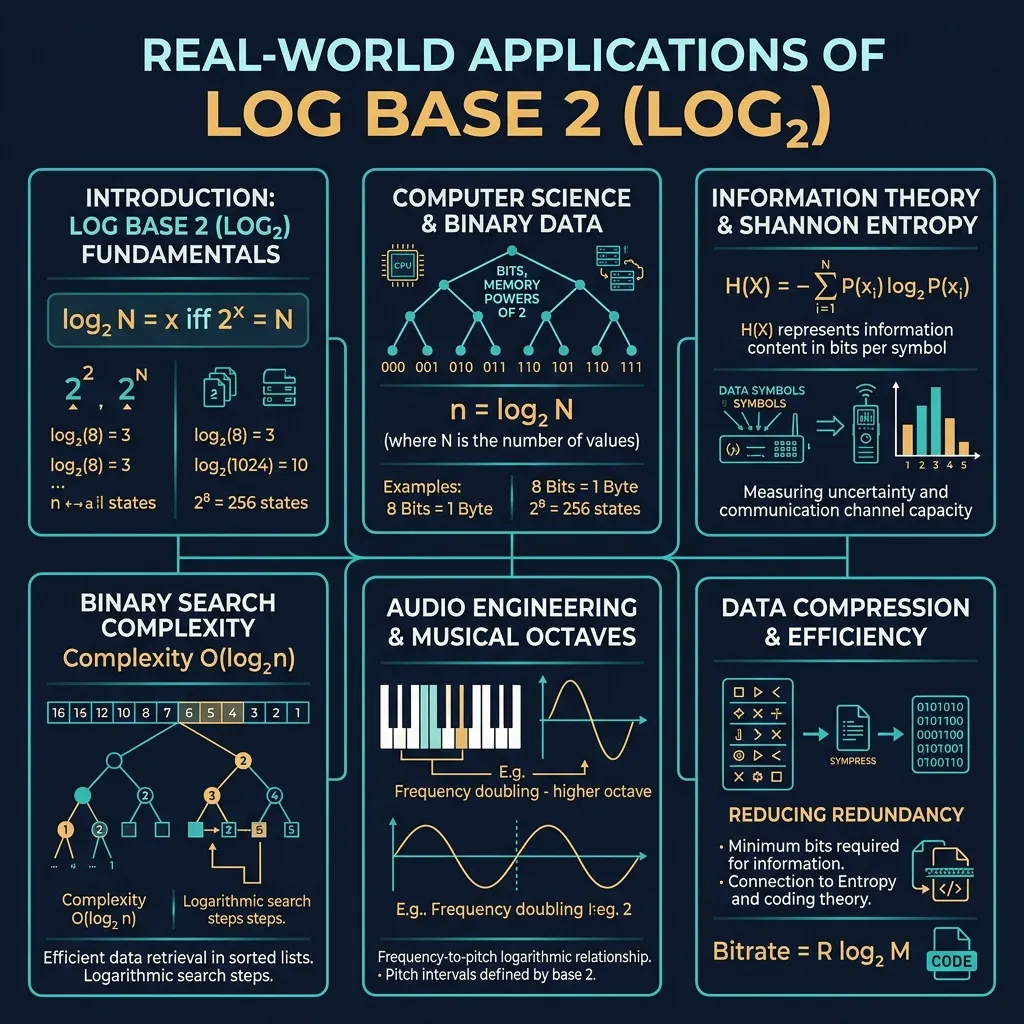
The binary logarithm is ubiquitous in computer science because computers operate natively in base 2. Key applications:
- Algorithm complexity: Binary search on an array of 1,000,000 elements takes at most ⌈log₂(1,000,000)⌉ = 20 comparisons. Merge sort runs in O(n log₂ n). AVL trees maintain O(log₂ n) height.
- Memory addressing: A 32-bit address space supports 232 = 4,294,967,296 unique addresses. Conversely, log₂(4 GB) = log₂(232) = 32 bits. A 64-bit system → 264 ≈ 18.4 exabytes addressable.
- Data storage units: 1 byte = 8 bits = log₂(256) bits of address space. 1 KiB = 210 bytes → log₂(1 KiB) = 10. This is why memory is measured in powers of two.
- Hash tables: A hash table with 2k buckets uses the k least-significant bits of the hash. The number of bits needed is exactly ⌈log₂(capacity)⌉.
- Huffman coding: Optimal prefix codes assign −log₂(p) bits to a symbol with probability p. This is the information-theoretic minimum.
- Networking: IPv4 CIDR notation /n means 232−n host addresses. /24 → 28 = 256 hosts, /16 → 216 = 65,536 hosts.
Use our Exponent Calculator to compute 2n — the inverse of log base 2 — for any of these scenarios.
Log Base 2 and Information Theory
Shannon entropy — the theoretical minimum number of bits needed to encode information — is defined using log₂:
- H(X) = −Σ p(x) × log₂(p(x)) bits per symbol
- For a fair coin flip (p = 0.5 for heads/tails): H = −(0.5 × log₂(0.5) + 0.5 × log₂(0.5)) = −(0.5 × (−1) + 0.5 × (−1)) = 1 bit
- For a fair 6-sided die: H = log₂(6) ≈ 2.585 bits per roll
- For 8 equally likely outcomes: H = log₂(8) = 3 bits exactly
Why log₂? Because the unit of entropy is the bit — and 1 bit of entropy is defined as the information from one fair binary decision. The binary logarithm gives entropy in bits directly, while loge gives nats and log10 gives bans/hartleys.
For compressing data optimally, a symbol with probability p requires − log₂(p) bits. A character appearing 1/4 of the time ideally gets a 2-bit code (since −log₂(0.25) = 2). This is the foundation of Huffman coding, arithmetic coding, and LZ compression algorithms.
Key Properties and Identities of log₂
These rules are fundamental for simplifying expressions and solving equations:
- Product rule: log₂(A × B) = log₂(A) + log₂(B)
- Quotient rule: log₂(A ÷ B) = log₂(A) − log₂(B)
- Power rule: log₂(Ak) = k × log₂(A)
- Root rule: log₂(√A) = log₂(A) / 2
- Reciprocal rule: log₂(1/N) = −log₂(N)
- Change of base: log₂(N) = logb(N) / logb(2) for any b > 0, b ≠ 1
- Inverse identity: 2log₂(N) = N and log₂(2x) = x
- Special values: log₂(1) = 0, log₂(2) = 1, log₂(1/2) = −1, log₂(0+) → −∞
Examples applying these properties:
- log₂(32) = log₂(25) = 5 (by power rule)
- log₂(48) = log₂(16 × 3) = log₂(16) + log₂(3) = 4 + 1.585 ≈ 5.585
- log₂(0.125) = log₂(1/8) = −log₂(8) = −3
- If log₂(x) = 7.5, then x = 27.5 = √(215) = √32768 ≈ 181.02
See our Antilog Calculator for computing 2x from any known log₂ value, or use the Inverse mode built into this calculator.
Log Base 2 Reference Table
Common values for quick reference — these appear frequently in programming and engineering:
- log₂(1) = 0
- log₂(2) = 1
- log₂(3) ≈ 1.58496
- log₂(4) = 2
- log₂(8) = 3
- log₂(10) ≈ 3.32193
- log₂(16) = 4
- log₂(32) = 5
- log₂(64) = 6
- log₂(100) ≈ 6.64386
- log₂(128) = 7
- log₂(256) = 8
- log₂(512) = 9
- log₂(1,000) ≈ 9.96578
- log₂(1,024) = 10
- log₂(1,048,576) = 20 (= 1 MiB)
- log₂(1,073,741,824) = 30 (≈ 1 GiB)
The full interactive reference table with any custom input is available directly in the calculator tool above. Use the Factor Calculator to explore the prime factorization structure of the integer results.
Log Base 2 in Audio: Musical Octaves
In music and audio engineering, pitch perception is logarithmic — and specifically base-2 logarithmic for octaves. Doubling a frequency always raises pitch by exactly one octave, regardless of the starting frequency:
- Middle A = 440 Hz → one octave up = 880 Hz (440 × 2 = 880)
- One octave down = 220 Hz (440 / 2 = 220)
- Number of octaves between two frequencies f₁ and f₂ = log₂(f₂ / f₁)
- From 20 Hz (bass) to 20,000 Hz (treble): log₂(20000/20) = log₂(1000) ≈ 9.97 octaves of audible range
- From A4 (440 Hz) to A7 (3520 Hz): log₂(3520/440) = log₂(8) = 3 octaves exactly
The equal-tempered 12-tone scale divides each octave into 12 equal semitones. One semitone = 21/12 ≈ 1.0595 times the frequency. Thus the frequency ratio for n semitones = 2n/12, and the number of semitones between two frequencies = 12 × log₂(f₂/f₁). Our Pythagorean Theorem Calculator similarly uses the same exponential-to-logarithm inverse relationship in its computations.
Related Calculators
- Antilog Calculator — The inverse of log₂(N) is 2x (binary antilogarithm). Our Antilog Calculator computes antilog₂(x) = 2x directly, with full step-by-step working across all bases. Since log₂ and antilog₂ are inverse functions, antilog₂(log₂(N)) = N identically — use both calculators together to verify any result.
- Exponent Calculator — log₂(N) answers "what exponent?" while the Exponent Calculator answers "what is 2 raised to this exponent?" Computing 2x for fractional x (like 23.32193 = 10) is exactly the reverse of log₂(10) = 3.32193.
- Significant Figures Calculator — Log base 2 results for non-powers-of-2 are always irrational. Proper significant figure handling is essential: log₂(100) = 6.64385618… has 11+ digits. Use our Significant Figures Calculator to round to the correct precision for your application.
- Factor Calculator — Integer log₂ results (log₂(64) = 6, log₂(256) = 8) correspond to perfect powers of 2. The Factor Calculator reveals these numbers' factorizations: 256 = 28, 1024 = 210. When log₂(N) is not an integer, N is never a power of 2, and its factorization will include at least one prime other than 2.
- Triangle Area Calculator — Heron's formula A = √[s(s−a)(s−b)(s−c)] uses square roots, which relate to log₂: √N = 2(log₂N)/2 = 2log₂(√N). The log₂ of a square root is always half the log₂ of the original number.