Exponent Calculator
Free Exponent Calculator: compute bⁿ for any base and exponent — positive, negative, fractional, or zero. Find nth roots, apply all 7 exponent laws, solve...
Formula used
How to Use the Exponent Calculator
This calculator covers every type of exponent and power problem in five powerful modes:
- Basic Power (bⁿ): Enter any real base b and exponent n to compute bⁿ. Handles positive, negative, zero, decimal, and fractional exponents. Results displayed in both decimal and scientific notation. For integer exponents, also shows the repeated-multiplication breakdown: 2⁵ = 2 × 2 × 2 × 2 × 2 = 32.
- Nth Root (ⁿ√b): Find the nth root of any positive number: ⁿ√b = b^(1/n). Supports square roots (n=2), cube roots (n=3), and all higher roots. Shows exact fractional exponent form alongside decimal result.
- Fractional Exponent (b^(m/n)): Compute b^(m/n) = ⁿ√(bᵐ). Enter base, numerator, and denominator separately for precision. Handles negative fractional exponents: b^(-m/n) = 1 / ⁿ√(bᵐ).
- Exponent Laws Solver: Enter two powers with the same base and choose which law to apply: product rule (bᵐ × bⁿ), quotient rule (bᵐ ÷ bⁿ), power of power ((bᵐ)ⁿ), or product of powers ((ab)ⁿ). See each law applied step by step.
- Exponential Growth/Decay: Model real-world growth and decay: A = P × bᵗ where P is the initial value, b is the growth factor, and t is time. Find doubling time, half-life, and percent change per period. Compare against simple and compound interest growth.
All modes show a step-by-step breakdown, the exact mathematical identity used, and a 12-tile power reference table. Click any result tile to copy its value.
Understanding Exponents and Powers
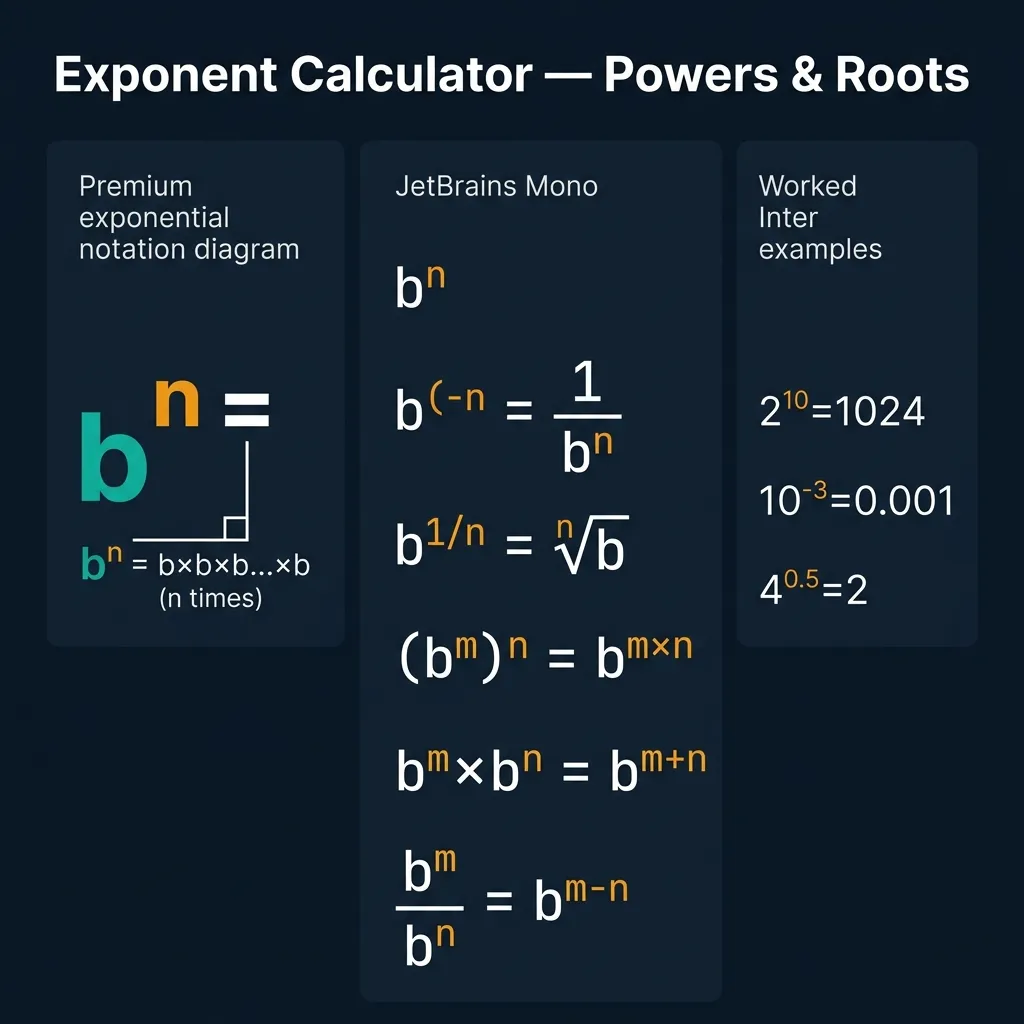
An exponent (also called a power or index) tells you how many times to multiply the base by itself:
- bⁿ = b × b × b × … × b (n times), where b is the base and n is the exponent.
- 2⁵ = 2 × 2 × 2 × 2 × 2 = 32 — "2 to the power of 5" or "2 raised to the 5th"
- 10³ = 10 × 10 × 10 = 1,000 — the foundation of scientific notation
- 3⁴ = 81, 5² = 25, 7¹ = 7, anything⁰ = 1 (except 0⁰ which is indeterminate)
The result of an exponentiation is called the power. So "2 to the power of 10" = 2¹⁰ = 1,024. Negative exponents represent reciprocals: 2⁻³ = 1/2³ = 1/8 = 0.125. Fractional exponents represent roots: 8^(1/3) = ∛8 = 2.
Key vocabulary: the expression "bⁿ" is called a power expression. "b" is the base, "n" is the exponent, index, or power (these terms are interchangeable). The result is called the value of the power.
The 7 Laws of Exponents
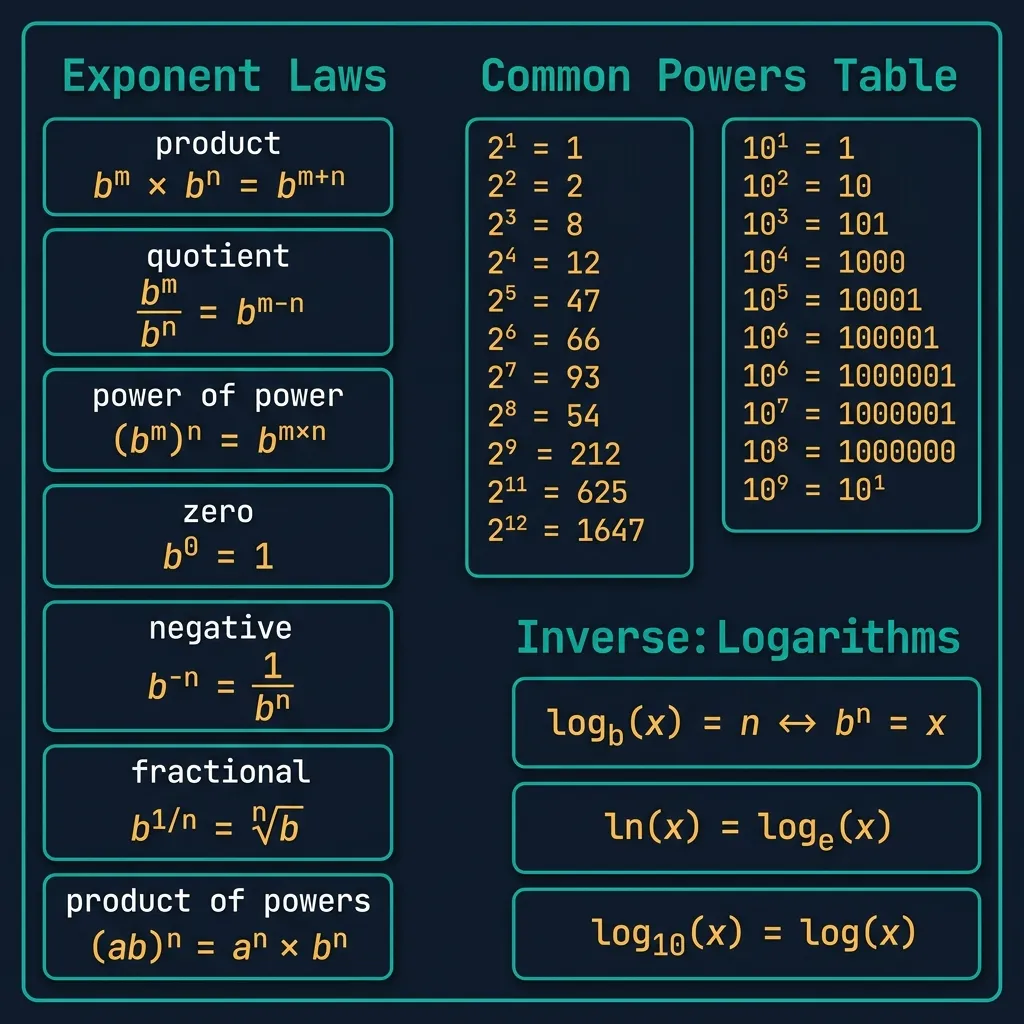
The seven fundamental laws of exponents are tools for simplifying and manipulating power expressions:
- 1. Product Rule: bᵐ × bⁿ = bᵐ⁺ⁿ — When multiplying powers with the same base, add the exponents. Example: 2³ × 2⁴ = 2⁷ = 128. Why? (2×2×2) × (2×2×2×2) = 2⁷.
- 2. Quotient Rule: bᵐ ÷ bⁿ = bᵐ⁻ⁿ — When dividing powers with the same base, subtract the exponents. Example: 10⁶ ÷ 10² = 10⁴ = 10,000. This rule explains why b⁰ = 1: bⁿ ÷ bⁿ = bⁿ⁻ⁿ = b⁰, and any number divided by itself is 1.
- 3. Power of a Power: (bᵐ)ⁿ = bᵐⁿ — When raising a power to another power, multiply the exponents. Example: (2³)⁴ = 2¹² = 4,096. Also (3²)³ = 3⁶ = 729.
- 4. Zero Exponent: b⁰ = 1 for any b ≠ 0 — Any non-zero number raised to zero equals 1. Derived from quotient rule: bⁿ/bⁿ = bⁿ⁻ⁿ = b⁰ = 1. Note: 0⁰ is undefined (indeterminate form).
- 5. Negative Exponent: b⁻ⁿ = 1/bⁿ — A negative exponent means the reciprocal. Example: 5⁻² = 1/5² = 1/25 = 0.04. And (1/3)⁻² = 3² = 9. Negative exponents are essential in scientific notation: 10⁻⁶ = one millionth.
- 6. Fractional Exponent: b^(1/n) = ⁿ√b — A fraction exponent equals the corresponding root. Example: 64^(1/3) = ∛64 = 4. More generally: b^(m/n) = ⁿ√(bᵐ) = (ⁿ√b)ᵐ. Example: 8^(2/3) = ∛(8²) = ∛64 = 4.
- 7. Product of Powers: (ab)ⁿ = aⁿ × bⁿ — When a product is raised to a power, each factor is raised to that power. Example: (2 × 3)⁴ = 2⁴ × 3⁴ = 16 × 81 = 1,296. Also (6)⁴ = 1,296 ✓. Similarly: (a/b)ⁿ = aⁿ/bⁿ.
Negative and Zero Exponents
Negative exponents are one of the most misunderstood topics in mathematics. Key points to remember:
- b⁻ⁿ ≠ negative number. A negative exponent makes the expression smaller (a fraction), NOT negative. Example: 2⁻³ = 1/8 = 0.125 — a positive fraction.
- Moving across the fraction bar flips the sign: b⁻ⁿ / 1 = 1 / bⁿ. And 1 / b⁻ⁿ = bⁿ.
- Negative base matters: (-2)³ = (-2) × (-2) × (-2) = -8 (negative, odd exponent). (-2)⁴ = 16 (positive, even exponent). (-2)⁻³ = 1/(-2)³ = -1/8 = -0.125.
- 10 to negative powers for scientific notation: 10⁻¹ = 0.1, 10⁻² = 0.01, 10⁻³ = 0.001, 10⁻⁶ = 10⁻⁶ (one millionth), 10⁻⁹ = one billionth. Use our Significant Figures Calculator to correctly handle precision when working with scientific notation.
- b⁰ = 1 for all b ≠ 0. But 0⁰ is indeterminate (it appears in combinatorics as 1 by convention, but is undefined in calculus limits). This calculator returns 1 for 0⁰ following the combinatorial convention.
Fractional Exponents and Roots
Fractional exponents unify powers and roots into a single notation:
- b^(1/2) = √b (square root). Example: 25^(1/2) = √25 = 5. Verify: 5² = 25 ✓.
- b^(1/3) = ∛b (cube root). Example: 27^(1/3) = ∛27 = 3. Verify: 3³ = 27 ✓.
- b^(1/n) = ⁿ√b (nth root). Example: 32^(1/5) = ⁵√32 = 2. Verify: 2⁵ = 32 ✓.
- b^(m/n) = ⁿ√(bᵐ) = (ⁿ√b)ᵐ — general fractional exponent. Example: 8^(2/3) = ∛(8²) = ∛64 = 4. Or: (∛8)² = 2² = 4 ✓. Both paths give the same result.
- Negative fractional exponents: b^(-m/n) = 1/(b^(m/n)). Example: 27^(-2/3) = 1/(27^(2/3)) = 1/(∛27)² = 1/9 ≈ 0.1111.
Fractional exponents are the key to solving radical equations and appear constantly in calculus (derivatives of power functions: d/dx[xⁿ] = n·xⁿ⁻¹), statistics (standard deviation involves square roots), and physics (the intensity-distance relationship I ∝ r⁻² uses a negative integer exponent). Use our Hypotenuse Calculator for right triangle calculations that involve square roots (√(a²+b²)).
Scientific Notation and Powers of 10
Scientific notation expresses any number as a × 10ⁿ where 1 ≤ |a| < 10. Exponents are the backbone of this system:
- 6.022 × 10²³ (Avogadro's number) = 602,200,000,000,000,000,000,000
- 1.602 × 10⁻¹⁹ (electron charge in coulombs) = 0.0000000000000000001602
- 3.0 × 10⁸ m/s (speed of light) = 300,000,000 m/s
- 9.109 × 10⁻³¹ kg (electron mass)
Powers of 2 are fundamental in computing: 2¹⁰ = 1,024 ≈ 10³ (1 KB ≈ 1,000 bytes); 2²⁰ = 1,048,576 ≈ 10⁶ (1 MB); 2³⁰ ≈ 10⁹ (1 GB); 2⁴⁰ ≈ 10¹² (1 TB); 2⁶⁴ = 18,446,744,073,709,551,616 (maximum value of a 64-bit unsigned integer). The reason 1 KB is often defined as 1,024 bytes (not 1,000) is that 2¹⁰ = 1,024 is the nearest power of 2 to 10³. The Significant Figures Calculator helps manage precision when converting between these representations.
Exponential Growth and Decay
The generalized exponential model is: A = P × bᵗ
- P = initial amount (principal)
- b = growth factor per unit time (b > 1 for growth, 0 < b < 1 for decay)
- t = number of time periods
- A = amount after t periods
Compound interest: A = P(1 + r)ⁿ where r is the rate per period and n is the number of periods. Example: $1,000 at 8% per year for 10 years: A = 1000 × 1.08¹⁰ = 1000 × 2.1589 = $2,158.90. The exponent is the number of compounding periods. Compare against our Percentage Calculator for simple interest, where the growth is linear (P × r × t) rather than exponential.
Doubling time (Rule of 72): At growth rate r%, the doubling time ≈ 72/r periods. At 8% annual growth: doubling time ≈ 72/8 = 9 years. More precisely: t_double = ln(2)/ln(1+r) = log₂(2)/log₂(1+r). Example: 1.08ᵗ = 2 → t = ln(2)/ln(1.08) ≈ 9.006 years.
Radioactive decay (half-life): A = A₀ × (1/2)^(t/t½) where t½ is the half-life. Carbon-14 has t½ = 5,730 years. After 11,460 years (2 half-lives): A = A₀ × (0.5)² = A₀/4 = 25% remains.
Population growth: N(t) = N₀ × eʳᵗ where e ≈ 2.71828 (Euler's number) and r is the continuous growth rate. This is the limit of A = P(1 + r/n)ⁿᵗ as n → ∞. At r = 3% per year: N doubles when eʳᵗ = 2 → t = ln(2)/0.03 ≈ 23.1 years.
Exponents and Logarithms (Inverse Operations)
The logarithm is the inverse of exponentiation: logᵦ(x) = n ↔ bⁿ = x.
- log₂(1024) = 10 because 2¹⁰ = 1,024
- log₁₀(1000) = 3 because 10³ = 1,000 (common log)
- ln(e²) = 2 because e² = e² (natural log, base e ≈ 2.71828)
- Conversion: logₐ(x) = logᵦ(x) / logᵦ(a) — change of base formula
- Logarithm laws mirror exponent laws: log(ab) = log(a) + log(b); log(a/b) = log(a) − log(b); log(aⁿ) = n·log(a)
Given bⁿ = x, find n: n = log(x)/log(b) = ln(x)/ln(b). Example: 2ⁿ = 1000 → n = log(1000)/log(2) = 3/0.30103 ≈ 9.966. So 2¹⁰ ≈ 1,024 and 2⁹·⁹⁶⁶ ≈ 1,000. This calculator shows the logarithm result alongside the power result in every mode.
Real-World Applications
- Computing and Information Theory: Memory sizes (2¹⁰ = 1 KB, 2²⁰ = 1 MB), encryption key lengths (2¹²⁸ for AES-128), hash function outputs (2²⁵⁶ SHA-256 possible hashes), and algorithm complexity (O(2ⁿ) for exponential time algorithms). Our Significant Figures Calculator handles the precision for these massive numbers.
- Finance: Compound interest A = P(1+r)ⁿ, Present Value PV = FV/(1+r)ⁿ, bond pricing, options pricing (Black-Scholes uses eˢ). All use exponents as their core operation. Compare with our Percentage Calculator for percentage-based financial calculations.
- Physics: Newton's law of gravitation (F ∝ r⁻²), light intensity falloff (I ∝ r⁻²), electric field (E ∝ r⁻²), spring energy (E = ½kx² uses exponent 2), kinetic energy (KE = ½mv² uses exponent 2), and the Schrödinger equation involves e^(iωt). The Richter scale is logarithmic: each unit represents 10× more shaking amplitude.
- Biology: Bacterial growth follows N = N₀ × 2ᵗ/ᵗᵈ. A colony doubling every 20 minutes starting from 100 cells: after 3 hours (9 doublings) = 100 × 2⁹ = 51,200 cells. DNA replication: starting with 1 double-stranded DNA, after n PCR cycles: 2ⁿ copies. After 30 cycles: 2³⁰ = 1,073,741,824 ≈ 10⁹ copies!
- Statistics and ML: The normal distribution PDF uses e^(-x²/2). Logistic regression uses 1/(1 + e^(-z)). The softmax function uses eˣ. Information entropy uses log₂. Gradient descent updates involve exponents through the power rule of calculus.
Related Calculators
- Significant Figures Calculator — When computing large exponents like 2¹⁰⁰ ≈ 1.268 × 10³⁰, the result must be expressed to the appropriate number of significant figures. If your base has 3 sig figs (e.g., 1.99), the result: 1.99¹⁰ ≈ 904 (3 sig figs, not 904.231...). This tool ensures correct scientific precision in all exponential computations.
- Hypotenuse Calculator — The Pythagorean theorem c = √(a² + b²) is a direct application of exponents and roots: squaring both legs (exponent 2) then taking the square root (exponent 1/2). The formula c² = a² + b² is itself an exponent equation. Understanding b^(1/2) = √b (fractional exponent = square root) directly connects the Exponent Calculator to this tool.
- Percentage Calculator — Percentages and exponents are deeply linked via compound interest and percentage change. Simple percentage change P% gives A = P₀(1 + P/100), while compounding n times gives A = P₀(1 + P/100)ⁿ — an exponent expression. The Exponent Calculator handles the (1+r)ⁿ part; this Percentage Calculator handles one-period percentage operations.
- Trigonometry Calculator — Euler's formula eⁱˣ = cos(x) + i·sin(x) connects exponents directly to trigonometric functions through the complex plane. Taylor series expansions of sin(x), cos(x), and eˣ all involve infinite sums of power terms xⁿ/n! — pure exponential expressions. Understanding eˣ (the natural exponential) is prerequisite to understanding oscillatory processes in physics and engineering.
- Arc Length Calculator — The standard form of a circle (x² + y² = r²) uses exponent 2 symbolically, defining arc length formulas via integration that involve (1 + (dy/dx)²)^(1/2), a fractional exponent of a sum of squares. In addition, parametric representations of circles use eⁱᶿ in complex analysis, linking the Arc Length Calculator to the Exponent Calculator through both geometry and calculus.