Table of Contents

What this calculator does
For a related scenario, see investment calculator.
How this page uses the idea: Convert between cat years and human years using a common piecewise model: fast kitten growth, then about four human years per cat year after age two. Optional months for finer input. You work with Conversion, Age (years), Additional months (0–11). The tool’s headline Equivalent age is produced under the model summarized as
H = 24 + 4(c - 2); c = 2 + H - 244. Interpreting the readout still depends on dominance, independent assortment, and whether you are modeling one locus—assumptions the FAQ calls out when they matter.
Cat Age Calculator — Cat Years vs Human Years

Topic framing and scientific context
If your use case differs, compare with bmi calculator.
This calculator targets cat age calculator and is generated for the topic signals: cat age calculator, cat age calculator, cat years to human years.
The goal is reproducible computation with transparent fields, explicit result schema, and auditable intermediate values.
Interpret outcomes under explicit biological assumptions encoded in the model; avoid extrapolating beyond those assumptions.

Core model and formula surface
A nearby model is available in dog size calculator.
Plain-text fallback: H = 24 + 4(c - 2); c = 2 + \frac{H - 24}{4}.
In implementation terms, this output is produced by calculate() with deterministic operator order and explicit field mapping.
Input dictionary (field-by-field)
You can cross-check with atom calculator.
- Conversion (
conversionMode)
- Age (years) (
years)
- Additional months (0–11) (
months)
Input quality checklist
- Confirm each field is entered in the expected unit/encoding.
- Avoid mixing semantic categories inside one field (e.g., type + unit in the same value).
- Prefer realistic ranges from domain practice before interpreting output.
Use these fields exactly as modeled; unit/encoding mismatches are the most common source of interpretive error.
Output schema and result interpretation
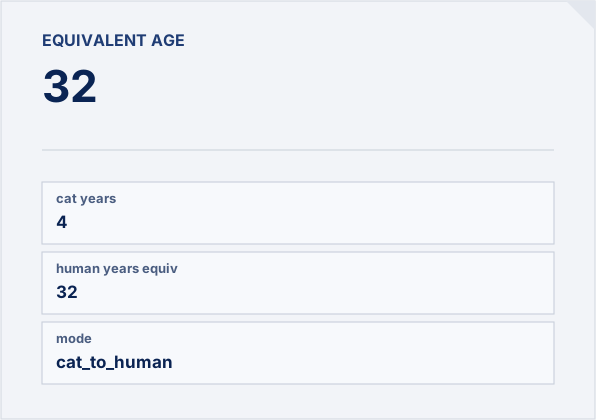
Simulated result snapshot explanation
Sample input data used for this image
- Conversion (
conversionMode): cat_to_human
- Age (years) (
years): 4
- Additional months (0–11) (
months): 0
Output values shown in the snapshot
- Equivalent age: 32
- cat_years: 4
- human_years_equiv: 32
- mode: cat_to_human
- formula: H = 24 + 4*(c - 2); c = 2 + (H ...
Why this result matters (goal of the calculation)
This calculator uses the input configuration above to produce a model-based Equivalent age for cat age calculator.
The objective is to turn raw inputs into one actionable headline metric plus supporting values, so users can make a decision with a traceable rationale instead of reading an isolated number.
For extended analysis, review punnett square calculator.
Primary output contract:
- label: Equivalent age
- type: number
- display semantics: headline first, then breakdown/intermediates for audit.
Reading the result correctly
- Treat the primary result as the headline answer to the configured model.
- Use breakdown rows as justification for the headline, not separate conclusions.
- If a value looks surprising, audit intermediate rows before changing assumptions.
When present, breakdown rows should be read as the trace from inputs to final result, not as independent conclusions.
Worked examples (traceable and reproducible)
Bundled sample input: conversionMode=cat_to_human, years=4, months=0.
Recommended audit workflow:
- Substitute values exactly as entered.
- Follow formula/operator order used in code.
- Compute intermediate quantities before final rounding.
- Validate that the displayed primary output is numerically consistent with breakdown rows.
Assumptions, boundaries, and failure modes
This tool is only as reliable as the assumptions it encodes:
- multi-locus interaction, linkage, and non-Mendelian effects may be out of scope;
- environmental modulation and penetrance may be simplified;
- observational outcomes can deviate from theoretical expectation.
Treat output as model-consistent evidence, not universal truth outside the encoded domain.
Validation checklist before using results
- Slightly perturb one input and confirm direction-of-change is sensible for the domain.
- Check unit consistency for every field participating in the formula.
- Compare one case against an independent hand calculation or reference method.
- Ensure displayed result and structured breakdown agree.
Practical applications and decision workflow
- Use for fast scenario comparison under fixed assumptions;
- Use breakdown fields to communicate result provenance (what drove the number/text);
- Escalate to domain-specific expert review when decisions are high-impact.
