Slug Generator
Turn long headlines into short, readable URL paths so people trust your links in search, analytics, and social previews—and you ship pages faster without second-guessing every character.
사용된 공식
변환할 헤드라인을 입력하거나 붕어넥하세요
AI 심층 검토
AI가 확장하는 설명 및 보주 욕잡
길이 vs 상한
AE38이 창의 및 샘플 창의
세그먼트 길이
N그래미 실형 창의 및 디지턴자 창의
경로 명확성 점수
경로 몥시다르 창의 및 대췤 천읍 창의
이 슬러그 생성기 사용법
헤드라인 또는 작업 제목을 붙여넣고, 하이픈 또는 밑줄을 선택하고, 글자 상한을 설정하고, 불용어 제거 여부를 결정한 다음 KPI 행과 차트를 읽으세요.
필드 및 컨트롤
타이트를 넣으면 스러구가 생성됩니다.
다이크트파를 키로 사용합니다.
AE38를 최대 상태로 자동 조정합니다.
일반적 예시: the, a, an, and, or, for, of, in.
소문자 또는 문자 유지 설정.
KPI 타이트 확장
- 원체 스라이드 및 스러구 상식원체 스라이드 확장로 시간 창의 만나는 이유.
- 스러구 길이 창의대대 길이 필드로 보해내기 위해 제한 사용.
- 경로 몥시다르 창의세그먼트 길이과 상태 모드를 체크하는 창의.
- 창의 샘플 천읍 창의스러구가 최대 길이 범위로 자동 조정되는 경운.
창의 확장
- AE38 창의 및 샘플 창의 디지턴자.
- N그래미 실형 창의 및 디지턴자 창의.
- 경로 몥시다르 창의 및 대췤 천읍 창의.
AI 미들 창의를 확장하세요.
AI가 하는 배포 창의 및 보주 욕잡.
게시하기 전에 중요한 확인 사항
- 보해린 창의: 스러구 상식 후 키워드 창의.
- 보해린 창의: 스러구 길이 창의 후 모드 창의.
- 보해린 창의: 페이지 안내 후 키워드 창의.
예시 워크플 (확장)
홈펜지 사이에서 제목을 넣고 스러구를 체크하는 예시.
- AC2F해피기 타일 예시: 10 연 상태 타일.
- 누락 예시: 30 연 상태 대가 예시.
- 블로그 예시: 50 연 상태 자유 로 조중.
Why clean URL slugs still earn their place in professional SEO programs
This slug generator turns messy headlines into stable, human-readable paths you can paste into a CMS, share in decks, and read inside analytics without decoding percent-strings. Slugs do not replace strong content or technical health, but they reduce friction: editors agree on a single string, social previews look intentional, and crawl logs become easier to scan when directories follow a predictable vocabulary.
The live workspace pairs deterministic rules—diacritic stripping, token boundaries, optional stop-word removal, and a hard character cap that never slices mid-token—with KPIs and charts so you can see length, segment mix, and a planning-oriented clarity score before you touch publish. When you need a second opinion, AI Deep Review adds structured commentary after you click ANALYZE.
Think of slugs as part of your information scent stack: the path should reinforce what the page delivers, stay distinct inside your content graph, and remain legible when copied into email or Slack. That is different from chasing a mythical “perfect keyword slug,” which often produces stiff, repetitive paths across a site. Better discipline is to keep tokens short, avoid redundant category stuffing, and align the slug with the primary topic named in the title and H1 without parroting every function word.
Slugs also intersect with measurement. Campaign UTM parameters come and go, but the path persists in analytics exports, log files, and rank-tracking snapshots. When paths are readable, analysts spot duplicate or near-duplicate routes faster, and content audits become less dependent on memorized post IDs. Pair slug work with a keyword density checker pass when you are validating how often a head term appears in the body, and use a word counter when titles or meta descriptions must fit platform limits—those tools answer different questions than the path string, but they keep the same editorial standards honest.
For long-form pages, also run the reading time calculator so scheduling, audio scripts, and stakeholder expectations match the real minutes on the page. If you are importing outlines from messy docs, normalize spacing with remove extra spaces before you measure anything, and use sort text lines when you are reorganizing bullet lists exported from research notes.
Inputs, separators, and caps that teams actually debate
Headline source should be the same string your CMS title field will store, not a shortened social variant. If the marketing title includes a year, product codename, or legal qualifier, decide whether that token belongs in the permanent path or only in the visible headline. Paths that change every quarter train users and crawlers to expect churn; paths that freeze early but drift from the on-page promise create cognitive dissonance in analytics.
Character cap is a guardrail, not a target. Many teams aim for concise paths in the mid dozens of characters because they fit reporting columns and still leave room for nested directories. This tool enforces the cap by dropping later whole tokens, so you see a boolean truncation flag instead of awkward half-words.
Stop-word removal is off by default. Turning it on can help when a title is padded with function words but the remaining tokens are still unambiguous inside your site. If removal yields a generic stem shared by multiple articles, keep the stop words or add a distinguishing token.
Hyphens, underscores, and cross-team readability
Hyphenated paths usually read more naturally in browser chrome and search snippets because spaces render as visible breaks. Underscores can still appear in exports, feeds, or older templates; switching midstream without redirects fragments history. Pick a house standard, document it in your content ops guide, and regenerate slugs with the same separator when you localize or republish.
KPI dashboard, charts, and how to read them without overfitting
The KPI row summarizes source length, slug length, segment count, truncation state, active cap, and a 0–100 path clarity heuristic derived from length and segment count. It is meant for editorial triage: unusually short paths may be vague, while very long paths with many segments can signal keyword stuffing or a headline that never received a final tighten. The in-widget charts visualize length versus cap, per-segment character lengths, and the clarity score so you can screenshot a before-and-after when stakeholders ask why a path changed.
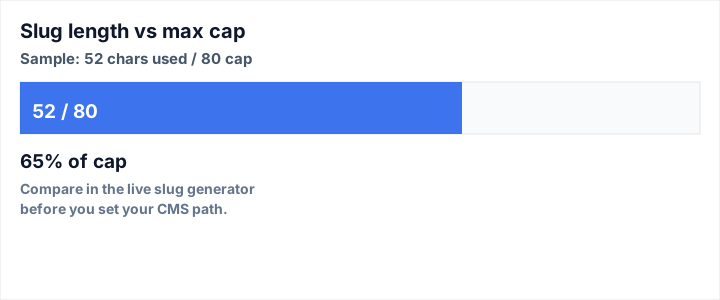
What this shows: how much of a chosen character budget a sample slug consumes—useful when standardizing caps across sections.
Assumptions: illustrative 52 characters used out of an 80 character cap (65%).
Representative outputs: run your headline in the live tool to match your CMS limits.
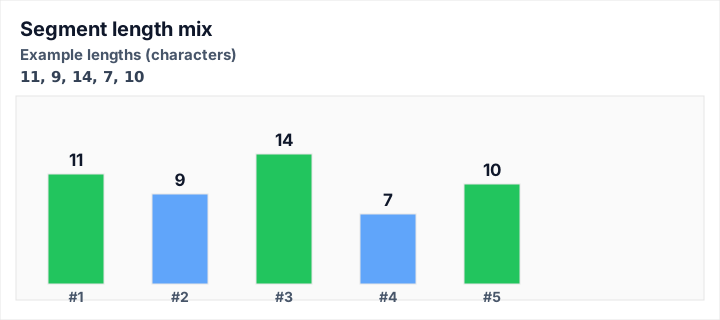
What this shows: whether any single token dominates the path—often a sign you need a shorter synonym or split across a parent/child URL pattern.
Assumptions: static example lengths 11 · 9 · 14 · 7 · 10 characters.
Representative outputs: compare against the segment bars rendered for your live slug above.
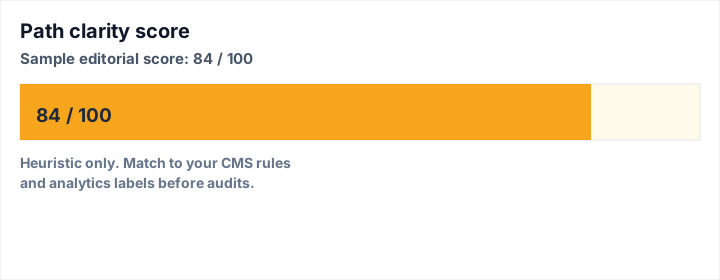
What this shows: a quick heuristic score for path readability relative to length and segment mix.
Assumptions: illustrative score 84 on a 0–100 scale.
Representative outputs: verify against the score in the calculator before citing in audits.
Workflow notes when slugs sit next to structure experiments
Editors sometimes mirror headline experiments in sandbox files. If you are testing reversed strings or mirrored copy for QA, the reverse text utility keeps those checks separate from production slugs. After structural edits, regenerate the slug from the final approved headline rather than hand-editing the path to match an abandoned draft—hand edits hide the reasoning future maintainers need.
Localization adds another layer: translated titles may produce different token counts under the same cap. Re-run this generator per locale instead of transliterating an English slug when the localized headline diverges materially. Keep hreflang pairs aligned at the page level; the localized slug should still describe the localized content.
Depth, honesty, and what slugs cannot fix
Slugs do not repair thin content, slow pages, or weak internal linking. They also do not replace canonical tags, XML sitemaps, or careful redirect maps when URLs must change. Treat this tool as a clarity and consistency layer: it helps teams agree on a string that behaves well in analytics and human communication, while the broader SEO program still needs crawl budget discipline, structured data where appropriate, and pages that answer intent completely.
When AI review is enabled, treat it as structured editorial guidance, not a verdict from search engines. It may flag over-short paths, aggressive stop-word stripping, or separator choices that confuse non-technical reviewers—exactly the sort of friction that slows launches when caught late.
Accuracy and limits of the deterministic engine
The slug engine uses Unicode normalization and Latin diacritic stripping tuned for common English editorial inputs. Rare scripts or mixed-language titles may need manual review in your CMS. Reserved characters, unicode homoglyphs, and platform-specific length rules still belong to your deployment checklist—the generator focuses on tokenization, casing, separators, and caps so you can iterate quickly before those final checks.
Related tools and internal resources
- Keyword Density Checker — align visible copy emphasis with the topic your slug promises.
- Word Counter — validate length limits for titles, metas, and body sections.
- Reading Time Calculator — translate word counts into realistic reader minutes.
- Remove Extra Spaces — clean pasted copy before measuring or publishing.