Random Number Generator
Pick a range, choose integers or decimals, and generate transparent draws you can audit—ideal when you need fair samples, reproducible demos, or quick classroom sets without wrestling with spreadsheets.
사용된 공식
이 난수 생성기 사용법
정수 또는 소수를 선택하고, 허용되는 최소값과 최대값을 설정하고, 필요한 숫자 수를 선택한 다음 생성을 누르세요.
일상적 사용을 반영합니다: 1–30 범위의 중복 없는 교실 랜덤 호출, 1–100 범위의 12개 복권 스타일 선택.
- 교실 만려 예시: 1–30 범위의 중복 없는 방망 라키바키기
- 복웕 스타일 12개 생성: 1–100 범위
- 리스토리 확망 경로 디지턴자 선택
필드 및 컨트롤
닫힌 범위 내의 정수를 생성합니다.
[min, max]에서 연속 균일 값을 추출한 다음 선택한 소수점 자리로 반올림합니다.
입력한 텍스트는 결정론적 스트림의 일부가 됩니다.
디지턴자 선택은 특정 크기에 따라 디지턴자를 적용합니다.
중요 주의사항
이 페이지는 교육, QA, 투명성을 위한 것입니다 — 규제된 도박, 암호화, 컴플라이언스 샘플링용이 아닙니다.
Why transparent random number generation still earns a dedicated workspace
A trustworthy random number generator is less about mystique and more about clear rules: which values are allowed, how many draws you take, whether repeats are permitted, and whether anyone can replay the same sequence. Teams reach for quick draws when assigning review tickets, rotating classroom participation, simulating inputs for QA, or prototyping games—yet the failure mode is almost always ambiguous instructions, not the arithmetic itself.
Uniform models—where each allowed outcome is meant to carry equal weight—are the default mental model for “pick something at random.” When the range is discrete (integers) that means every integer between your minimum and maximum should appear with probability one divided by the count of integers in the span. When the range is continuous, fairness lives on intervals: the chance of landing inside a sub-interval scales with its width. The live tool above makes those boundaries explicit so you can align spoken promises with what the machine actually does.
Randomness also intersects scheduling and measurement elsewhere on the site. If you are translating rates into outcomes, pair draws with a percentage calculator so headline percents stay tied to numerators and denominators you can defend. When timestamps matter for ordering events or log correlation, cross-check formatting with the Unix timestamp converter before you freeze a methodology appendix.
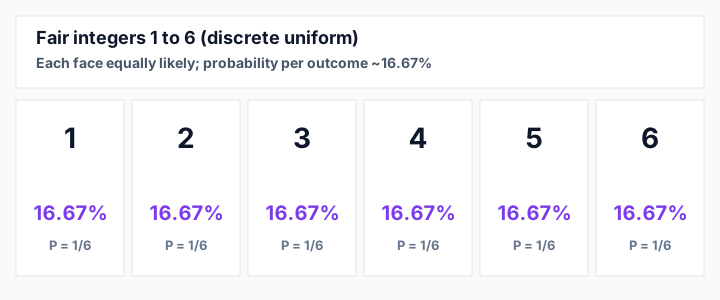
What this shows: a discrete uniform model where six equally likely outcomes split probability evenly—useful mental scaffolding before you move to wider integer ranges.
Assumptions: integers restricted to 1…6; idealized fair draw (no loaded die).
Check: each listed probability is 1 ÷ 6 ≈ 16.67%; live batches from the tool will differ unless you fix a seed.
Uniform draws, independence, and the stories they cannot tell
Independence means one draw does not influence the next unless you explicitly change the rules. Turning on “unique” removes replacement: each integer can appear at most once, which is perfect for calling students or sampling SKUs without duplication, but it is no longer the same model as repeated spins of a wheel. Communicate which narrative you used when you publish outcomes.
Sample summaries—mean, spread, standard deviation—describe the batch you just drew, not the long-run law of large numbers in one click. Small samples look “lumpy.” That is expected. If you need statistically defensible sample sizes for production quality or survey work, escalate beyond a browser utility to documented sampling plans and governance.
For editorial workflows that mix narrative and numeric discipline, keep word budgets honest with the word counter before you bolt randomization into copy experiments, then return here when you need the actual draws.
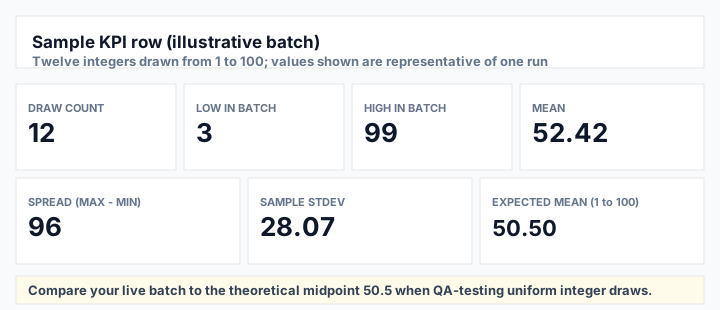
What this shows: how a single batch can be audited quickly—count, extremes, central tendency, dispersion—against the theoretical midpoint of a symmetric range.
Assumptions: twelve integers from 1…100; numbers illustrated are representative, not prescriptive.
Representative outputs: mean 52.42, spread 96, sample stdev 28.07 vs expected mean 50.50—rerun in the live random number generator before citing in formal reports.
Integers versus decimals: when rounding becomes part of the experiment
Integer mode answers counting questions: seats, tickets, people, enumerated cases. Decimal mode answers measurement questions: durations, synthetic sensor readings, jittered schedules—provided everyone understands rounding. Each extra decimal place tightens the grid of possible outputs; it does not automatically add physical meaning.
Financial scenarios rarely belong in a generic RNG field without currency context. If you are stress-testing percent-based fees or tiered rates, anchor the story with the loan calculator or investment calculator so cash flows and random perturbations are not conflated.
Health and biometrics analogies
Randomized tie-breaking sometimes shows up in wellness challenges or cohort sorting. If the underlying construct is anthropometric, keep clinical context in tools designed for it—our BMI calculator remains the right place for weight-for-height screening narratives, while this page handles the draw itself.
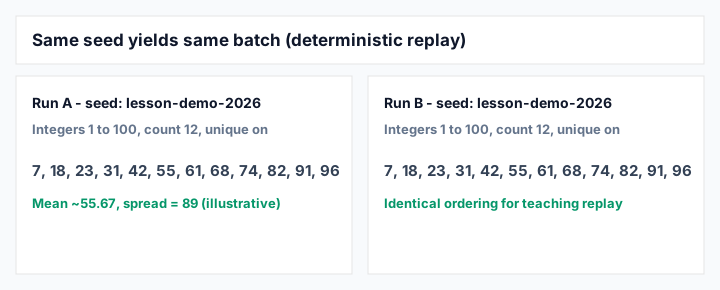
What this shows: deterministic replay when the seed string and parameters match—valuable for lesson plans, screenshots, and regression checks.
Assumptions: seed text lesson-demo-2026; integers 1…100; count 12; unique on.
Note: illustrative sequence; your engine output may differ—verify inside the interactive random number picker before treating any list as authoritative.
Reading the KPI dashboard and frequency snapshot together
The KPI row compresses location and dispersion: minimum and maximum show coverage, mean shows where the cloud centers, spread highlights extremes, and sample standard deviation signals how tight or loose the batch is. The frequency chart is a sanity lens—if you expected broad coverage but see a single tall bar, question whether the range, rounding, or uniqueness constraint accidentally narrowed the outcome space.
This page never replaces audited statistical software, but it does give product, education, and operations teams a shared vocabulary before they export numbers into slides or tickets.
Sampling narratives for classrooms, QA, and lightweight games
Classrooms. Use unique integers when every learner should get exactly one turn before anyone repeats. Publish the min, max, count, and uniqueness rule on the board so the online random number generator output can be reproduced or challenged transparently.
QA and UX. Decimal draws help fuzz inputs within realistic bounds. Pair ranges with acceptance criteria rather than hoping random clicks surface edge cases—document the seed when you need a failing example to reopen later.
Games and simulations. Explain replacement versus no replacement before someone cries foul. If prizes are regulated, involve legal review; this tool is educational, not a compliance engine.
Related calculators and utilities
- Percentage calculator — keep proportional language aligned with numerators and denominators when random picks feed scoring rules.
- Investment calculator — explore growth scenarios when random shocks are only one chapter of a longer financial story.
- Loan calculator — translate quoted rates into payment pressure before layering randomized what-if tweaks.
- Unix timestamp converter — normalize epoch values when randomized schedules cross time zones.
- Word counter — stabilize copy length before you bolt random variants into structured content tests.
- BMI calculator — reserve health-specific framing for a tool built around height and weight, not incidental random tie-breakers.