Hexagon Calculator
辺、面積、周長、辺心距離、外接円半径、短対角線のいずれか1つの既知値から、正六角形の全プロパティを計算。面積、周長、辺心距離、外接円半径、長対角線、短対角線、ステップバイステップの導出を即座に取得。
Hexagon Calculator
Regular Hexagon · Area, Perimeter, Diagonals, Apothem & More
Table of Contents
What Is a Regular Hexagon?
A regular hexagon is a polygon with six equal sides and six equal interior angles, each measuring exactly 120°. The sum of interior angles is 720°. A regular hexagon possesses the highest order of rotational symmetry of any polygon commonly encountered in nature and engineering — it can be rotated by 60°, 120°, 180°, 240°, or 300° and remain visually identical.
The hexagon's unique geometry makes it the most efficient shape for tiling a plane without gaps. It encloses more area per unit of perimeter than a square or triangle. This is precisely why honeycombs, basalt columns, and graphene lattices are hexagonal. The ratio of area to perimeter for a regular hexagon is s√3/4 per unit perimeter — approximately 13% more efficient than a square grid.
Every regular hexagon can be divided into six equilateral triangles, all with the same side length as the hexagon itself. This decomposition underpins most hexagon formulas and proofs. The center of the hexagon is equidistant from all six vertices (circumradius R = s) and equidistant from all six sides (apothem a = s√3/2).
How to Use the Hexagon Calculator
This Hexagon Calculator supports six input modes — you can enter any one known measurement and instantly compute all other hexagon properties. Here is a step-by-step guide:
- Step 1 — Select input type: Choose from Side Length, Area, Perimeter, Apothem, Circumradius (Long Diagonal / 2), or Short Diagonal.
- Step 2 — Enter your value: Type the numeric value in the input field. Use the unit selector to choose mm, cm, m, in, or ft.
- Step 3 — Click Calculate: The calculator instantly outputs all properties: area, perimeter, apothem, circumradius, long diagonal, short diagonal, and interior angle — with step-by-step derivation.
- Step 4 — Copy results: Click any result card to copy its value to clipboard.
All calculations use double-precision floating-point arithmetic (IEEE 754) and exact geometric constants (√3 = 1.7320508…). The SVG diagram updates in real time to reflect your hexagon's proportions.
Area of a Regular Hexagon
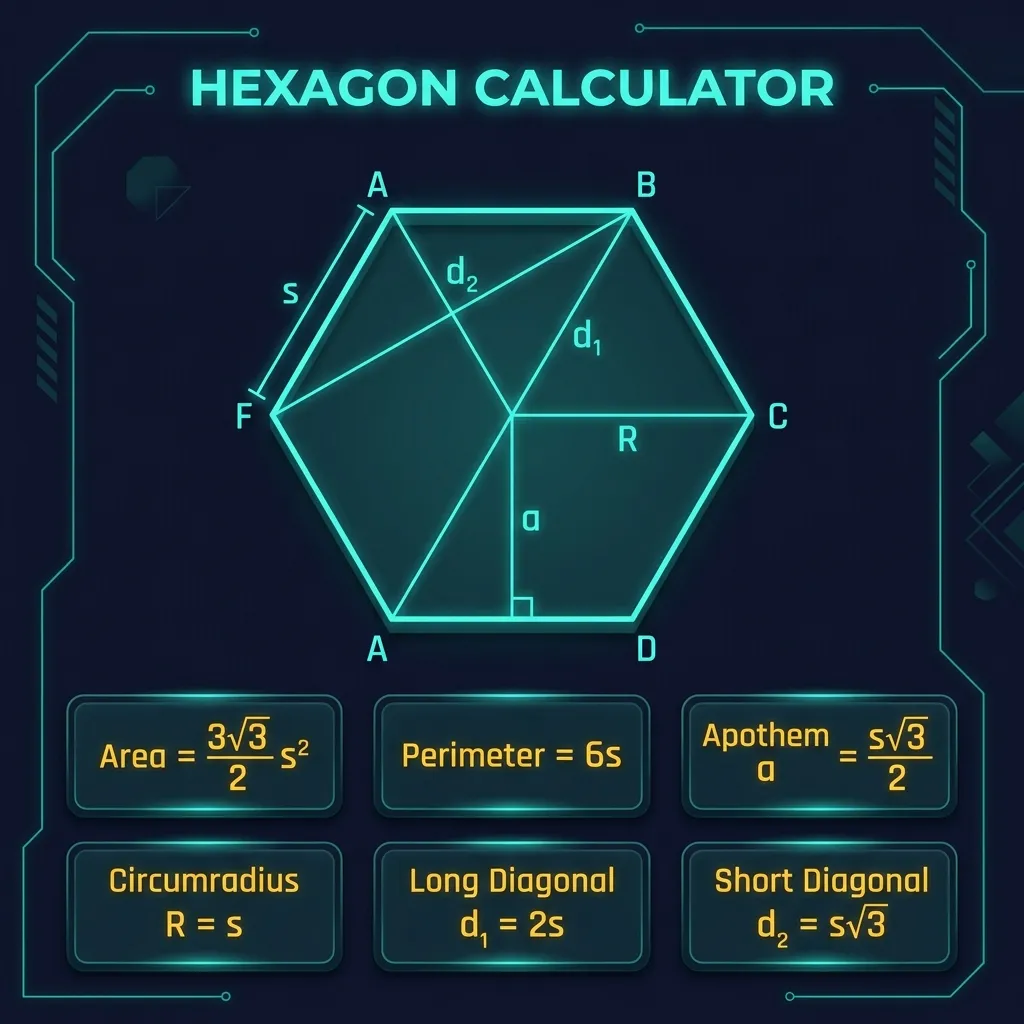
The area of a regular hexagon with side length s is:
- A = (3√3 / 2) × s² ≈ 2.5981 × s²
This formula is derived by decomposing the hexagon into six equilateral triangles, each with area (√3/4) × s², then multiplying by 6: A = 6 × (√3/4) × s² = (3√3/2) × s².
Example: A hexagonal floor tile with side s = 30 cm. A = (3√3/2) × 30² = 2.5981 × 900 = 2,338.3 cm². Compare this with a square tile of side 30 cm (A = 900 cm²) — the hexagon encloses 2.6× more area for the same side length.
When the area is known and you want the side length: s = √(2A / (3√3)). For example, A = 1,000 cm² → s = √(2000 / 5.1962) ≈ 19.60 cm.
Perimeter of a Regular Hexagon
The perimeter of a regular hexagon is simply six times the side length:
- P = 6s
Example: s = 25 mm → P = 6 × 25 = 150 mm = 15 cm. Conversely, given P, the side is s = P/6. A hexagonal nut (ISO metric) with P = 24 mm has s = 4 mm — this is the "across-the-flats" dimension used in engineering specifications.
The perimeter-to-area ratio is P/A = 6s / ((3√3/2)s²) = 4/(√3 × s) — it decreases as s increases, confirming that larger hexagons are proportionally more area-efficient.
Diagonals of a Regular Hexagon
A regular hexagon has nine diagonals total: three long diagonals and six short diagonals.
- Long diagonal (d₁) = 2s — passes through the center, connecting opposite vertices. This equals the diameter of the circumscribed circle (2R).
- Short diagonal (d₂) = s√3 ≈ 1.7321 × s — connects vertices two positions apart (skipping one vertex).
Example: s = 10 cm. Long diagonal d₁ = 20 cm; Short diagonal d₂ = 10√3 ≈ 17.32 cm. Note that d₂ equals the long diagonal of the equilateral triangle formed by three adjacent vertices — this is the basis for the "short diagonal" in hexagonal grid systems.
In engineering, the long diagonal determines the required bore size for a bolt hole, while the short diagonal (often called "across-the-flats" or width across flats) determines the wrench size. For ISO hex bolts, the two diagonals are related by d₁/d₂ = 2/√3 ≈ 1.1547.
Apothem (Inradius) Formula
The apothem (also called the inradius or r) is the perpendicular distance from the center of the hexagon to the midpoint of any side — it equals the radius of the largest inscribed circle:
- a = (s√3) / 2 ≈ 0.8660 × s
Example: s = 8 cm → apothem a = 8√3/2 = 4√3 ≈ 6.928 cm. The area can also be expressed using the apothem: A = 3 × a × s = 3as. This formula parallels A = (1/2) × P × a (half the perimeter times the apothem), the general polygon area formula.
If only the apothem is known: s = 2a/√3 = (2a√3)/3. For a = 10 cm: s = 20/√3 ≈ 11.547 cm.
Circumradius Formula
The circumradius R is the distance from the hexagon's center to any vertex — it equals the radius of the smallest circumscribed circle:
- R = s
This elegant result (R equals the side length itself) is unique to the regular hexagon. It follows directly from the fact that the hexagon consists of six equilateral triangles of side s. No other regular polygon has this property.
Example: s = 12 mm → R = 12 mm. The circumscribed circle has diameter 2R = 24 mm = d₁ (the long diagonal). If only R is known: s = R (trivially). This also means A = (3√3/2) × R² and P = 6R.
Solving from Any Known Value
The calculator automatically derives all properties from whichever input you provide. Key inverse formulas:
- From Area (A): s = √(2A / (3√3)); then all other properties follow.
- From Perimeter (P): s = P / 6.
- From Apothem (a): s = (2a) / √3 = (2a√3) / 3.
- From Circumradius (R): s = R.
- From Long Diagonal (d₁): s = d₁ / 2.
- From Short Diagonal (d₂): s = d₂ / √3 = (d₂√3) / 3.
All six input modes are supported in the calculator above. Select the known quantity, enter its value, choose your unit, and click Calculate.
Unit Conversion Table
The calculator computes all output in the unit you select. Area is returned in the selected unit squared. Here are key length unit relationships:
- 1 in = 25.4 mm = 2.54 cm
- 1 ft = 304.8 mm = 30.48 cm = 12 in
- 1 m = 100 cm = 1,000 mm ≈ 39.37 in ≈ 3.281 ft
- 1 yd = 91.44 cm = 3 ft
Area conversions (×unit²): 1 ft² = 929.03 cm²; 1 in² = 6.452 cm²; 1 m² = 10,000 cm². The calculator outputs the area in the selected unit².
Real-World Applications of the Hexagon
The regular hexagon appears in an extraordinary range of engineering, scientific, and design contexts:
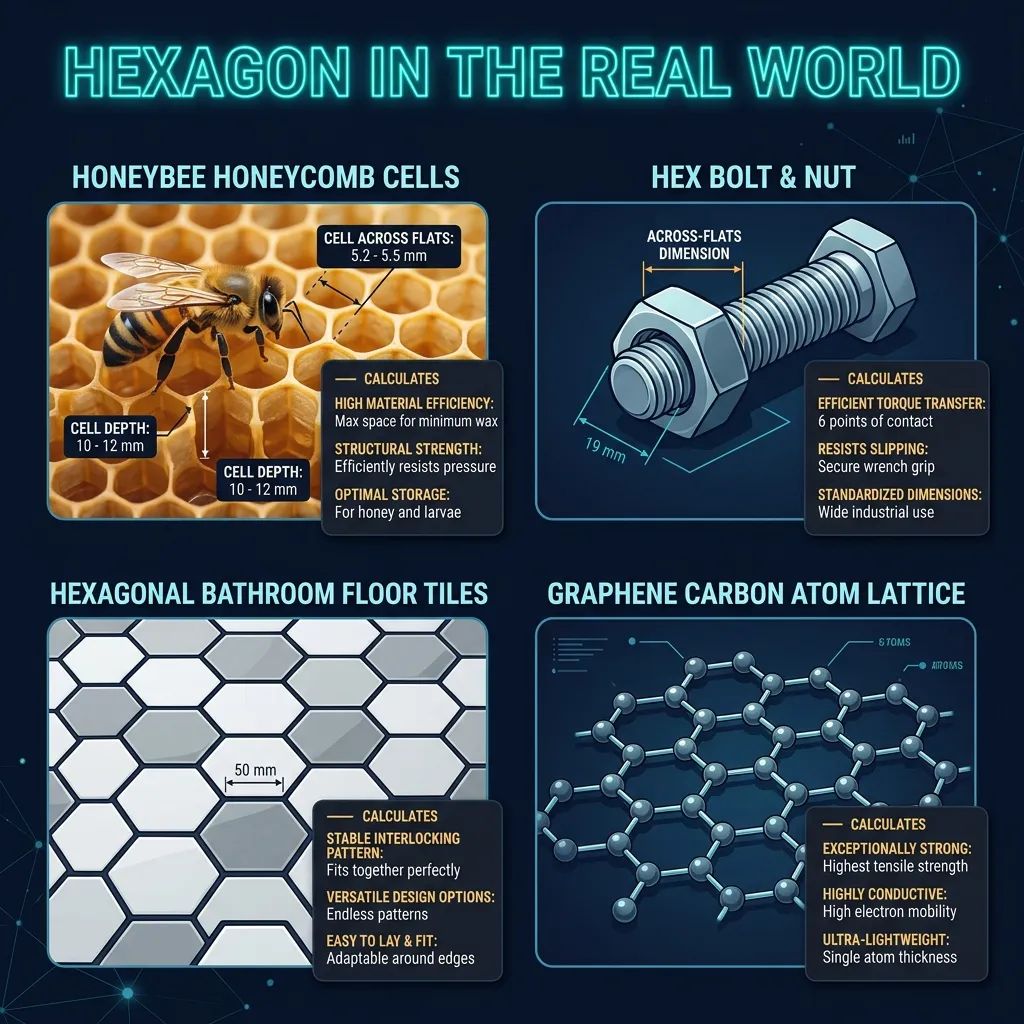
- Honeybee combs: Bees build hexagonal cells because hexagonal packing minimizes the total wall material per unit of stored volume — a principle proved rigorously by Thomas Hales in the Honeycomb Conjecture (1999). The Area of a Circle Calculator helps compare circle vs. hexagon packing efficiency.
- Hex nuts and bolts: ISO and ANSI fastener standards define hex nut sizes by the width across flats (apothem × 2) and width across corners (long diagonal). A standard M10 hex nut has s ≈ 8.4 mm, giving an apothem of ≈ 7.3 mm (the 14.6 mm AF wrench size).
- Graphene and carbon nanotubes: Carbon atoms in graphene form a 2D hexagonal lattice with a C–C bond length (side) of 1.42 Å. The hexagonal unit cell area is A = (3√3/2) × (1.42 Å)² ≈ 5.24 Ų.
- Floor and wall tiling: Hexagonal tiles are preferred for bathrooms and kitchens because hexagonal grids have fewer grout lines per unit area than square grids. For a 10 m² floor using 30 cm tiles (s = 15 cm): A_tile = (3√3/2) × 15² ≈ 584.6 cm² = 0.0585 m². Number of tiles ≈ 10 / 0.0585 ≈ 171 tiles.
- Astronomy and hexagonal craters: Some impact craters and planetary features (Saturn's north polar hexagon, ~25,000 km across) exhibit near-hexagonal geometry due to standing wave patterns in the atmosphere.
- Board games and wargames: Hexagonal grids (hexmaps) are used in strategy games because each hex cell has six equidistant neighbors, unlike square grids (4 face-neighbors, 4 corner-neighbors at different distances).
Related Calculators — Internal Links
- Area of a Circle Calculator — Compute circle area, circumference, diameter, and radius. The circumscribed circle of a hexagon with side s has radius R = s and area π × s².
- Circumference Calculator — Find circle circumference, arc length, and sector area. For a hex circumscribed circle: C = 2π × s.
- Triangle Area Calculator — Calculate equilateral triangle area. A regular hexagon = 6 equilateral triangles of side s, each with area (√3/4)s².
- Sector Area Calculator — Arc length and sector area for any circle. Hexagon sectors subtend 60° central angles.
- Right Triangle Calculator — Solve right triangles. The apothem, half-side, and circumradius of a hexagon form a 30-60-90 triangle.
- Pythagorean Theorem Calculator — Find hypotenuse or sides. Used to verify hexagon diagonal relationships: d₂² = (s√3)² = 3s².
- Volume Calculator — Compute volumes of 8 3D shapes. Hexagonal prism volume = A_hex × h = (3√3/2)s² × h.
Hexagon Calculatorのよくある質問
正六角形の面積の数式は何ですか?
辺長 s の正六角形の面積は A = (3√3 / 2) × s² ≈ 2.5981 × s² です。これは六角形を6個の正三角形に分割し、各三角形の面積 (√3/4) × s² に6を掛けて導出されます。例:s = 10 cm → A = 2.5981 × 100 = 259.81 cm²。
正六角形の周長はどうやって求めますか?
正六角形の周長は P = 6s(sは辺長)です。6辺すべてが等しいので、辺長に6を掛けるだけです。例:s = 8 in → P = 48 in。周長がわかっていて辺長を求める場合:s = P / 6。
六角形の辺心距離とは何ですか?
辺心距離(内接円半径)は、六角形の中心から任意の辺の中心点までの垂直距離です。正六角形の場合:a = (s√3) / 2 ≈ 0.8660 × s。最大の内接円の半径に等くなります。例:s = 12 cm → a = 12√3/2 ≈ 10.392 cm。辺心距離がわかっている場合:s = 2a / √3。
正六角形の外接円半径とは何ですか?
外接円半径 R は中心から任意の頂点までの距離です。正六角形の場合、R = s(外接円半径は辺長に等しい)です。これは正六角形に特有の性質で、他の正多角形にはありません。六角形が6個の辺長 s の正三角形で構成されることから導出されます。外接円の直径は 2s で、長対角線に等しいです。
正六角形にはいくつの対角線がありますか?
正六角形には合計9本の対角線があります:中心を通る3本の長対角線(d₁ = 2s)と、2つ離れた頂点を結ぶ6本の短対角線(d₂ = s√3 ≈ 1.7321 × s)。長対角線は外接円の直径に等しいです。エンジニアリングでは、長対角線がボーレーシズを、短対角線がレンチサイズを決定します。
正六角形は現実のどこに登場しますか?
正六角形は多くの自然現象や工学分野で見られます:ミツバチの巣(六角形のセルは単位体積あたりの壁材料を最小限にする)、六角ナットとボルト(ISOファスナ規格は対面幅と対角幅でサイズを定義)、グラフェン格子(炭素原子が1.42 Åの結合長で2次元六角形配列を形成)、床タイル(六角形グリッドは方形グリッドよりも目地線が少ない)、土星の北極六角形(約25,000 kmの巨大な大気定在波)、戦略ボードゲームの六角形グリッドマップ。