Vertex Form Calculator
Free Vertex Form Calculator: convert standard form (ax²+bx+c) to vertex form y=a(x−h)²+k, find the vertex, axis of symmetry, x-intercepts, y-intercept,...
उपयोग किया गया सूत्र
What Is Vertex Form?
The vertex form of a quadratic equation is y = a(x − h)² + k, where (h, k) is the vertex — the maximum or minimum point of the parabola. This form is called "vertex form" because the vertex coordinates are directly visible in the equation, unlike standard form (y = ax² + bx + c) where the vertex requires calculation.
Both forms represent the same parabola — they are mathematically equivalent. The choice of form depends on what information you need at a glance: vertex form for optimization and graphing, standard form for root-finding and factoring.
The Vertex Form Formula Explained
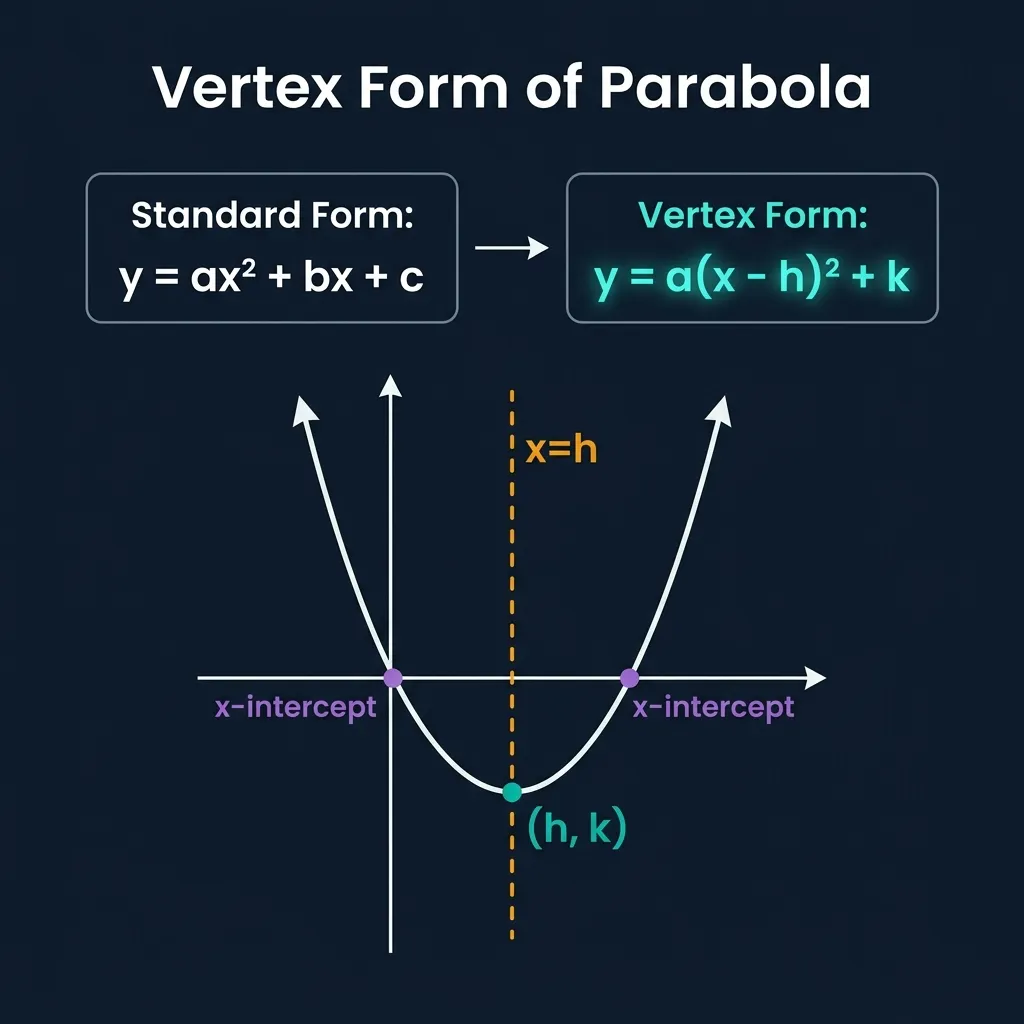
In y = a(x − h)² + k:
- a — the leading coefficient. Controls direction and width: a > 0 opens upward (minimum), a < 0 opens downward (maximum). |a| > 1 narrows the parabola; 0 < |a| < 1 widens it.
- h — the x-coordinate of the vertex. This is also the axis of symmetry: x = h. Note: the formula uses (x − h), so y = (x − 3)² has h = 3, not −3.
- k — the y-coordinate of the vertex. This is the minimum value of y when a > 0, or the maximum value when a < 0.
The vertex (h, k) is the most important single point of a parabola: it is the turning point, the extremum, and the point where the axis of symmetry intersects the parabola.
How to Use the Vertex Form Calculator
This calculator has three modes:
- Standard → Vertex: Enter a, b, c from standard form y = ax² + bx + c. The calculator finds h = −b/(2a), k = c − b²/(4a), writes the vertex form, and computes all properties.
- Vertex → Standard: Enter a, h, k from vertex form. The calculator expands y = a(x−h)²+k into y = ax²+bx+c by multiplying out the squared term.
- Vertex Form Info: Enter a, h, k to explore all parabola properties — vertex, axis, roots, y-intercept, focus, directrix, domain, range — without conversion.
Press Enter or click Calculate. An animated SVG parabola diagram updates with your values. Click any KPI card to copy that value to clipboard.
Converting Standard Form to Vertex Form
Given y = ax² + bx + c, convert to vertex form using these formulas:
- h = −b / (2a) — this is the x-coordinate of the vertex and the axis of symmetry
- k = c − b² / (4a) — this is the y-coordinate of the vertex (minimum or maximum)
- Substitute into y = a(x − h)² + k
Alternatively, use completing the square: factor out a from the x-terms, complete the square inside the bracket, then adjust the constant. Example: y = 2x² − 8x + 6. Factor: y = 2(x² − 4x) + 6. Complete the square: y = 2(x² − 4x + 4 − 4) + 6 = 2(x−2)² − 8 + 6 = 2(x−2)² − 2. So h = 2, k = −2, vertex at (2, −2).
Converting Vertex Form to Standard Form
Given y = a(x − h)² + k, expand to standard form:
- Expand (x − h)² = x² − 2hx + h²
- Distribute a: a(x − h)² = ax² − 2ahx + ah²
- Add k: y = ax² − 2ahx + (ah² + k)
- Therefore: b = −2ah and c = ah² + k
Example: y = 3(x − 2)² + 1. Expand: y = 3(x² − 4x + 4) + 1 = 3x² − 12x + 12 + 1 = 3x² − 12x + 13. Check: h = −(−12)/(2×3) = 12/6 = 2 ✓, k = 13 − 144/12 = 13 − 12 = 1 ✓.
Finding the Vertex of a Parabola
The vertex is the most critical point of any parabola. Three methods:
- From vertex form y = a(x−h)²+k: Vertex = (h, k). Read directly from the equation.
- From standard form y = ax²+bx+c: x = −b/(2a), then substitute back: y = a(−b/2a)²+b(−b/2a)+c = c − b²/(4a).
- By completing the square: Algebraically transform standard form into vertex form as shown above.
The vertex represents the minimum point when a > 0 (parabola opens up) or the maximum point when a < 0 (parabola opens down). In optimization problems — maximizing area, minimizing cost, finding the peak of a projectile — the vertex gives the answer directly.
X-Intercepts and the Discriminant
The x-intercepts (also called roots or zeros) are where the parabola crosses the x-axis (y = 0). Using the quadratic formula on vertex form:
- Set y = 0: a(x − h)² + k = 0 → (x − h)² = −k/a → x = h ± √(−k/a)
- Equivalently, using standard form: x = [−b ± √(b² − 4ac)] / (2a)
The discriminant D = b² − 4ac tells you the number of roots:
- D > 0: Two distinct real roots — parabola crosses x-axis at two points
- D = 0: One repeated root — parabola is tangent to x-axis (touches but doesn't cross)
- D < 0: No real roots — parabola is entirely above or below x-axis
From vertex form: D > 0 when −k/a > 0, i.e., k and a have opposite signs. D = 0 when k = 0 (vertex on x-axis). D < 0 when k and a have the same sign.
Focus and Directrix of a Parabola
Every parabola has a focus (a point) and a directrix (a line) such that every point on the parabola is equidistant from both. These are fundamental to the optical properties of parabolic mirrors and satellite dishes:
- Focus: (h, k + 1/(4a))
- Directrix: y = k − 1/(4a)
- p = 1/(4a) — focal distance (distance from vertex to focus)
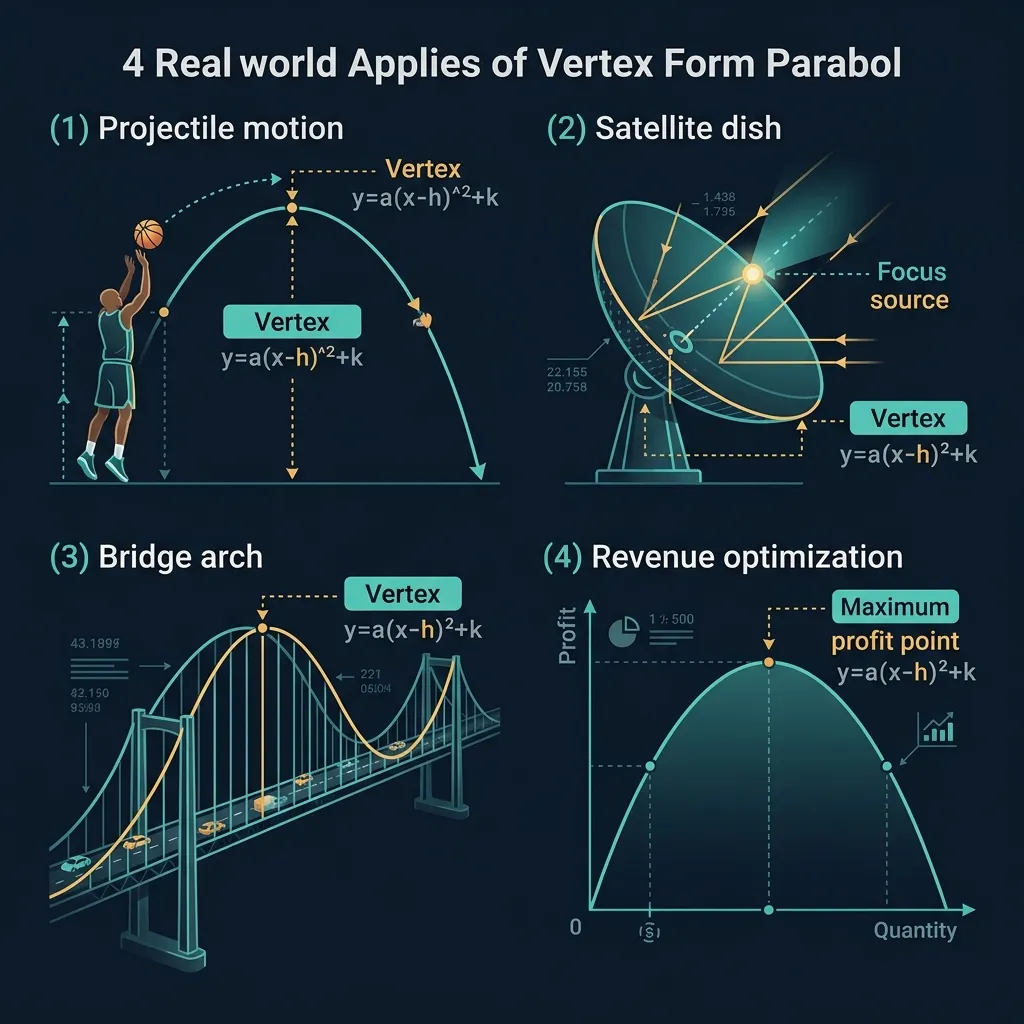
When a > 0 (opens up), the focus is above the vertex and the directrix is below. Parallel rays hitting a parabolic dish reflect to the focus — the principle behind satellite dishes, telescope mirrors, and car headlights.
Example: y = x² (a=1, h=0, k=0). Focus = (0, ¼). Directrix: y = −¼. Any point (x, x²) on the parabola has equal distance to (0, ¼) and to the line y = −¼. Verify at (1,1): distance to focus = √(1²+(1−¼)²) = √(1+9/16) = √(25/16) = 5/4. Distance to directrix = 1+¼ = 5/4 ✓.
Worked Examples
- Example 1 — Standard to Vertex: y = x² − 6x + 8. a=1, b=−6, c=8. h = −(−6)/(2×1) = 3. k = 8 − 36/4 = 8 − 9 = −1. Vertex form: y = (x−3)² − 1. Vertex: (3, −1). Roots: x = 3 ± 1, so x = 4 and x = 2 ✓.
- Example 2 — Vertex to Standard: y = −2(x+1)² + 8. a=−2, h=−1, k=8. b = −2×(−2)×(−1) = −4. c = (−2)(1) + 8 = 6. Standard form: y = −2x² − 4x + 6. Check roots: x = [4 ± √(16+48)]/(−4) = [4 ± 8]/(−4) → x = −3 or x = 1.
- Example 3 — Optimization: A ball is thrown with height h(t) = −5t² + 20t + 1. Find max height. a=−5, b=20, c=1. t_vertex = −20/(−10) = 2 sec. h_max = 1 − 400/(−20) = 1 + 20 = 21 m at t=2 seconds.
Real-World Applications of Vertex Form
- Projectile motion: The height of a thrown object follows h = −½gt² + v₀t + h₀. Vertex form reveals the maximum height and time directly: t_max = v₀/g, h_max = h₀ + v₀²/(2g).
- Revenue and profit optimization: Revenue R = p × q(p) often forms a parabola. The vertex gives the price that maximizes revenue — a direct application in economics and business.
- Engineering — parabolic antennas: Satellite dishes and radio telescopes are designed with parabolic cross-sections. All incoming parallel signals reflect to the focus, where the receiver is placed.
- Architecture — suspension bridges: The main cable of a suspension bridge (under uniform load) takes a parabolic shape. Vertex form models the cable height as a function of horizontal position.
- Optics — headlights and reflectors: Parabolic reflectors with the light source at the focus produce parallel beams. The inverse applies to solar concentrators and telescopes.
Related Calculators — Internal Links
- Slope-Intercept Calculator — For linear equations y = mx + b. When a parabola's tangent line at the vertex is needed, or linear approximations are required.
- Distance Formula Calculator — Compute distance between two points on a parabola, or between the vertex and focus using coordinates.
- Midpoint Calculator — The vertex is the midpoint of the two x-intercepts (roots). Verify this with the midpoint formula: h = (x₁ + x₂)/2.
- Pythagorean Theorem Calculator — Used in computing distances on the parabola coordinate plane.
- Right Triangle Calculator — Parabola problems often involve right triangles formed by the vertex, focus, and points on the directrix.