Height Calculator
Free Height Calculator: convert between cm and feet/inches, predict your child's adult height using the Mid-Parental method, and check height percentile by...
????? ???? ??? ?????
- Above average for US adult women (162.1 cm / 5'4")
- Netherlands men average 182.5 cm (6'0") — among the world's tallest
- Global adult male average: ~171 cm (5'7") across all populations
- 1 inch = 2.54 cm exactly · 1 foot = 30.48 cm exactly
How to Use This Height Calculator
This calculator offers three powerful modes: Convert Height, Predict Child Height, and Height Percentile. Select your mode and enter the required values for instant results.
Mode 1: Convert Height
The most-used feature. Enter any height in centimeters to instantly get feet and inches — or enter feet and inches to get centimeters.
How to use:
- Select Convert Height mode
- Enter your height in cm or select Imperial and enter feet + inches
- Toggle the unit system to see both formats instantly
Example: 175 cm = 5 feet 8.9 inches ≈ 5 ft 9 in
Mode 2: Predict Child Height
Using the clinically validated Mid-Parental Height (MPH) Method, this mode estimates a child's predicted adult height based on the biological parents' heights.
How to use:
- Select Predict Child Height mode
- Enter Father's height and Mother's height (either cm or feet/inches)
- Select the child's sex
- Click Calculate
The result shows the predicted target height with a realistic ±4 inch (±10 cm) range — the range within which 95% of children fall.
Mode 3: Height Percentile
Understand where a height falls relative to the general population. Based on US CDC NHANES reference data for adults.
- Select Height Percentile mode
- Enter sex (Male/Female) and height
- Get your approximate population percentile
Note: All results are estimates based on statistical population data. Individual height outcomes depend on genetics, nutrition, health history, and many other factors. Consult a pediatrician for clinical assessment.
Height Calculator: The Complete Guide
Height is one of the most frequently measured physical characteristics — and for good reason. It has implications for health screening, clinical assessment, athletic suitability, ergonomic design, and everyday practical planning. This guide covers everything you need to know about height measurement, conversion, prediction, and reference data.
Height Unit Systems: Metric vs. Imperial
The world uses two primary height measurement systems:
Metric (SI) — Used by most countries globally:
- Centimeters (cm): Most common in medical contexts. A height of 175 cm is typical for adult men in many regions.
- Meters (m): Used in formal scientific contexts. 175 cm = 1.75 m.
Imperial — Used primarily in the United States, United Kingdom (informally), and Canada:
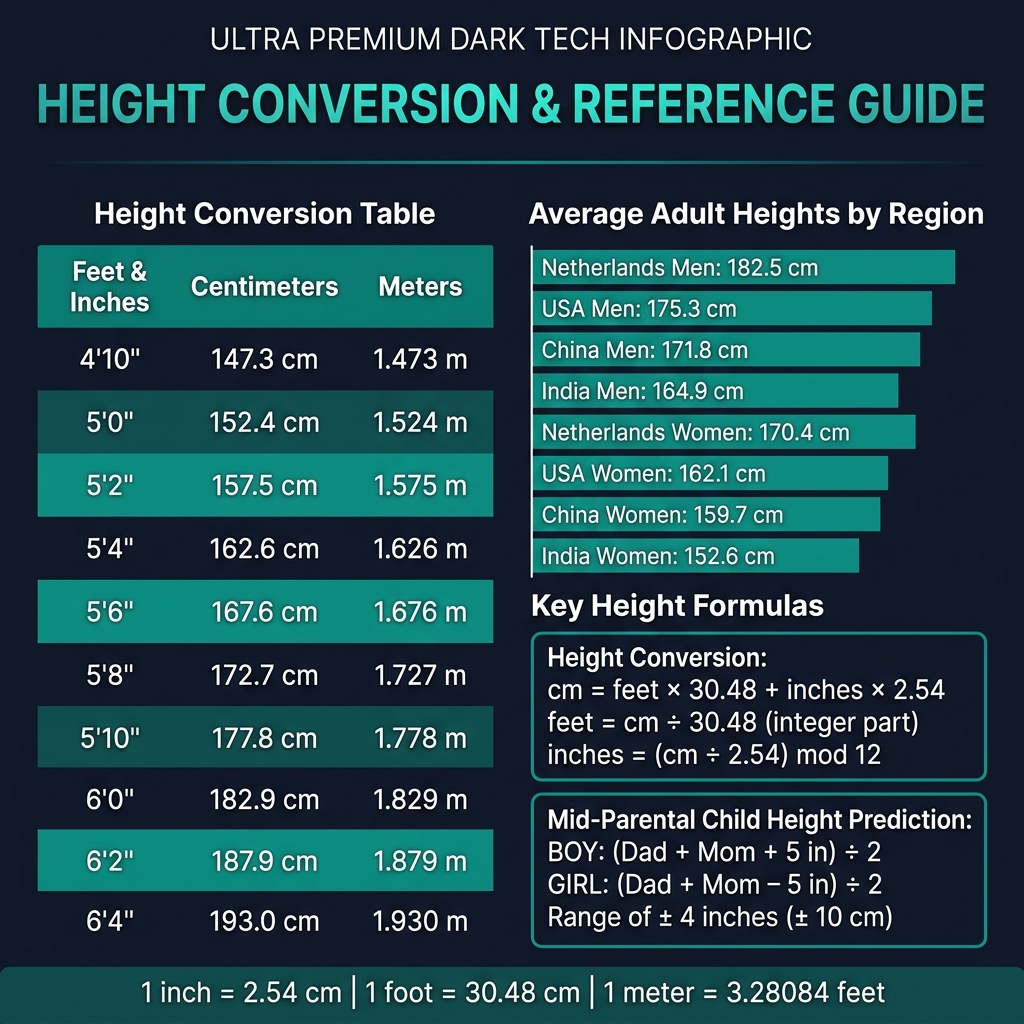
- Feet (ft) and Inches (in): An adult height of 5 feet 9 inches is common in the US. There are 12 inches per foot, and 1 inch = 2.54 cm exactly.
Conversion formulas:
- cm to inches: divide by 2.54
- cm to feet: divide by 30.48
- inches to cm: multiply by 2.54
- feet to cm: multiply by 30.48
Average Human Heights by Country
Height varies significantly by population and country. These averages are based on comprehensive national survey #
Tallest nations (men): Netherlands (182.5 cm), Montenegro (183.2 cm), Denmark (181.9 cm), Norway (179.7 cm)
Global averages (adult men): 171–175 cm (5'7"–5'9")
Global averages (adult women): 159–163 cm (5'2"–5'4")
The United States average for adult men is approximately 175.3 cm (5'9"), and for adult women approximately 162.1 cm (5'4"), based on CDC NHANES survey data.
How to Predict a Child's Adult Height
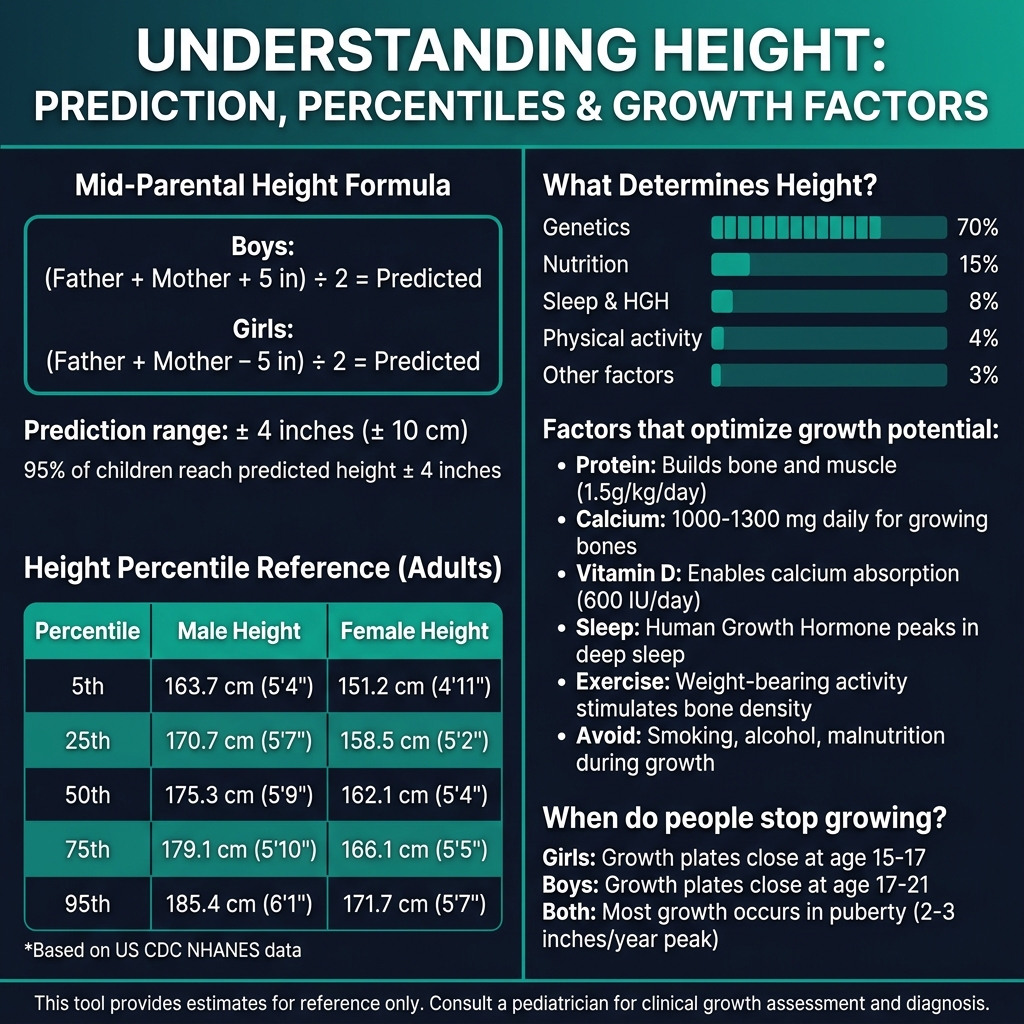
The Mid-Parental Height (MPH) Method is the most widely used clinical tool for estimating a child's predicted adult height. It was developed from population studies correlating parental and offspring heights.
Formula:
- For a boy: (Father's height in inches + Mother's height in inches + 5) ÷ 2
- For a girl: (Father's height in inches + Mother's height in inches − 5) ÷ 2
The result is the mid-parental target height. The prediction range is ±4 inches (±10 cm) — 95% of children will reach an adult height within this range.
Example:
- Father: 5'11" (71 inches)
- Mother: 5'5" (65 inches)
- Boy prediction: (71 + 65 + 5) ÷ 2 = 70.5 inches = 5'10.5" (range: 5'7" – 6'2")
- Girl prediction: (71 + 65 − 5) ÷ 2 = 65.5 inches = 5'5.5" (range: 5'2" – 5'10")
Accuracy of the MPH method: Research shows MPH has a standard deviation of approximately 2 inches for boys and 1.8 inches for girls. It is a strong population-level predictor but cannot account for individual genetic variation, epigenetics, or growth conditions.
Use our BMI Calculator alongside height predictions for a comprehensive health snapshot — BMI depends directly on both height and weight. For body shape classification using proportions, the Body Shape Calculator uses similar measurements.
Height Percentiles: Where Does Your Height Rank?
Height percentiles tell you what percentage of the population is shorter than a given height. A person at the 75th percentile is taller than 75% of their demographic group.
Adult Male Height Percentiles (US CDC Data):
| Percentile | Height |
|---|---|
| 5th | 163.7 cm (5'4.5") |
| 25th | 170.7 cm (5'7.5") |
| 50th | 175.3 cm (5'9") |
| 75th | 179.1 cm (5'10.5") |
| 95th | 185.4 cm (6'1") |
Adult Female Height Percentiles (US CDC Data):
| Percentile | Height |
|---|---|
| 5th | 151.2 cm (4'11.5") |
| 25th | 158.5 cm (5'2.5") |
| 50th | 162.1 cm (5'4") |
| 75th | 166.1 cm (5'5.5") |
| 95th | 171.7 cm (5'7.5") |
Height percentile data for children is age-specific and tracked using CDC growth charts from birth through 20 years. The adult reference data above applies to individuals 20 years and older.
Factors That Affect Adult Height
Height is determined by an interplay of genetic and environmental factors:
Genetics (60–80% of variation): Parental height is the strongest single predictor of a child's adult height. However, genetics operates through many genes (polygenic inheritance), making identical outcomes even between siblings uncommon.
Nutrition (15–20%): Caloric sufficiency and specific nutrients are critical during growth phases:
- Protein: Essential for bone and muscle synthesis. Growing children need 1.2–1.5 g/kg/day.
- Calcium: 1000–1300 mg/day during adolescence for bone density and growth.
- Vitamin D: Required for calcium absorption. Deficiency stunts growth.
- Zinc and Iron: Deficiency linked to growth retardation in children.
Sleep and Growth Hormone: The majority of human growth hormone (HGH) secretion occurs during the first few hours of deep (slow-wave) sleep. Chronic sleep deprivation during childhood can reduce growth hormone output and affect final height.
Physical Activity: Weight-bearing exercise stimulates bone density and healthy growth plate development. However, excessive athletic training at young ages without adequate nutrition can delay growth.
Medical Factors: Conditions such as growth hormone deficiency, hypothyroidism, celiac disease, inflammatory bowel disease, and chronic illness can significantly impact height if untreated during growth phases.
When Does Height Growth Stop?
Height growth depends on open growth plates (epiphyseal plates) at the ends of long bones. Once growth plates close (ossify), further height increase is not possible:
- Girls: Growth plates typically close at ages 15–17, with most height gained by age 16.
- Boys: Growth plates typically close at ages 17–21, with most height gained by age 18.
- Peak growth velocity: Occurs during early puberty — approximately 7–12 cm/year for boys and 6–9 cm/year for girls during peak growth spurts.
An X-ray of the hand and wrist (bone age study) can determine whether growth plates are still open, which pediatric endocrinologists use in clinical assessment.
Internal Tools for a Complete Health Picture
- BMI Calculator — Calculate your Body Mass Index from height and weight
- Body Shape Calculator — Analyze body proportions from bust, waist, hip, and shoulder measurements
- Age Calculator — Know your precise age for accurate age-adjusted health metrics
- Loan Calculator — Plan healthcare or fitness program budgets