Body Fat Calculator
Calculate your body fat percentage using the U.S. Navy circumference method and BMI-based formula. Get fat mass, lean mass, category rating, and ideal body...
Formule utilis�e
How to Use the Body Fat Calculator
This calculator uses the U.S. Navy circumference method — the most widely validated non-invasive body fat formula that requires only a flexible tape measure. Unlike the BMI Calculator which measures weight relative to height without considering body composition, body fat percentage directly quantifies the proportion of your body that is adipose tissue — providing a far more accurate health picture for most people.
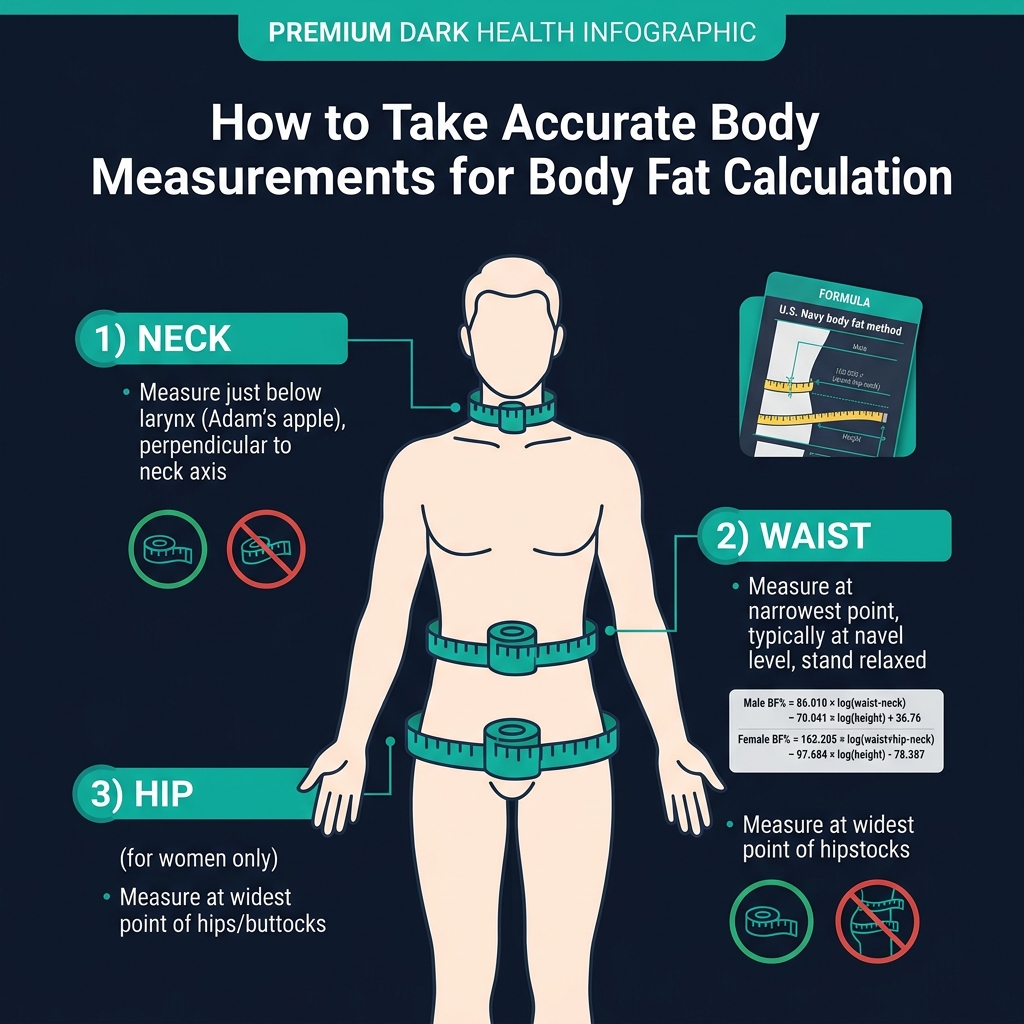
How to Take Accurate Measurements
- Height: Stand barefoot against a flat wall. Measure from floor to the top of your head (without shoes). For best accuracy, measure in the morning when you are tallest. Our Height Calculator can help convert between unit systems precisely.
- Neck: Measure circumference just below the larynx (Adam's apple for men). Keep the tape perpendicular to the neck axis. Look straight ahead and relax your neck — do not tense up.
- Waist: Stand relaxed (do not suck in). Measure at your narrowest point, typically at or just above your navel. Keep the tape parallel to the floor. Take the measurement after a normal exhale.
- Hip (women only): Measure at the widest point of your hips and buttocks. Keep feet together and the tape parallel to the floor.
- Weight (optional): Enter your weight to calculate your absolute fat mass and lean body mass in addition to body fat percentage.
Measurement Tips for Accuracy
- Use a non-stretch tape measure. Fabric tape can stretch over time and introduce errors.
- Take each measurement twice and average the results if they differ by more than 0.5 inches (1 cm).
- Measure at roughly the same time each day — body circumferences fluctuate with food intake, hydration, and digestive content by 0.5–1.5 inches.
- Pull the tape snug but not tight enough to compress the skin.
Methods: U.S. Navy vs. BMI-Based Formula
Accurate height measurement with our Height Calculator is critical for both the Navy Method and the BMI-based formula — an error of just 1 inch can shift the body fat estimate by 1–2 percentage points.
U.S. Navy Circumference Method (Primary)
Developed by Dr. Hodgdon and Beckett for the U.S. Department of Defense, this formula uses body circumference measurements to estimate body density, then converts to body fat percentage. It is the standard method used by all U.S. military branches for fitness testing:
- Male: BF% = 86.010 × log₁₀(waist − neck) − 70.041 × log₁₀(height) + 36.76
- Female: BF% = 163.205 × log₁₀(waist + hip − neck) − 97.684 × log₁₀(height) − 78.387
All measurements in centimeters. Accuracy: ±3–4% compared to DEXA scan (the gold standard). This is sufficient for tracking trends over time even if absolute values have some individual error.
Limitations of the Navy Method
- Waist measurement depends heavily on consistency of measurement location. Even 1 cm difference at waist can shift BF% by 0.5–1%.
- Less accurate for very muscular individuals (underestimates BF%) and very obese individuals (overestimates BF%).
- Not validated for populations outside the typical adult age range (15–65).
Gold Standard Comparison
For clinical precision, DEXA (Dual Energy X-ray Absorptiometry) scans are the gold standard with ±1.5% accuracy. Hydrostatic (underwater) weighing and BOD POD (air displacement plethysmography) are also highly accurate. The Navy method provides excellent tracking ability at no cost and with no specialized equipment.
Body Fat Categories and What They Mean
Body fat percentage reveals your physique composition in a way that weight and BMI cannot. Understanding where your result sits in context of the Body Shape Calculator's body proportions gives a complete picture of both your fat distribution and overall body composition.
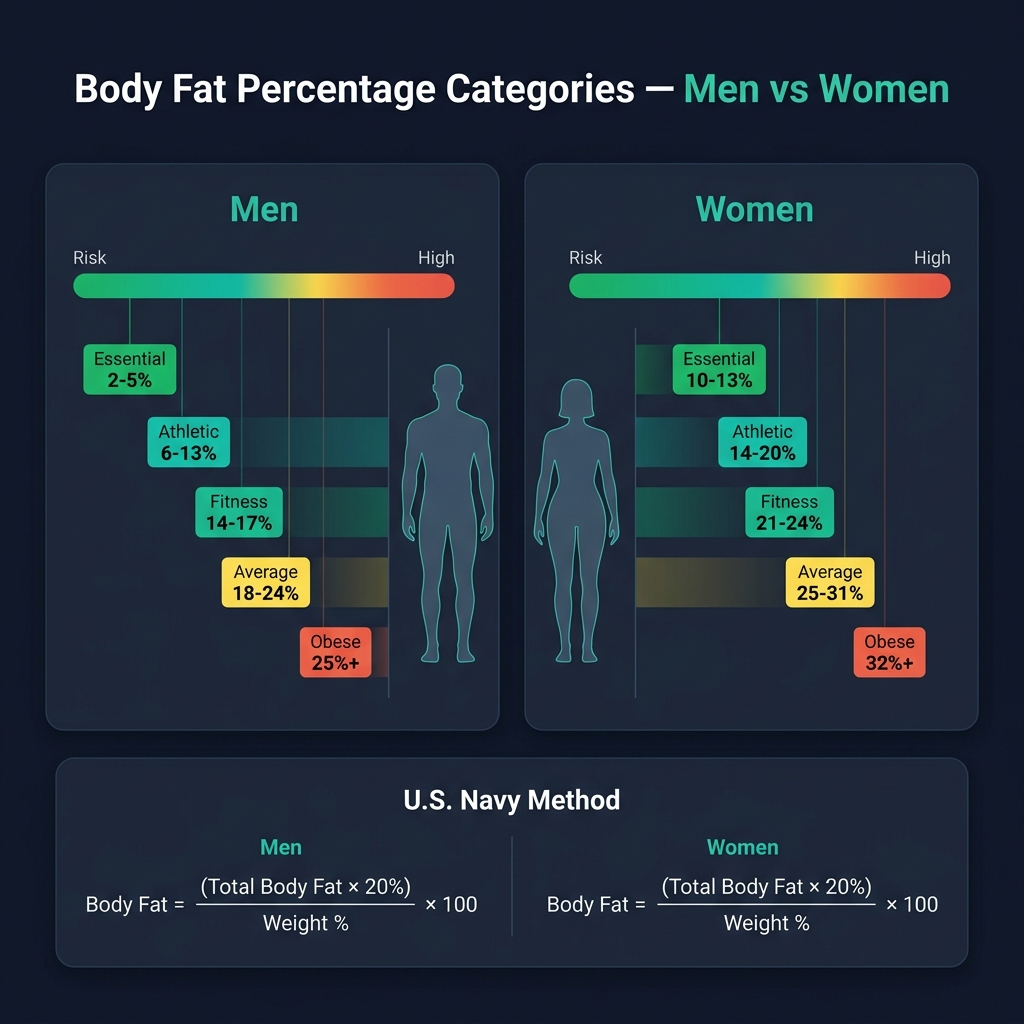
Body Fat Categories for Men
- Essential Fat (2–5%): The minimum fat required for physiological function — organ protection, nerve insulation, and hormonal production. Athletes may approach this range during competition peaking but cannot maintain it long-term. Below 4%, testosterone drops sharply.
- Athletic (6–13%): The visible range where lean muscle definition is clearly evident — abdominal vascularity begins to appear at the lower end. Typical competitive bodybuilders, sprinters, and male fitness models operate in this range.
- Fitness (14–17%): Healthy, lean physique with visible abdominal definition in good lighting. Typical fitness-conscious men with regular training and reasonable diet.
- Average (18–24%): The statistical average for adult men in most developed countries. Generally healthy but with some subcutaneous fat visible at the abdomen.
- Obese (25%+): Excess adipose tissue associated with elevated risk of cardiovascular disease, type 2 diabetes, metabolic syndrome, and sleep apnea.
Body Fat Categories for Women
- Essential Fat (10–13%): Women have biologically higher essential fat than men due to sex-specific fat depots in the breasts, uterus, and hormonal reserves. Below 12%, menstrual irregularity is common.
- Athletic (14–20%): Excellent body composition for female athletes. Elite female athletes in endurance and aesthetic sports typically maintain 15–18%.
- Fitness (21–24%): Fit, healthy female physical form with visible muscle tone but some subcutaneous fat distribution for feminine shape.
- Average (25–31%): Typical range for healthy adult women. Body composition in this range carries minimal additional health risk if waist circumference is within healthy limits.
- Obese (32%+): Elevated health risks similar to men at high body fat, with additional hormonal disruption from excess estrogen production by adipose tissue.
Why Body Fat Percentage Matters More Than Weight
Two individuals can have identical body weight and BMI yet radically different health profiles. A 180-pound person with 12% body fat is physiologically very different from a 180-pound person with 35% body fat — yet they would appear identical on a standard scale and in a BMI calculation. Understanding your maintenance calories using our Maintenance Calorie Calculator helps you manage the energy intake that ultimately determines body fat accumulation or reduction over time.
Body Fat and Metabolic Health
Excess body fat — particularly visceral fat (fat surrounding internal organs) — is strongly associated with:
- Insulin resistance: Excess free fatty acids impair insulin signaling, raising blood glucose levels and progression toward type 2 diabetes
- Cardiovascular disease: Adipose tissue releases inflammatory cytokines that contribute to arterial plaque formation and hypertension
- Hormonal disruption: Aromatase enzymes in fat tissue convert testosterone to estrogen — high body fat in men significantly lowers testosterone
- Sleep apnea: Upper airway fat deposits collapse the airway during sleep, disrupting breathing and sleep quality
Muscle Mass and "Normal-Weight Obesity"
Research identifies a condition called "normal-weight obesity" — individuals within a healthy BMI range but with high body fat percentage and low lean mass. These individuals carry the metabolic risks of obesity despite appearing healthy by weight. Only body fat percentage measurement can identify this condition.
How to Reduce Body Fat: Diet and Training Strategies
Reducing body fat requires a sustained calorie deficit — consistently eating fewer calories than your TDEE. Our Calorie Deficit Calculator computes the exact daily deficit needed to reach a target body fat by a specific date, accounting for your TDEE and weight loss timeline.
Nutrition Strategies for Fat Loss
- Calorie deficit of 300–500 kcal/day: The most reliable and sustainable fat loss rate. Combines minimal muscle loss with consistent progress of 0.3–0.5 kg/week.
- High protein intake (1.8–2.4 g/kg): Preserves lean mass during a deficit, increases satiety, and has the highest thermic effect of food — you burn 20–30% of protein calories just digesting it.
- Whole food emphasis: Whole foods are more satiating per calorie than processed foods, making it easier to naturally reduce intake without hunger.
Exercise Strategies for Fat Loss
- Resistance training (3–5×/week): Preserves and builds lean muscle during a deficit, raises resting metabolism, and improves insulin sensitivity — making fat cells more likely to release stored fat.
- NEAT (Non-Exercise Activity Thermogenesis): Daily movement like walking accounts for up to 350 kcal/day difference between individuals. Increasing steps to 8,000–10,000/day can accelerate fat loss measurably.
- Cardio (optional): Creates additional calorie deficit and improves cardiovascular health. Choose modalities you enjoy for sustainability — swimming, cycling, or walking all work equally well for fat loss if energy expenditure matches.
Improving Measurement Accuracy Over Time
For a comprehensive body composition monitoring system, use this calculator with the BMI Calculator to track your weight-to-height ratio alongside body fat %, the Body Shape Calculator to monitor how body fat distribution affects your proportions, and the Harris-Benedict Calculator for a detailed BMR calculation that helps set your calorie targets for fat loss or muscle gain.
Best Practices for Tracking Progress
- Measure monthly, not weekly. Body fat changes slowly — measuring too frequently introduces noise from hydration and digestive variation that can discourage progress you're actually making.
- Use consistent conditions. Always measure in the morning before eating, after using the bathroom, following a rest day (not after intense training, which causes temporary muscle swelling).
- Track trends, not single data points. A single measurement can be off by ±1–2% due to hydration state. The trend over 3–6 months is what matters.
- Combine with progress photos and measurements. Body fat percentage is one metric — photos every 4 weeks and monthly circumference measurements provide the complete picture of body composition change.