Arc Length Calculator
Free Arc Length Calculator: find arc length, sector area, chord length, circular segment area, and arc angle from any two known values of a circle....
Formule utilise
How to Use the Arc Length Calculator
This calculator solves all six key quantities for a circular arc — arc length, radius, central angle, sector area, chord length, and circular segment area. It works in five modes depending on which two values you already know:
- Radius + Angle → Arc Length: The classic mode. Enter the circle's radius and the central angle (degrees or radians) to compute arc length, sector area, chord length, and segment area in one click.
- Arc Length + Radius → Angle: Given the arc length and radius, find the central angle. Useful when you know the physical arc measurement but not the subtended angle.
- Arc Length + Angle → Radius: Reverse the formula to find the radius of a circle given a known arc length and angle. Common in engineering when designing curved tracks or pipe bends.
- Sector Area + Angle → Radius: From a sector's area and its central angle, calculate the radius of the full circle.
- Chord + Angle → Radius & Arc: Given the chord length and the central angle, find the radius, arc length, and sector area, using the relationship c = 2r·sin(θ/2).
All modes support both degrees and radians — toggle the unit before entering your angle. Press Calculate (or Enter) to get instant results with full step-by-step working. Click any result tile to copy its value.
The Arc Length Formula Explained
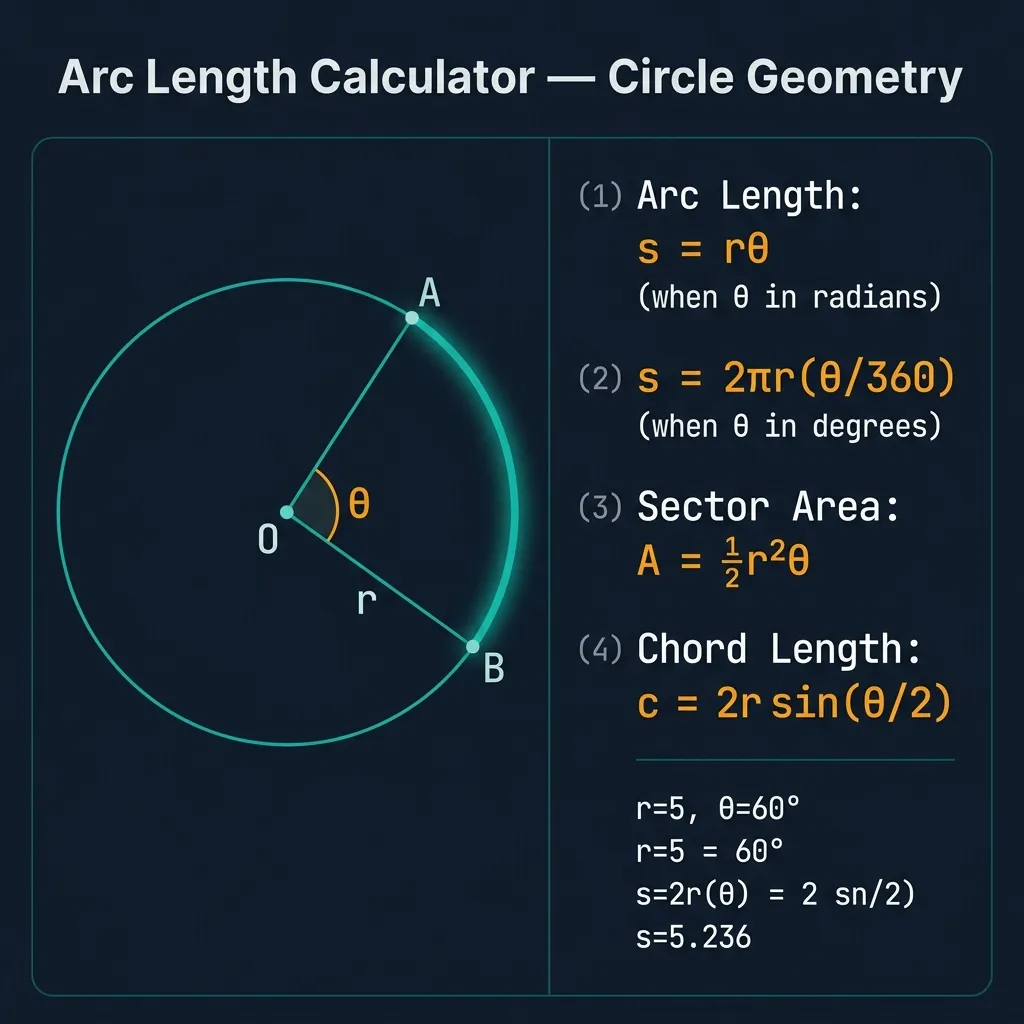
The arc length formula connects three fundamental circle properties: radius, central angle, and arc length.
- In radians: s = r · θ — where s is arc length, r is radius, and θ is the central angle in radians. This elegant formula shows that arc length equals the radius multiplied by the angle — which is actually the definition of the radian itself: one radian is the angle subtended when the arc length equals the radius.
- In degrees: s = (θ/360) · 2πr = πrθ/180 — a fraction of the full circumference (2πr), where the fraction is θ/360°.
Worked example: A circle with radius r = 5 cm and central angle θ = 60°. Convert to radians: 60 × π/180 = π/3 ≈ 1.0472 rad. Arc length s = 5 × π/3 = 5π/3 ≈ 5.236 cm. As a fraction of circumference: s = (60/360) × 2π × 5 = (1/6) × 31.416 = 5.236 cm. ✓ Both methods agree.
Note that for a full circle (θ = 360° = 2π rad), the arc length equals the full circumference: s = r × 2π = 2πr. Our Circumference Calculator handles the full-circle case and also computes diameter, area, and related properties.
Sector Area Formula
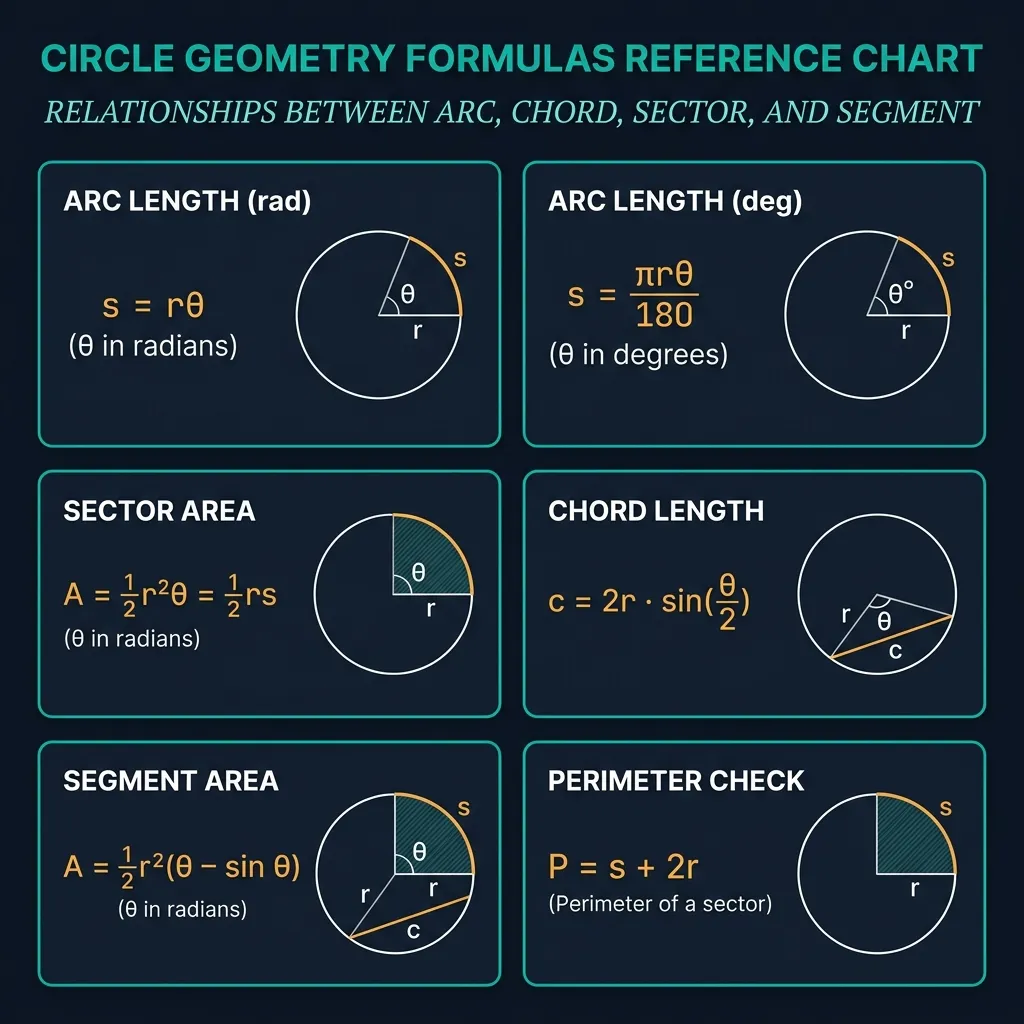
A sector is the "pie slice" bounded by two radii and the arc between them. Its area is a fraction of the full circle's area (πr²):
- In radians: A = ½ · r² · θ
- In degrees: A = (θ/360) · πr²
- Using arc length: A = ½ · r · s (since s = rθ, so ½r²θ = ½rs)
Example: r = 5 cm, θ = 60° = π/3 rad. Sector area = ½ × 25 × π/3 = 25π/6 ≈ 13.09 cm². Or using arc length s ≈ 5.236: A = ½ × 5 × 5.236 ≈ 13.09 cm². ✓
The perimeter of a sector consists of the arc plus two radii: P = s + 2r. For our example: P = 5.236 + 10 = 15.236 cm. This is important in engineering when calculating material needed for curved surfaces like fan blades or curved roof segments.
Chord Length and Circular Segment
The chord is the straight line connecting the two endpoints of the arc. The chord length is:
- c = 2r · sin(θ/2)
This comes from the triangle formed by the two radii and the chord: the two radii of length r meet at the center at angle θ. The perpendicular bisector from the center to the chord has length r·cos(θ/2), and the half-chord has length r·sin(θ/2). Doubling gives c = 2r·sin(θ/2).
For θ = 60° and r = 5: c = 2 × 5 × sin(30°) = 10 × 0.5 = 5.0 cm. Note that for θ = 60°, the chord equals the radius — these are the points of an equilateral triangle inscribed in the circle.
The circular segment is the region between the chord and the arc (not the sector, which includes the triangle). Segment area = Sector area − Triangle area:
- A_segment = ½r²(θ − sin θ) (θ in radians)
- The triangle area is ½r²sin(θ), and sector area is ½r²θ, so segment area = ½r²(θ − sin θ).
For θ = 60° = π/3 and r = 5: Segment area = ½ × 25 × (π/3 − sin(60°)) = 12.5 × (1.0472 − 0.8660) ≈ 12.5 × 0.1812 ≈ 2.264 cm². Use our Right Triangle Calculator when you need to work with the triangle formed by the two radii and the chord.
Degrees vs. Radians in Arc Calculations
The choice between degrees and radians affects every arc formula:
- In radians: s = rθ (simple product)
- In degrees: s = πrθ/180 (requires the conversion factor π/180)
Radians are the "natural" unit for circular motion because the formulas become simpler — no conversion factor needed. Key conversions: 1 radian = 180°/π ≈ 57.296°; 1° = π/180 ≈ 0.01745 rad. Common angles: 30° = π/6, 45° = π/4, 60° = π/3, 90° = π/2, 180° = π, 270° = 3π/2, 360° = 2π. Our Trigonometry Calculator includes a built-in angle converter that handles degrees, radians, gradians, and turns.
Arc length in calculus: For a curve y = f(x), the arc length from x = a to x = b is: s = ∫[a to b] √(1 + (f'(x))²) dx. This is the continuous generalization of the Euclidean distance formula, and for a circle, it reduces exactly to s = rθ. The connection between the calculus formula and the geometric formula is through the parametric form of the circle: x = r·cos(t), y = r·sin(t), giving ds/dt = r, so total arc length over angle θ is rθ.
Real-World Applications of Arc Length
- Engineering — Pipe and Track Bends: When designing curved pipes, railway tracks, or road curves, engineers specify the bend radius and sweep angle, then compute arc length to determine pipe/track material needed. A highway curve with radius 500 m and sweep angle 45° has arc length = 500 × (π/4) ≈ 392.7 m — nearly 400 m of curved road. Similarly, pipe fabricators compute arc lengths for bends to ensure correct total pipe length.
- Architecture and Landscaping: Curved garden paths, circular fountain borders, arched windows, and dome sections all require arc length calculations. An arched Gothic window with a circular radius of 2 m and an arc spanning 120° has arc length = 2 × (2π/3) = 4π/3 ≈ 4.19 m of stone trim to order. See our Circumference Calculator for full circular border calculations.
- GPS and Navigation: On Earth's surface (approximated as a sphere of radius ≈ 6,371 km), arc length formulas via the haversine formula compute the great circle distance between two geographic coordinates. A 1° arc along a meridian is approximately 111 km. The Midpoint Calculator can find the geographic midpoint between two points on a map.
- Manufacturing — CNC Routing and Laser Cutting: CNC machines specify curved toolpaths by arc radius and sweep angle. The machine computes arc length to determine feed rate timing. A circular pocket of radius 30 mm machined at 120° arc sections requires arc length = 30 × (2π/3) = 20π ≈ 62.83 mm per section.
- Astronomy: Angular diameter of celestial objects is given in arc minutes/seconds. The physical size of the Moon's disk (angular diameter ≈ 0.5°, distance ≈ 384,400 km) is arc length = 384,400 × (0.5 × π/180) ≈ 3,354 km — close to the Moon's actual diameter of ≈ 3,474 km. This shows arc length formula works well when the angle is small.
- Clock Design: The minute hand of a clock sweeps 360° in 60 minutes = 6° per minute. For a clock with minute hand length 10 cm, the tip travels arc length = 10 × (6 × π/180) ≈ 1.047 cm per minute — nearly exactly 1 cm/minute. Over an hour: 10 × 2π = 62.83 cm — the circumference.
Arc, Sector, Segment — Key Differences
These three terms describe related but distinct parts of a circle:
- Arc: The curved portion of the circle's circumference between two points. Length = rθ (radians).
- Sector: The "pie slice" region bounded by two radii and the arc. Area = ½r²θ. Also called a "circular sector."
- Segment: The region between the chord and the arc. Area = ½r²(θ − sin θ). Smaller than the sector (excludes the central triangle).
Minor vs. major arc: Every pair of points on a circle defines two arcs. The minor arc is the shorter one (central angle < 180°); the major arc is the longer one (central angle > 180°). Similarly, a minor and major sector/segment exist. Our calculator handles angles from 0° to 360° for all modes. Use our Significant Figures Calculator to round arc length results to the appropriate precision for engineering reports.
Related Calculators
- Circumference Calculator — The arc length is a fraction of a circle's circumference. When the central angle is 360° (the full circle), arc length equals circumference = 2πr. This tool computes circumference, diameter, radius, area, and related properties — the full-circle companion to this Arc Length Calculator.
- Right Triangle Calculator — The triangle formed by two radii and the chord of an arc is an isosceles triangle. The perpendicular bisector from the center to the chord is a right-triangle leg. This tool handles all right-triangle side-angle calculations using the Pythagorean theorem and trig ratios — essential for chord geometry problems.
- Trigonometry Calculator — All arc formulas involve sine, cosine, and their inverses. The chord formula c = 2r·sin(θ/2) requires a sine computation; solving for θ from a known arc/radius involves arctan or arccos. This tool covers all six trig functions, inverse functions, Law of Sines/Cosines, and has a built-in angle unit converter.
- Midpoint Calculator — When working with the ends of an arc on a coordinate system, the midpoint of the chord can be found with the midpoint formula. The center of the circle can be found using the perpendicular bisector of the chord, which passes through it. This tool handles 2D/3D midpoints, section formula, and centroid calculations.
- Significant Figures Calculator — Arc length measurements in engineering and science must be stated to the correct precision. If the radius is given to 3 significant figures, the arc length result should also be reported to 3 sig figs. This tool applies sig fig rules for all arithmetic operations — essential for scientific accuracy in arc length reporting.