Weight Gain Calculator
Calculate your exact daily calorie surplus and food intake target to reach your goal weight or build muscle. Get your TDEE, surplus recommendations, weekly...
F�rmula utilizada
How to Use the Weight Gain Calculator
This calculator is the mirror image of a Calorie Deficit Calculator — instead of computing how much to eat below maintenance to lose fat, it tells you exactly how much above maintenance to eat to gain weight or build muscle on schedule. You input your current weight, goal weight, and timeline, and it computes the precise daily calorie surplus and food intake target required.
Step-by-Step Input Guide
- Select sex — Biological sex affects BMR constants and the rate at which muscle can be gained. Males typically have higher testosterone and more lean mass, enabling faster muscle accrual than females under equivalent training conditions.
- Choose unit system — Imperial uses pounds (lbs) and feet/inches; Metric uses kilograms (kg) and centimeters (cm). All conversions are handled internally.
- Enter your age — Age affects BMR and muscle protein synthesis rates. Younger adults (18–35) generally build muscle faster; rates decline modestly from age 35 onward.
- Enter current weight — Use your consistent morning weight (after waking, before eating or drinking). Avoid post-workout or post-meal measurements which can be 1–3 lbs heavier from fluid retention.
- Enter goal weight — Set a realistic target. In a lean bulk, experienced lifters gain 0.5–1 kg per month; beginners can gain 1–1.5 kg per month due to "newbie gains."
- Enter your height — Required for BMR calculation via the Mifflin-St Jeor equation. Even a 3 cm error in height can shift your daily calorie target by 50–75 kcal.
- Select activity level — Choose the level that reflects your actual weekly training volume plus daily movement. Resistance training significantly raises TDEE; bodybuilders training 5+ days per week often qualify as "Very Active."
- Set your timeline — Enter the number of weeks you want to reach goal weight. The calculator flags whether the implied gain rate is lean, moderate, or aggressive.
The Science of Calorie Surplus and Muscle Gain
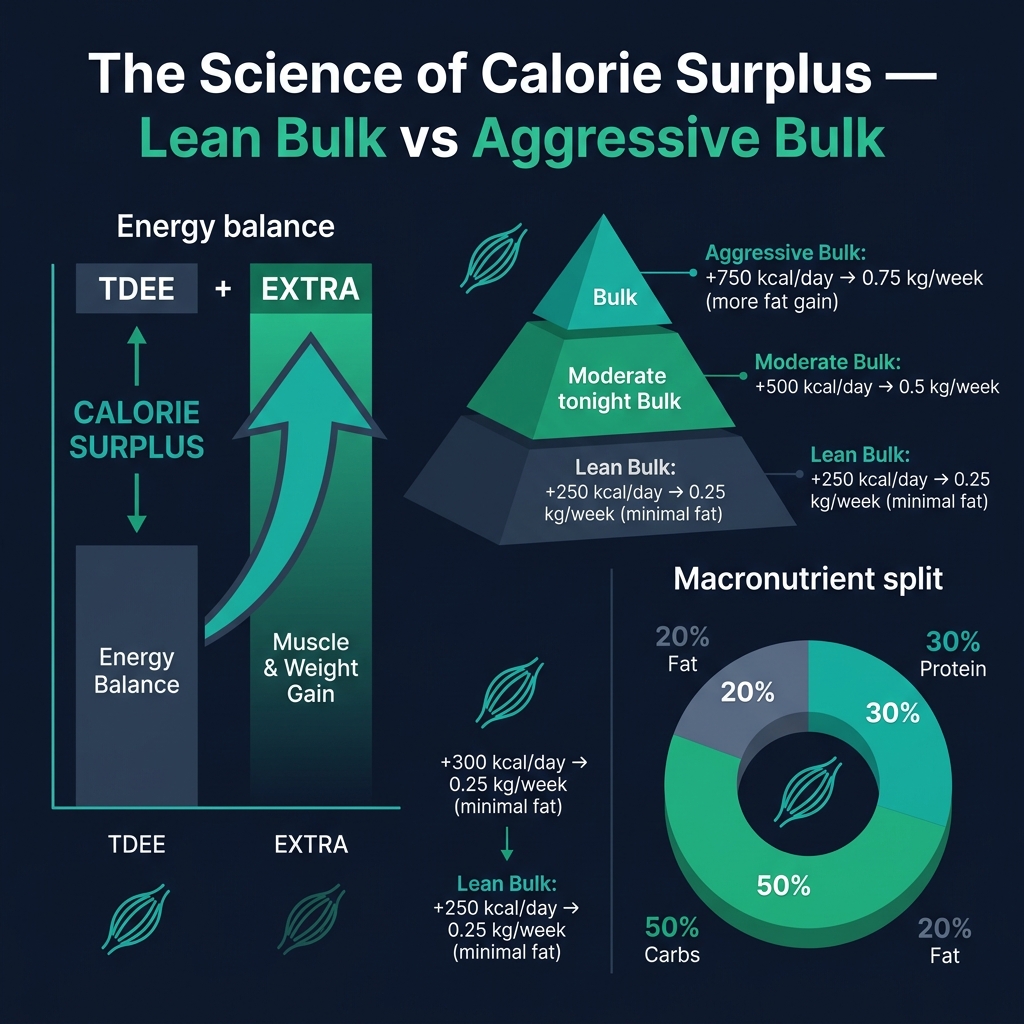
Gaining weight — and specifically muscle mass — requires a sustained calorie surplus. The the same Mifflin-St Jeor and Harris-Benedict BMR equations powering our Harris-Benedict Calculator form the metabolic foundation here. Your TDEE (Total Daily Energy Expenditure) represents your energy equilibrium; eating above it provides the raw energy substrate for new tissue synthesis.
Why 7,700 Calories Per Kilogram?
This calculator uses 7,700 kcal/kg as the energy equivalent for weight gain — the same constant used in calorie deficit calculations. However, the composition of weight gained differs by surplus size and training status:
- Small surplus (+250 kcal/day) with resistance training: Approximately 60–70% of gained weight is muscle, 30–40% is fat. Slow, high-quality gains.
- Moderate surplus (+500 kcal/day): Approximately 50% muscle, 50% fat — reasonable compromise between speed and body composition quality.
- Large surplus (+750+ kcal/day): Increasingly, gains shift toward fat as muscle protein synthesis has a ceiling rate. Gaining weight faster than your muscles can grow just means gaining fat.
The Muscle Protein Synthesis Rate Ceiling
A critical concept: the human body has a maximum rate at which it can add new muscle tissue, regardless of how much you eat. Research suggests this ceiling is approximately 0.25–0.5 kg of lean muscle per week for advanced trainees, and perhaps 0.5–1 kg per week for true beginners. Any surplus beyond what's needed to support this ceiling rate is stored as fat. This is why "lean bulking" outperforms aggressive bulking for body composition over multi-month timescales.
How Much Surplus Do You Actually Need?
Before calculating your surplus, you need to know your maintenance calories precisely. Our Maintenance Calorie Calculator uses the same Mifflin-St Jeor formula to compute your TDEE in detail — running it first creates a more accurate baseline than relying solely on the estimate embedded in this calculator.
Surplus Recommendations by Experience Level
- Beginners (0–1 year training): Can support 0.75–1.5 kg/month lean mass gain. Recommend surplus of +300–500 kcal/day. Beginners experience superior muscle protein synthesis rates due to high hormonal sensitivity to resistance training stimuli.
- Intermediate (1–3 years training): Support 0.5–1 kg/month. Recommend surplus of +250–400 kcal/day. The lean bulk approach (lower surplus) is increasingly important at this stage to minimize fat gain.
- Advanced (3+ years training): Natural muscle gain potential is 0.25–0.5 kg/month. Recommend surplus of +150–250 kcal/day. Larger surpluses add fat without additional muscle at this stage.
The Lean Bulk Advantage
A lean bulk (+200–350 kcal/day) avoids the "bulk-and-cut" cycle trap where you spend months gaining excess fat only to then spend months in a calorie deficit losing it — and potentially some hard-earned muscle. Accumulating a lean bulk for 6–12 months can produce the same or better muscle gain as an aggressive bulk with none of the unwanted fat accumulation.
Training: The Non-Negotiable Partner to Surplus Eating
Tracking your body composition improvements alongside your weight changes — using tools like the BMI Calculator to monitor your weight-to-height ratio as you gain — provides important health context. However, BMI alone cannot distinguish muscle gain from fat gain, which is why progress photos and body measurements are essential tracking tools during a bulk.
Resistance Training Requirements
Without resistance training, a calorie surplus produces primarily fat gain — not muscle. For the calorie surplus to drive meaningful muscle hypertrophy, progressive overload resistance training is required:
- Frequency: 2–4 resistance training sessions per week, hitting each major muscle group at least twice per week
- Volume: 10–20 sets per muscle group per week is the widely cited hypertrophic volume range for most trainees
- Progressive overload: Incrementally increasing weight, sets, or reps over time — the primary driver of continued muscle protein synthesis stimulus
- Compound movements: Squats, deadlifts, bench press, rows, and overhead press maximize muscle recruitment and hormonal response per unit of training time
Sleep: The Underrated Gain Driver
The majority of muscle protein synthesis occurs during sleep, driven by growth hormone pulses and testosterone secretion. Research shows that sleep-restricted individuals on a calorie surplus gain significantly less muscle and more fat than those sleeping 7–9 hours. Getting sufficient sleep is as important as training and nutrition for maximizing the return on a calorie surplus.
Nutrition Strategy for Maximum Muscle Gain
Understanding how your body proportions and shape change during a bulk — tracked with the Body Shape Calculator — helps ensure your weight gain is reshaping your physique in a balanced, proportional way rather than accumulating unevenly.
Protein: Build the Muscle, Not Just the Calories
Protein provides the amino acid building blocks for new muscle tissue. During a calorie surplus for muscle gain:
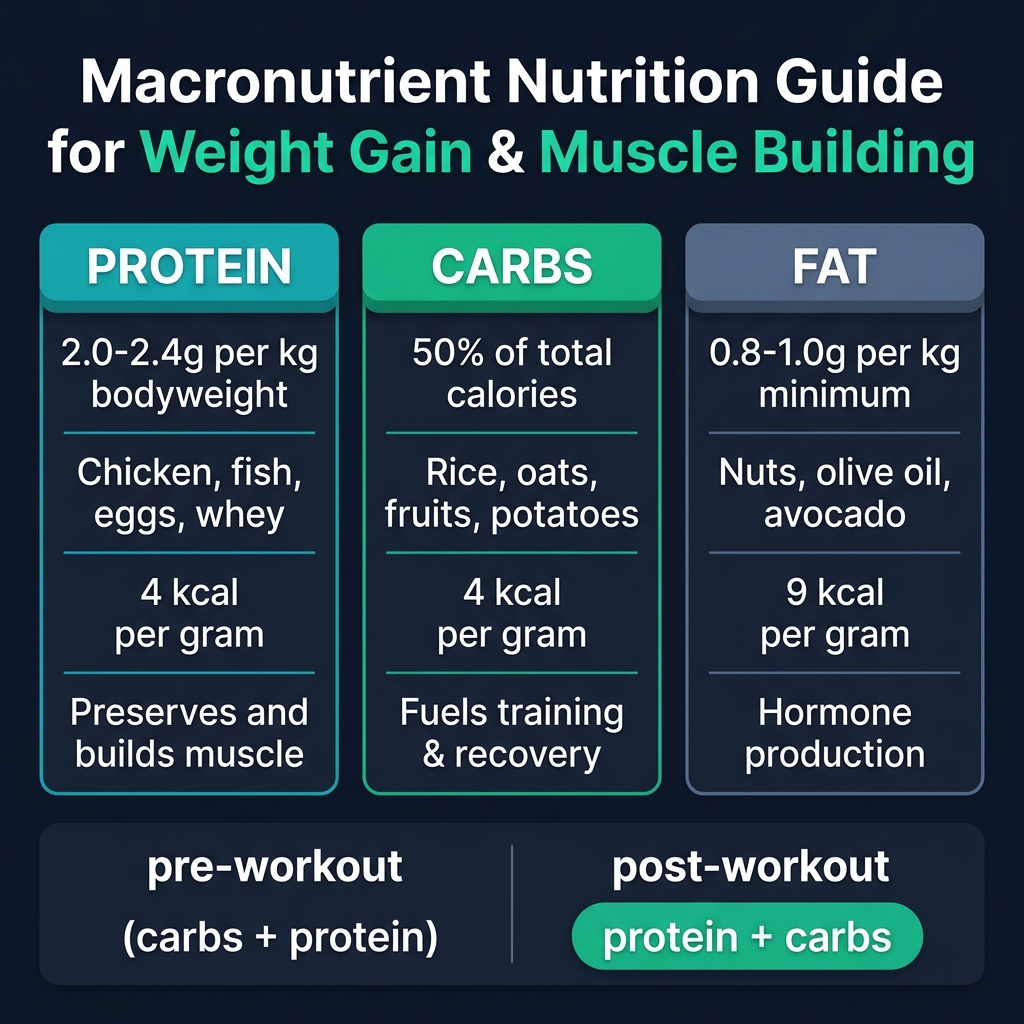
- Optimal intake: 1.6–2.2 g per kg of body weight per day for trained individuals (a 2022 meta-analysis found no additional benefit above 2.2 g/kg)
- Distribution: Spread across 3–5 meals or snacks of 30–50 g protein each to maximize muscle protein synthesis stimulation throughout the day
- Sources: Lean meats, fish, eggs, dairy (especially cottage cheese and Greek yogurt), legumes, and quality protein powders
Carbohydrates: Fuel Performance and Recovery
Carbohydrates are the premium fuel for high-intensity resistance training. A high-carbohydrate diet during a bulk serves three purposes: fueling training sessions, replenishing muscle glycogen post-workout, and triggering the insulin response that shuttles amino acids into muscle cells. Target 40–60% of your total calorie surplus from carbohydrates. Prioritize complex carbohydrates (oats, rice, potatoes, fruit) with faster-digesting carbohydrates (sports drinks, bananas) around training sessions.
Fat: Hormonal Foundation
Dietary fat is essential for testosterone and growth hormone production — the two hormones most critical to muscle gain. During a bulk, fat intake should not fall below 0.8–1.0 g per kg of body weight per day. Too little fat during a bulk suppresses testosterone production and blunts the anabolic hormonal environment required for muscle synthesis.
Meal Timing and Frequency
- Pre-workout (1–2 hours before): 30–40 g protein + 50–80 g carbohydrates to fuel training and initiate recovery
- Post-workout (within 2 hours): 30–40 g protein + 50–80 g carbohydrates to maximize muscle protein synthesis window
- Meal frequency: 4–6 smaller meals per day spreads protein intake optimally and helps reach high daily calorie targets without feeling excessively full
Tracking Progress and Adjusting Your Surplus
For a complete health monitoring system, combine this calculator with our Maintenance Calorie Calculator to recalibrate your TDEE as body weight increases, our Harris-Benedict Calculator to compare formula-specific BMR estimates, and our Calorie Deficit Calculator when transitioning from a bulk to a cut phase.
The 2-Week Calibration Method
- Track calories consistently for 2 full weeks using a food scale and tracking app. Log everything including condiments, cooking oils, and beverages.
- Weigh yourself daily under consistent conditions (morning, after toilet, before eating). Use a 7-day rolling average to eliminate water weight noise.
- Compare actual gain to predicted gain: If your 7-day average weight rose by 0.25 kg over 2 weeks at your calculated target, you are in the correct surplus. If weight did not change, add 100–200 kcal/day. If weight rose faster than expected, reduce by 100–200 kcal/day.
When to Recalculate
Recalculate your calorie target after every 3–5 kg of weight gain. As you become heavier and potentially more muscular, your TDEE increases — meaning your same intake produces a smaller and smaller surplus. Failing to recalculate is the most common reason people's bulks plateau after the first few weeks.