RMR Calculator
Calculate your Resting Metabolic Rate (RMR) using four evidence-based formulas: Mifflin-St Jeor, Harris-Benedict, Katch-McArdle, and Cunningham. Get your...
F�rmula utilizada
How to Use the RMR Calculator
This calculator runs four internationally validated formulas simultaneously to give you the most comprehensive RMR estimate available online. Unlike tools that use a single equation, comparing multiple formula outputs helps you identify your likely RMR range and understand where individual variation enters the picture. For a complete TDEE breakdown with detailed activity analysis, pair this with our Maintenance Calorie Calculator.
Input Guide
- Sex — Biological sex affects the additive constant in BMR/RMR formulas due to differences in average lean body mass composition. Males have a systematically higher RMR than females of the same weight and height by approximately 5–10%.
- Age — RMR declines approximately 1–2% per decade after age 30, primarily due to loss of metabolically active lean muscle mass. This is captured directly in all four formulas as a negative age coefficient.
- Weight — Use your consistent morning weight (after waking, before eating). Weight fluctuates 1–3 lbs daily; the morning measurement is most reproducible and closest to true lean mass weight.
- Height — Height is a proxy for skeletal size and lean mass potential. Enter barefoot height. A 1-inch error in height shifts RMR estimates by approximately 12–18 kcal/day.
- Body Fat % (optional) — Required for the Katch-McArdle and Cunningham formulas, which operate on lean body mass instead of total weight. Enter your body fat percentage if known — our Body Fat Calculator can compute this from circumference measurements using the U.S. Navy method.
- Activity Level — Used to compute your full TDEE from RMR. If in doubt, choose one level lower than you think — most people overestimate their activity level.
RMR vs BMR: What's the Difference?
The terms RMR and BMR are used interchangeably in most contexts, but they measure slightly different physiological states. Our Harris-Benedict Calculator computes what is technically a BMR using the revised Roza & Shizgal (1984) coefficients — the same equation used in this RMR calculator's Harris-Benedict output, making them directly comparable.
Basal Metabolic Rate (BMR)
BMR is measured under the most stringent possible conditions — after at least 8 hours of sleep, in a thermoneutral environment (20–22°C), after a 12-hour fast (post-absorptive state), with the subject completely motionless and in a relaxed state. It represents the absolute minimum calories required to maintain core physiological function: heartbeat, breathing, brain activity, body temperature regulation, and cell maintenance.
Resting Metabolic Rate (RMR)
RMR is measured under less strict conditions — typically after only 4–6 hours of fasting, in a seated or lying position in a comfortable room. It includes the energy cost of recent meals (thermic effect of food), minor postural muscle activity, and environmental temperature adaptation. RMR is typically 6–10% higher than BMR for the same individual. In practice, most online "BMR calculators" actually compute RMR, and the Mifflin-St Jeor formula — though labelled as BMR in many sources — was validated against RMR measurements.
Which One Should You Use?
For practical purposes of nutrition planning, TDEE calculation, and weight management, RMR is more useful than BMR because it better reflects real-world energy expenditure under normal daily conditions. True BMR measurement requires indirect calorimetry equipment in a clinical setting. Use RMR for all practical calorie planning.
The Four RMR Formulas Explained
1. Mifflin-St Jeor (1990) — Recommended
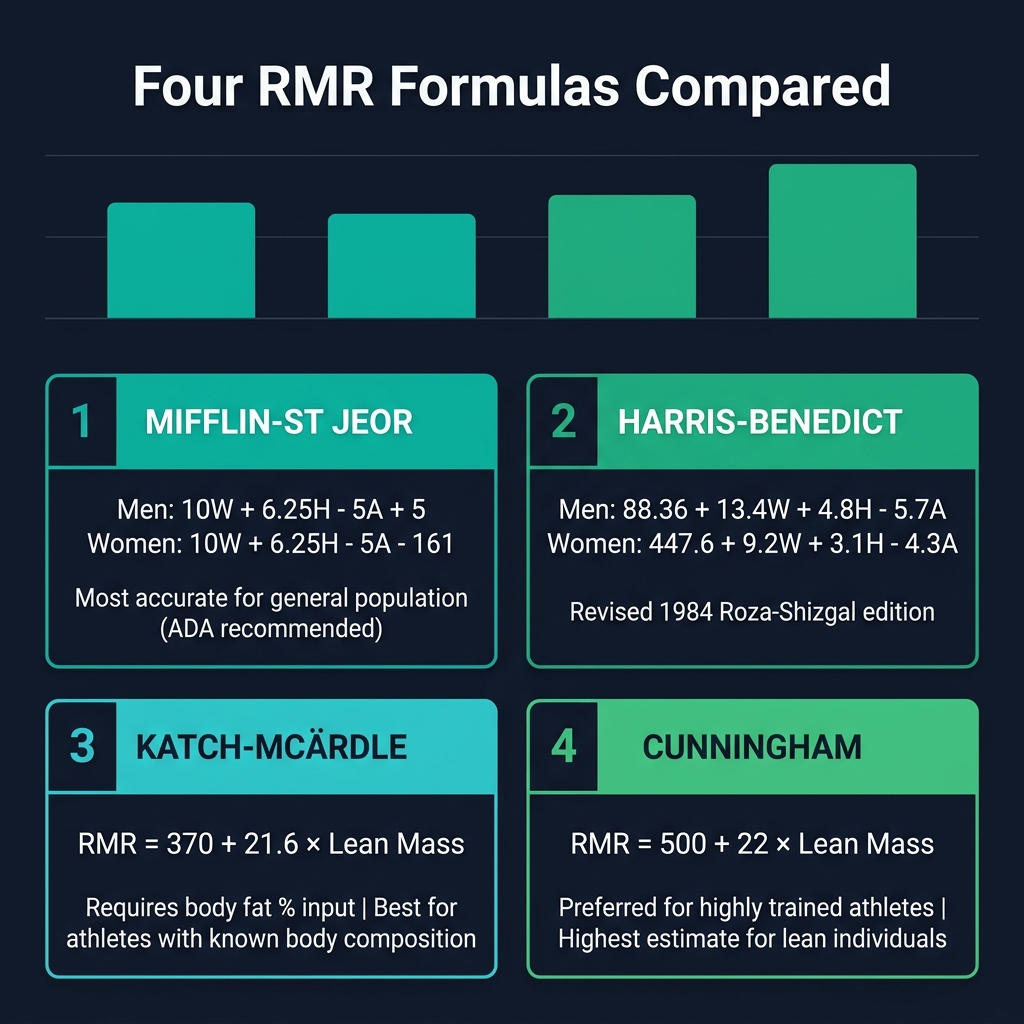
The Mifflin-St Jeor equation was developed in 1990 from a study of 498 adults and remains the most recommended formula by the Academy of Nutrition and Dietetics for estimating RMR in non-obese adults:
- Male: RMR = 10 × weight(kg) + 6.25 × height(cm) − 5 × age + 5
- Female: RMR = 10 × weight(kg) + 6.25 × height(cm) − 5 × age − 161
- Accuracy: Within ±10% for 82% of healthy non-obese adults (vs indirect calorimetry)
- Best for: General population, weight management, healthy adults
2. Harris-Benedict Revised (1984, Roza & Shizgal)
The original Harris-Benedict (1919) equations were revised by Roza and Shizgal in 1984 after being found to overestimate RMR by approximately 5% in the original 1919 study population:
- Male: RMR = 88.362 + 13.397 × weight + 4.799 × height − 5.677 × age
- Female: RMR = 447.593 + 9.247 × weight + 3.098 × height − 4.330 × age
- Accuracy: Slightly lower than Mifflin-St Jeor — tends to overestimate by ~5% compared to indirect calorimetry
- Best for: Cross-referencing Mifflin-St Jeor results, historical comparison
3. Katch-McArdle (1975) — Body Composition Method
The Katch-McArdle formula bypasses the sex-specific equations entirely by using lean body mass (LBM) as the single input. Since fat tissue is metabolically nearly inactive, LBM is a superior predictor of RMR than total body weight:
- Formula: RMR = 370 + 21.6 × lean body mass (kg)
- LBM calculation: LBM = total weight × (1 − body fat fraction)
- Accuracy: Most accurate formula when body fat percentage is known — outperforms weight-based formulas for athletes and unusually lean or obese individuals
- Best for: Athletes, bodybuilders, individuals with unusual body composition
4. Cunningham (1980) — Athletic Formula
The Cunningham equation uses the same LBM input as Katch-McArdle but with a higher constant, making it produce higher estimates particularly suited to highly trained athletes with elevated resting metabolism from greater mitochondrial density and organ mass:
- Formula: RMR = 500 + 22 × lean body mass (kg)
- Accuracy vs Katch-McArdle: Better fit for competitive athletes; overestimates for sedentary individuals
- Best for: Competitive athletes, trained individuals with very low body fat
From RMR to TDEE: Activity Level Multipliers
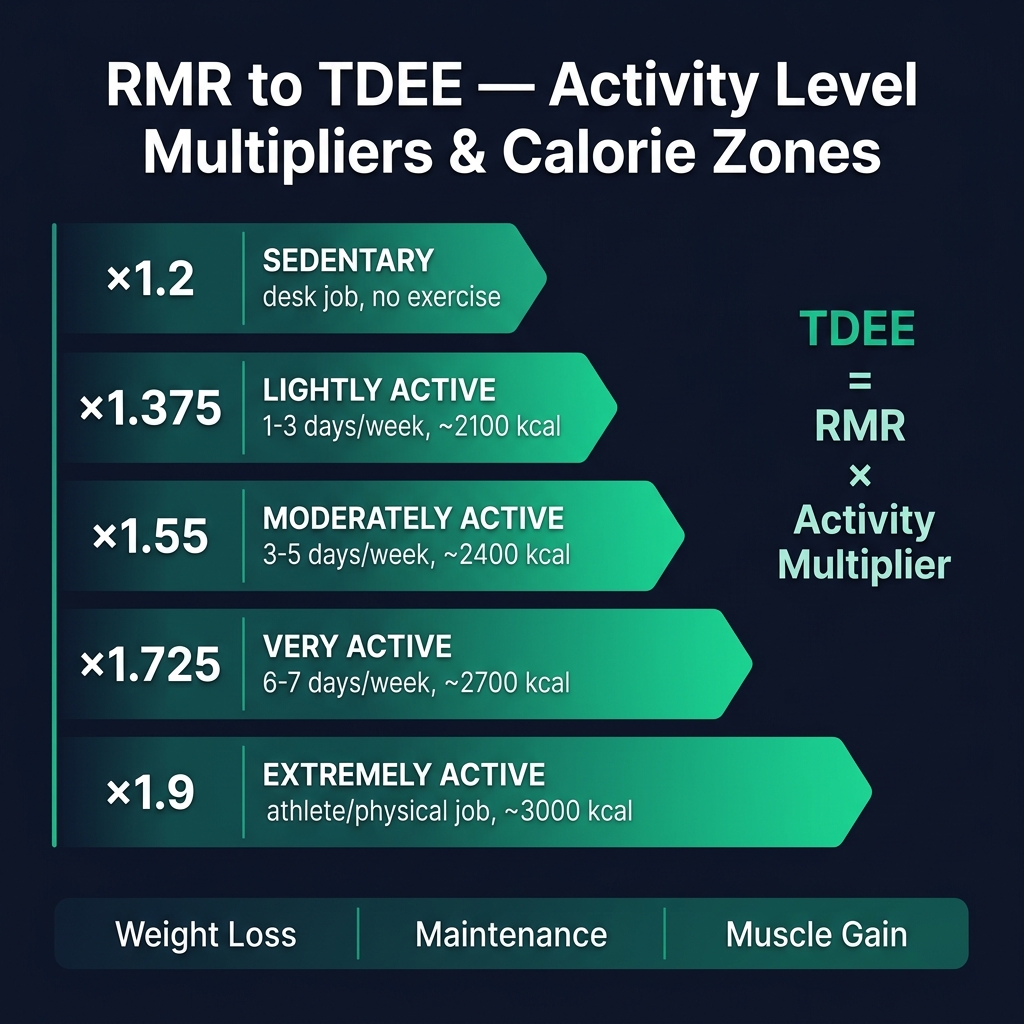
RMR accounts for only 60–70% of total daily energy expenditure. The remaining 30–40% comes from physical activity (planned exercise + NEAT) and the thermic effect of food (~10% of calories consumed). Your TDEE is computed by multiplying RMR by an activity factor — this is the calorie target for weight maintenance. To enter a deficit, use our Calorie Deficit Calculator with your TDEE as the baseline.
Activity Multiplier Reference
- Sedentary (×1.2): Desk job, minimal movement throughout the day. Less than 5,000 steps/day. No structured exercise.
- Lightly Active (×1.375): Light exercise 1–3 days/week. Office job with occasional walking. 5,000–7,500 steps/day.
- Moderately Active (×1.55): Moderate exercise 3–5 days/week. Standing job or active commute. 7,500–10,000 steps/day.
- Very Active (×1.725): Hard exercise 6–7 days/week. Physical job with additional training.
- Extremely Active (×1.9): Very hard daily exercise plus physical labor (construction, farming, competitive athletics in season).
How to Use Your RMR for Weight Management
For bulk phases targeting muscle gain, use our Weight Gain Calculator to compute the calorie surplus above your TDEE needed to reach a goal weight within a specific timeline — it uses the Mifflin-St Jeor formula for the same TDEE baseline this calculator provides.
RMR for Fat Loss
Your TDEE set by this calculator defines your maintenance intake. To lose body fat, create a deficit of 250–500 kcal/day below TDEE. Critically: never eat below your RMR — doing so forces your body to downregulate metabolic processes beyond what is safe, accelerates muscle catabolism, and risks micronutrient deficiency. Your RMR is the absolute calorie floor below which clinical supervision is required.
RMR for Muscle Gain
For lean muscle gain, add a surplus of 200–350 kcal above TDEE. This conservative surplus maximizes the muscle-to-fat ratio of gained tissue. Athletes and bodybuilders should use the Katch-McArdle or Cunningham formula result as their RMR if body fat percentage is known, as these are more accurate for individuals with unusual body composition.
Factors That Affect Your Actual Metabolic Rate
Use this calculator alongside our Harris-Benedict Calculator for formula-level comparison, our Maintenance Calorie Calculator for full TDEE with all activity breakdowns, and our BMI Calculator to track weight-to-height ratio as your body composition changes.
Key Factors That Raise RMR
- Higher lean muscle mass: Muscle tissue burns approximately 6 kcal/kg/day at rest compared to 2 kcal/kg/day for fat. Each kg of gained muscle raises RMR by ~6 kcal/day.
- Cold exposure: Non-shivering thermogenesis from brown adipose tissue activation and shivering thermogenesis can raise RMR by 10–20% in cold environments.
- Fever: Each degree Celsius increase in body temperature raises metabolic rate by approximately 7–13%.
- Caffeine and stimulants: Caffeine raises RMR by 3–11% for 3–5 hours post-consumption.
Key Factors That Lower RMR
- Prolonged calorie restriction: Adaptive thermogenesis — the body's metabolic adaptation to sustained restriction — can reduce RMR by 100–300 kcal/day beyond what weight loss alone predicts.
- Loss of muscle mass: Aging-related sarcopenia (muscle loss averaging 3–8% per decade after 30) is the primary driver of metabolic rate decline with age.
- Hypothyroidism: Thyroid hormones directly regulate all metabolic processes. Hypothyroidism can reduce RMR by 15–40%.