Hypotenuse Calculator
Free Hypotenuse Calculator using the Pythagorean theorem. Find the hypotenuse from two legs, find a missing leg, solve for angles and area, check...
Fórmula utilizada
How to Use the Hypotenuse Calculator
This calculator solves every right triangle problem involving the Pythagorean theorem. It provides five modes depending on which values you know:
- Find Hypotenuse (c from a and b): Enter both legs a and b to find the hypotenuse c = √(a² + b²), plus all angles, area, perimeter, and altitude to hypotenuse. This is the classic Pythagorean theorem mode.
- Find Leg a (from c and b): Given the hypotenuse c and one leg b, find the missing leg a = √(c² − b²). The input leg b must be strictly less than the hypotenuse.
- Find Leg b (from c and a): Same as above but solving for b given c and a.
- Special Triangles: Instantly compute exact and decimal values for the two classic special right triangles — the 45-45-90 (isosceles right triangle) and the 30-60-90 triangle — for any given side.
- Pythagorean Triple Checker: Enter any three positive integers to verify whether they form a Pythagorean triple, and optionally scale up/down to related triples.
All modes deliver: exact hypotenuse, both angles (in degrees and radians), area, perimeter, altitude to hypotenuse, and the circumradius. Press Calculate or Enter in any field for instant results. Click any result tile to copy its value.
The Pythagorean Theorem Explained
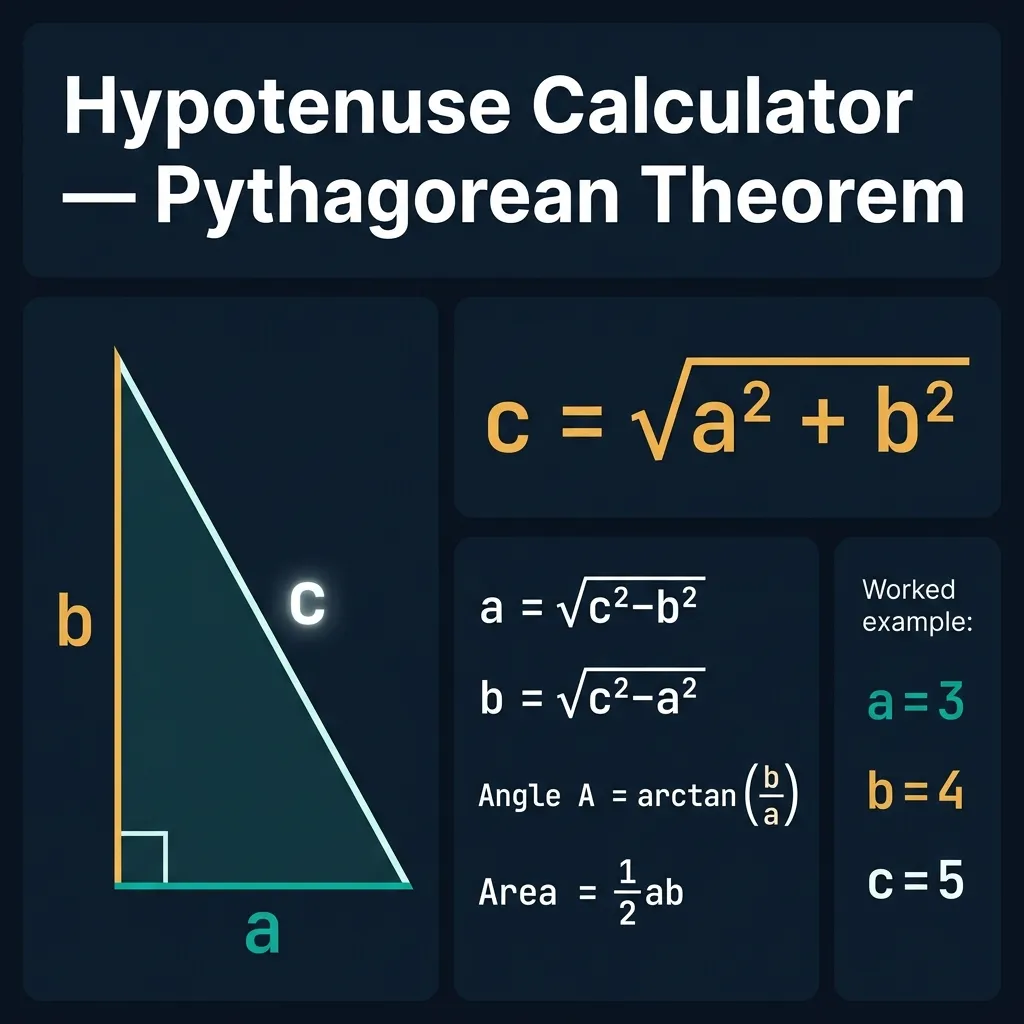
The Pythagorean theorem states: in any right triangle, the square of the hypotenuse equals the sum of the squares of the other two sides. In algebraic form: c² = a² + b², therefore c = √(a² + b²).
The theorem is named after the ancient Greek mathematician Pythagoras (around 570–495 BC), but the relationship was known to the Babylonians and Indians centuries earlier. The Plimpton 322 clay tablet (c. 1800 BC) contains Pythagorean triples — integer solutions to c² = a² + b².
Worked example — the famous 3-4-5 right triangle:
- Legs: a = 3, b = 4
- Hypotenuse: c = √(3² + 4²) = √(9 + 16) = √25 = 5
- Angle A (opposite leg a): arctan(a/b) = arctan(3/4) = arctan(0.75) ≈ 36.87°
- Angle B (opposite leg b): arctan(b/a) = arctan(4/3) ≈ 53.13°
- Sum of angles: 36.87° + 53.13° + 90° = 180° ✓
- Area = ½ × 3 × 4 = 6 square units
- Perimeter = 3 + 4 + 5 = 12 units
The 3-4-5 triple is a primitive Pythagorean triple (gcd(3,4,5) = 1). Any multiple is also a triple: 6-8-10, 9-12-15, 15-20-25, etc. For a complete explanation of right triangle angles and trig ratios, use our Right Triangle Calculator which also handles non-right triangles via Law of Sines/Cosines.
Finding a Missing Leg
When the hypotenuse c and one leg are known, the Pythagorean theorem rearranges to find the missing leg:
- Find leg a: a = √(c² − b²)
- Find leg b: b = √(c² − a²)
This requires c > b (or c > a), otherwise the expression under the square root would be negative — no real right triangle exists with a leg longer than its hypotenuse.
Example: Hypotenuse c = 13, known leg b = 5. Find leg a: a = √(13² − 5²) = √(169 − 25) = √144 = 12. This gives the classic 5-12-13 Pythagorean triple.
Example 2: Hypotenuse c = 10, known leg a = 6. Find b: b = √(100 − 36) = √64 = 8. This is the 6-8-10 triple (a multiple of 3-4-5: multiply by 2).
Special Right Triangles
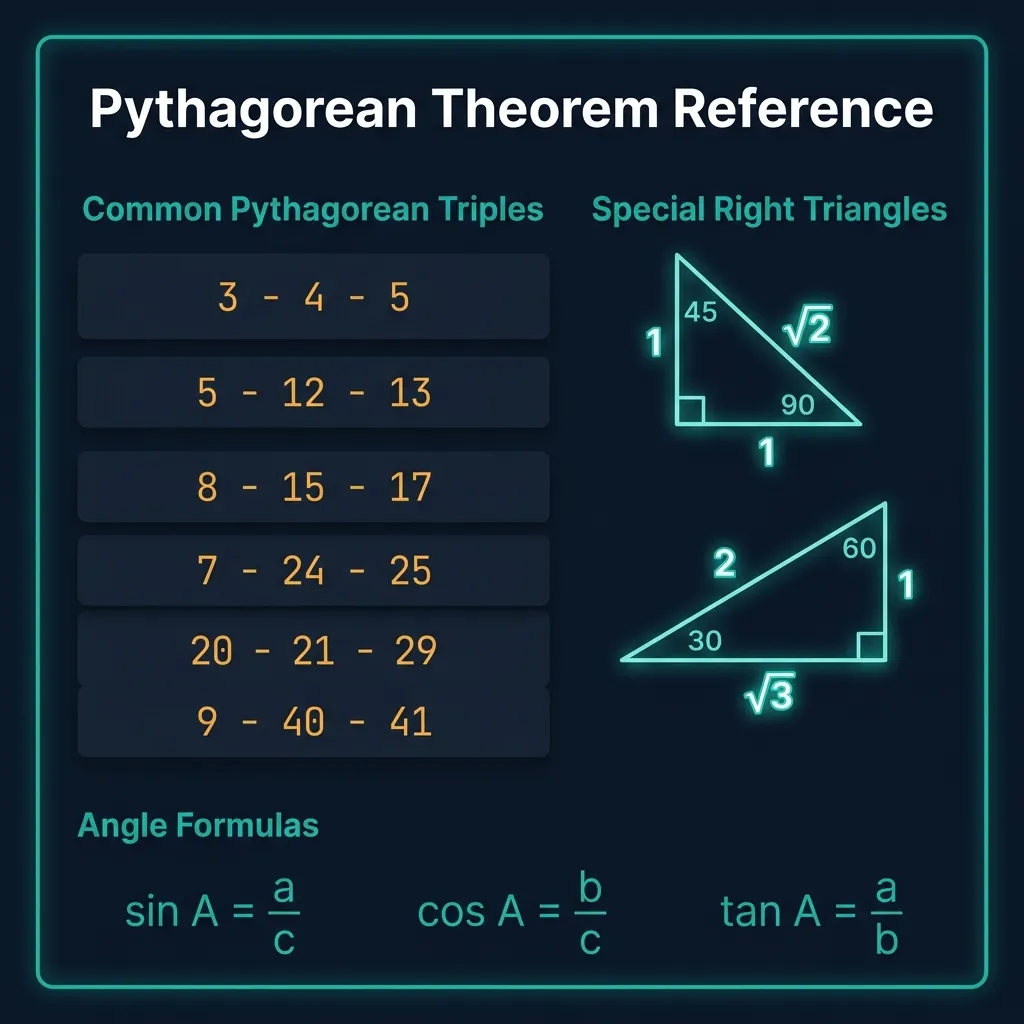
Two special right triangles have exact, elegant side ratios that appear constantly in mathematics, architecture, and engineering:
- 45-45-90 triangle (isosceles right triangle): Both legs are equal (a = b). The hypotenuse is always a√2. Angles: 45°, 45°, 90°. If a = 1: sides are 1, 1, √2 ≈ 1.4142. Commonly found in square diagonals, isometric drawings, and half-square tiles. Diagonal of a unit square = √2.
- 30-60-90 triangle (half-equilateral triangle): Formed by bisecting an equilateral triangle. Side ratios: 1 : √3 : 2. If the short leg (opposite 30°) = x, then the long leg = x√3 and hypotenuse = 2x. Angles: 30°, 60°, 90°. Appears in regular hexagons, equilateral triangles, and alt-azimuth telescope mounts. √3 ≈ 1.7321.
These exact ratios eliminate the need for trigonometry tables. For the 45-45-90: sin(45°) = cos(45°) = 1/√2 = √2/2 ≈ 0.7071. For the 30-60-90: sin(30°) = 0.5, cos(30°) = √3/2, sin(60°) = √3/2, cos(60°) = 0.5. Our Trigonometry Calculator computes all six trig functions for any angle, making it the perfect companion to this tool.
Pythagorean Triples
A Pythagorean triple is a set of three positive integers (a, b, c) satisfying a² + b² = c². A triple is primitive if gcd(a, b, c) = 1 (no common factor). Every primitive triple can be generated using the formula: a = m² − n², b = 2mn, c = m² + n², where m > n > 0, gcd(m, n) = 1, and m − n is odd.
- m=2, n=1: a=3, b=4, c=5 (the fundamental triple)
- m=3, n=2: a=5, b=12, c=13
- m=4, n=1: a=15, b=8, c=17
- m=4, n=3: a=7, b=24, c=25
- m=5, n=2: a=21, b=20, c=29
- m=5, n=4: a=9, b=40, c=41
Any multiple of a triple is also a triple: if (a, b, c) works, so does (ka, kb, kc) for any positive integer k. There are infinitely many Pythagorean triples. In our checker, we also detect if your input is a scaled version of a primitive triple and report the scale factor.
The Altitude to the Hypotenuse
When the altitude from the right angle vertex is drawn to the hypotenuse, it creates two smaller triangles that are each similar to the original triangle. Key relationships:
- Altitude h = (a × b) / c — the altitude to the hypotenuse connects the two smaller triangles.
- Projection of leg a onto hypotenuse: p = a² / c
- Projection of leg b onto hypotenuse: q = b² / c
- h² = p × q (geometric mean relationship)
- a² = p × c and b² = q × c (leg-on-hypotenuse projections)
- Circumradius R = c / 2 (the hypotenuse is the diameter of the circumscribed circle by Thales' theorem)
- Inradius r = (a + b − c) / 2
These altitude relationships are the foundation of the geometric mean method for solving right triangles and appear in projective geometry proofs of the Pythagorean theorem. The circumradius formula (R = c/2) is a direct consequence of Thales' theorem: any angle inscribed in a semicircle is a right angle.
Proofs of the Pythagorean Theorem
The Pythagorean theorem has more than 350 known proofs — more than any other theorem in mathematics. Notable proofs include:
- Geometric rearrangement: Draw a square with side (a + b). Inside it, place four congruent right triangles. The remaining central region forms a square of area c². The original square has area (a + b)² = a² + 2ab + b². The four triangles have combined area 4 × ½ab = 2ab. So c² = (a + b)² − 2ab = a² + b².
- Similar triangles (Euclid's proof): In right triangle ABC with altitude to hypotenuse creating triangles AHB and AHC, all three triangles are similar. The similarity ratios yield a² = p·c and b² = q·c, adding gives a² + b² = (p + q)·c = c².
- President Garfield's proof (1876): Forms a trapezoid with legs a and b; the trapezoid area = ½(a+b)² = three right triangles = 2×½ab + ½c², giving a² + b² = c².
- Complex number / dot product proof: |z|² = z·z̄; for z = a + bi, |z|² = a² + b² — connecting the theorem to absolute values in the complex plane.
The theorem generalizes: in a triangle with sides a, b, c and angle C opposite to c: c² = a² + b² − 2ab·cos(C). When C = 90°, cos(90°) = 0 and we get c² = a² + b². This is the Law of Cosines, which our Trigonometry Calculator uses to solve oblique triangles.
Real-World Applications
- Construction and Surveying: The "3-4-5" method is used daily by builders to establish a perfect 90° corner: measure 3 feet along one wall, 4 feet along another, and the diagonal should be exactly 5 feet if the corner is square. GPS surveying instruments compute ground distance from 3D coordinates using the 3D Pythagorean theorem: d = √(Δx² + Δy² + Δz²). Our Midpoint Calculator handles these coordinate geometry calculations.
- Navigation: Ship and aircraft navigation uses the hypotenuse to compute straight-line distances. If a ship travels 80 km east then 60 km north, the direct distance back to port = √(80² + 60²) = √(6400 + 3600) = √10000 = 100 km. This is the 3-4-5 triple scaled by 20.
- Architecture and Engineering: Roof rafter lengths, staircase stringer lengths, diagonal brace lengths, and screen diagonal sizes all use the Pythagorean theorem. A 16:9 screen with 65-inch diagonal: true height = 65/√(16²+9²) × 9 = 65/18.358 × 9 ≈ 31.86 inches; width ≈ 56.64 inches. Use our Arc Length Calculator for curved architectural members.
- Physics: Resultant velocity in 2D: v = √(vₓ² + vᵧ²). Magnitude of any 2D vector uses the formula. In optics, the critical angle for total internal reflection derivation uses the Pythagorean theorem in the right triangle formed by the wave vectors.
- Computer Graphics: Euclidean distance between two pixels (x₁,y₁) and (x₂,y₂): d = √((x₂−x₁)² + (y₂−y₁)²). Collision detection circles: two objects collide if distance between centers < sum of their radii. Every frame of a 3D game uses millions of Pythagorean theorem calculations for lighting, shading, and physics.
- Astronomy: The distance to a star using parallax, apparent size of galaxies from angular diameter distance, and the aberration of starlight all involve right triangle calculations with the hypotenuse formula. The parsec is defined using parallax: a right triangle with base = 1 AU and parallax angle = 1 arcsecond gives distance = 1 pc ≈ 3.086 × 10¹³ km.
Related Calculators
- Right Triangle Calculator — The advanced companion to this tool. While the Hypotenuse Calculator focuses purely on the Pythagorean theorem (c² = a² + b²), the Right Triangle Calculator solves any right triangle given angle+side or side+side combinations using trigonometric functions (sin, cos, tan). It also covers the Law of Sines and Law of Cosines for non-right triangles. Essential when you need angles, not just side lengths.
- Trigonometry Calculator — After finding the hypotenuse, you often need trig ratios: sin θ = opposite/hypotenuse, cos θ = adjacent/hypotenuse. This tool computes all six trig functions for any angle, inverse trig functions (arcsin/arccos/arctan), and both Law of Sines and Law of Cosines — the generalizations of the Pythagorean theorem to non-right triangles.
- Arc Length Calculator — The circumscribed circle of a right triangle has the hypotenuse as its diameter (Thales' theorem: R = c/2). Given R, use this tool to find arc lengths, sector areas, and chord lengths of the circumscribed circle. The inscribed circle radius r = (a + b − c)/2 relates to the area: A = r·s where s = (a + b + c)/2 is the semiperimeter.
- Midpoint Calculator — The center of the circumscribed circle of a right triangle is the midpoint of the hypotenuse. Given endpoints of the hypotenuse, this tool finds the circumcenter (midpoint), the circumradius (half the hypotenuse length using the distance formula), and can verify the right angle via the Pythagorean theorem on the resulting coordinate distances.
- Significant Figures Calculator — When computing hypotenuse lengths from measured leg values, the result should match the precision of the least precise input. If a = 3.2 m (2 sig figs) and b = 4.1 m (2 sig figs), then c = √(3.2² + 4.1²) = √(10.24 + 16.81) = √27.05 ≈ 5.201 m, but should be rounded to 5.2 m (2 sig figs). This tool ensures correct scientific precision.