Face Shape Calculator
Identify your face shape instantly — Oval, Round, Square, Heart, Diamond, Rectangle, or Triangle. Enter 4 face measurements to get your exact shape with...
F�rmula utilizada
How to Use the Face Shape Calculator
Enter four simple measurements to instantly discover your face shape and unlock personalized style recommendations for hairstyles, glasses, and makeup contouring. The same tape measure you use for clothing or when measuring height with our Height Calculator is perfect for face measurements.
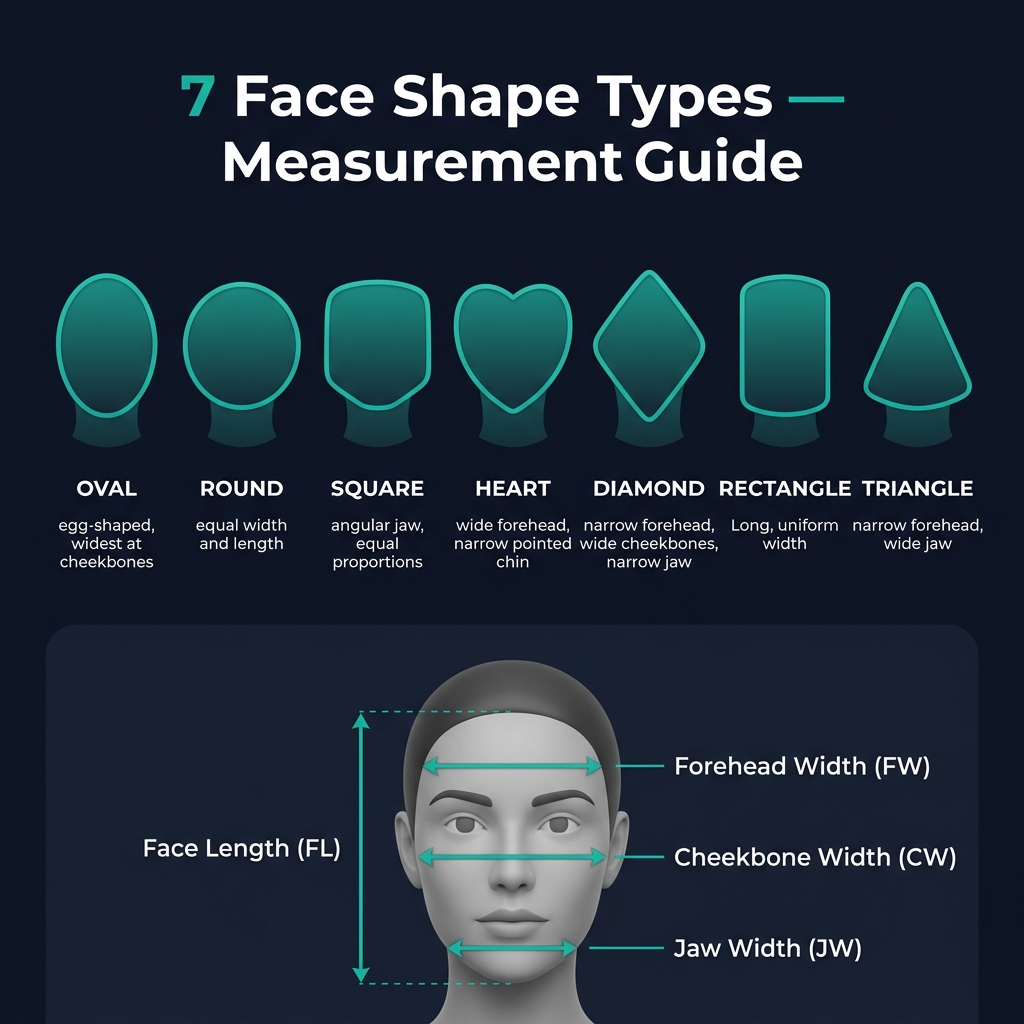
Step-by-Step Measurement Guide
- Select your unit system — Choose inches (in) for Imperial or centimeters (cm) for Metric. Use a flexible fabric tape measure for accuracy.
- Measure your face length (FL) — Measure vertically from the center of your hairline down to the tip of your chin. If you have a receding hairline, estimate where the natural hairline falls.
- Measure your forehead width (FW) — Measure horizontally across your forehead at its widest point, typically halfway between your eyebrows and hairline.
- Measure your cheekbone width (CW) — Measure across the widest part of your face at cheekbone level. Start just below the outer corner of each eye.
- Measure your jaw width (JW) — Measure across the widest part of your jaw, approximately at the corners of your jawbone (not chin tip).
- Click Calculate — Your face shape and key measurement ratios appear instantly with detailed style tips.
Measurement tips: Measure in front of a mirror for best accuracy. Pull hair back before measuring. Take each measurement twice and average the readings for the most reliable result.
The 7 Face Shapes: Complete Classification Guide
Face shape classification uses the proportional relationships between four key measurements — face length, forehead width, cheekbone width, and jaw width. Understanding these ratios helps stylists, dermatologists, and fashion consultants recommend the most flattering choices for any individual. Just as the Body Shape Calculator classifies body proportions from shoulder-to-hip measurements, face shape relies on its own set of precise width-to-length ratios.
Oval Face Shape
The oval face shape is often called the "ideal" face shape in both Western and Eastern aesthetic traditions. It is characterized by a face length approximately 1.5× the cheekbone width, with cheekbones as the widest point and the face gently tapering toward both the forehead and chin.
Key ratios: FL/CW ≈ 1.4–1.52, forehead slightly wider than jaw, cheekbones widest point.
Style advantage: Almost any hairstyle, glasses frame, and makeup technique flatters an oval face. This shape can experiment with extreme styles that might not work for other face shapes.
Round Face Shape
A round face has approximately equal face length and cheekbone width, with soft, curved angles rather than defined corners. The forehead, cheekbones, and jawline are all similar in width, creating a circular overall impression. A round face often correlates with higher body fat distribution around the face — monitoring overall body composition with the BMI Calculator provides a broader health picture alongside shape classification.
Key ratios: FL/CW < 1.30, all widths within 15% of each other.
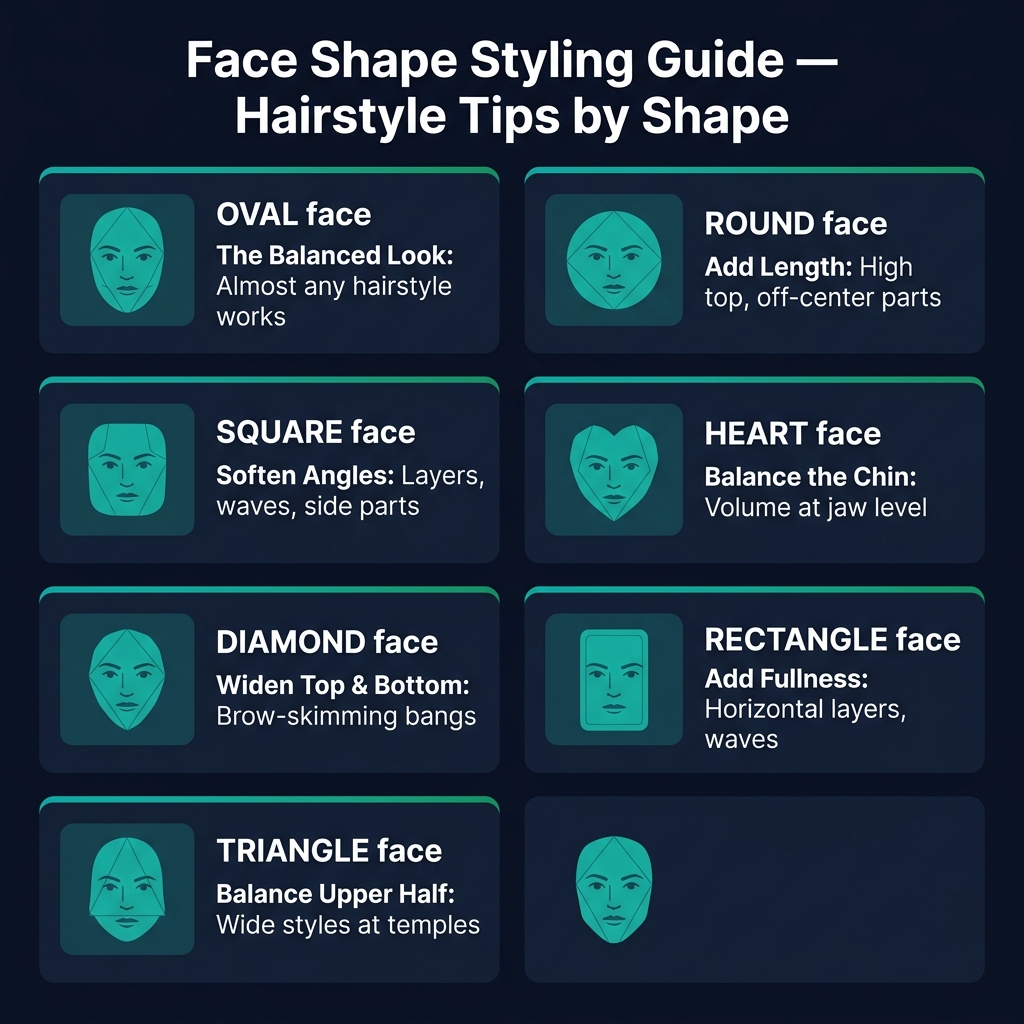
Style goal: Add visual length and minimize width. Opt for hairstyles with height at the crown, angular glasses frames, and contouring below the cheekbones.
Square Face Shape
A square face features a strong, angular jawline with forehead, cheekbones, and jaw all approximately equal in width. The jaw angle is sharp rather than rounded, creating structured, architectural facial geometry.
Key ratios: FL/CW ≈ 1.30–1.50, widths within 12% of each other, angular jaw.
Style goal: Soften the angles. Layer cuts, wavy textures, and oval or round glasses frames reduce visual sharpness at the jaw.
Heart Face Shape
A heart-shaped face has a wider forehead that tapers to a narrower, often pointed chin. The forehead is the widest measurement, wider than both the cheekbones and jawline. Many people with heart-shaped faces also have a widow's peak hairline.
Key ratios: FW > JW by 12%+, FW ≈ CW or FW > CW, narrow jaw.
Style goal: Add volume and width at the chin and jaw area. Chin-length layers, wide-leg glasses, and lower contouring balance the proportions.
Diamond Face Shape
The diamond face shape has cheekbones as the clearly widest point, with both the forehead and jaw narrower and similar in width to each other. This creates the appearance of high, dramatic cheekbones — a coveted feature in modeling and fashion.
Key ratios: CW > FW and CW > JW by 8%+, FW ≈ JW (within 18% of CW).
Style goal: Add width at the forehead and chin. Brow-grazing bangs, side-swept styles, and oval glasses frames create balance around the dramatic cheekbone width.
Rectangle / Oblong Face Shape
A rectangle or oblong face is longer than it is wide, with forehead, cheekbones, and jaw all similar in width. Unlike the square, the jaw is typically less angular. This face shape is characterized by its prominent vertical dimension.
Key ratios: FL/CW > 1.52, all widths within 15% of each other.
Style goal: Reduce length and add width. Horizontal layering, side-swept bangs, and wider glasses frames balance the elongated face proportions.
Triangle / Pear Face Shape
A triangle or pear-shaped face has a jaw that is wider than both the cheekbones and forehead — the inverse of the heart shape. Weight is distributed toward the lower face. This is sometimes also called the "pear" shape in facial aesthetics.
Key ratios: JW > CW or JW > FW by 5%+.
Style goal: Add volume and visual interest to the upper face. Volume at the crown, wider styles at the temples, and cat-eye glasses draw attention upward.
Measurement Technique: Getting Accurate Readings
The accuracy of your face shape result depends entirely on the quality of your measurements. Professional stylists and dermatologists use consistent measurement protocols for repeatable results. Measurement precision matters just as much here as it does when calculating your exact age for health milestones — use the Age Calculator to track age-related changes in your facial structure over time alongside these measurements.
- Use a flexible fabric tape measure — Hard rulers cannot follow facial contours and produce inaccurate readings. A soft tailoring tape is ideal.
- Measure over skin, not hair — Pull hair back completely before measuring. Include any hair between the tape and skin in your measurement only for hairline points.
- Use a well-lit mirror at eye level — Looking down or up changes head position and alters measurements.
- Take three measurements per point — Average the three readings to reduce positioning error. The difference should be less than 0.2 inches (0.5 cm).
- Measure bone structure, not soft tissue — Press the tape gently against the skin. Do not pull tight (which pushes tissue) or leave slack (which inflates measurements).
The Four Key Measurement Ratios Explained
Face shape classification is based on four measurements and the ratios between them. These proportion-based ratios follow the same analytical framework used in the Body Shape Calculator — where waist-to-hip ratio (WHR) and shoulder-to-waist ratio (SWR) classify body type — applied to facial geometry instead of body measurements:
- FL/CW ratio (Length-to-Width Ratio) — Divides face length by cheekbone width to determine how oval or elongated the face is. Values below 1.3 indicate round proportions; above 1.5 indicates rectangle/oblong territory.
- FW/CW ratio (Forehead Dominance) — Compares forehead width to the widest point (cheekbones). A ratio above 1.0 means the forehead is prominent — a key indicator for heart-shaped faces.
- JW/CW ratio (Jaw Dominance) — Compares jaw width to cheekbone width. A ratio above 1.0 indicates a wide, prominent jaw — the key indicator for triangle-shaped faces.
- FW-JW symmetry — The absolute difference between forehead and jaw width relative to cheekbone width. When both are narrow and similar (and cheekbones are widest), the face is diamond-shaped.
Styling by Face Shape: Hairstyles, Glasses, and Makeup
Once you know your face shape, every styling decision becomes more strategic. Here are expert-level recommendations for each category. Note that overall health and body composition — tracked with the Harris-Benedict Calculator for daily calorie needs — directly influences how your face shape appears, as fat distribution around the cheeks and jaw changes with body weight.
Hairstyle Recommendations
- Oval: Any length and style. Try one-length cuts, textured layers, or dramatic undercuts — versatility is the oval advantage.
- Round: Long layers below the chin, center parts, volume at the top. Avoid chin-length bobs and full, round styles that amplify the circular impression.
- Square: Soft waves, wispy layers, angled cuts. Avoid blunt cuts at the jaw and very short styles that emphasize jaw angles.
- Heart: Chin-length bobs, layered cuts with volume at the jaw. Avoid very high top volume and very short sides that emphasize width at the forehead.
- Diamond: Side-swept bangs, brow-grazing fringes, wide styles. Avoid very short sides that accentuate cheekbone width.
- Rectangle: Bobs, side-swept bangs, layers with horizontal volume. Avoid very long, straight styles that increase the sense of length.
- Triangle: Volume at the crown and temples, textured top layers. Avoid styles with volume at the jaw level that increase the already-wide lower face.
Glasses Frame Guide
- Oval: Almost any frame — cat-eye, round, rectangular, and oversized all work.
- Round: Angular frames (rectangular, square) add structure. Avoid small round frames.
- Square: Round, oval, or rimless frames soften jaw angles. Avoid geometric frames that add more lines.
- Heart: Bottom-heavy frames (aviators, round), semi-rimless. Avoid top-heavy or decorative frames that draw attention upward.
- Diamond: Oval, rimless, or frames with soft detailing at the brow line. Avoid narrow frames that make cheekbones appear wider.
- Rectangle: Tall frames, oversized, round or square with height. Avoid narrow, elongated frames.
- Triangle: Frames wider at the top (cat-eye, browline). Avoid bottom-heavy frames.
Complete Your Health and Style Profile
Face shape is one piece of a complete self-assessment. Combine these results with the Body Shape Calculator to understand your full body proportions — together they reveal how to dress and style for your complete silhouette. Use the BMI Calculator to monitor healthy weight range, since facial fat distribution shifts noticeably as body weight changes. For nutrition and calorie planning that supports your appearance and wellness goals, the Harris-Benedict Calculator delivers a precise daily calorie target based on your metabolism and activity level.