Period Calculator
Free period calculator that predicts your next 6 periods, ovulation date, and fertile window. Enter your last period date and cycle length for an accurate...
Formula used
How to Use the Period Calculator
This period calculator predicts your next 6 menstrual cycles, ovulation dates, and fertile windows using your last period start date and average cycle length. Unlike simple trackers, it also shows your current cycle phase and day-by-day countdown so you always know where you are in your cycle right now.
Your age affects cycle patterns significantly — younger women often have more irregular cycles, while cycles tend to stabilize in the mid-20s and shorten naturally as perimenopause approaches. Track alongside our Age Calculator if you want to cross-reference your age-related cycle expectations.
Step-by-Step Instructions
- Last Period Start Date: Enter the first day of your most recent period — the day bleeding began, even if it was initially light spotting. This is Day 1 of your current cycle. Accuracy here is the single most important input for the entire forecast.
- Average Cycle Length: The number of days from the first day of one period to the first day of the next. The average is 28 days, but 21–35 days is considered normal. If your cycle varies by more than 5 days each month, enter your best average over the past 3–6 months.
- Period Duration: How many days your period typically lasts (bleeding days). Most women experience 3–7 days; enter the average if this varies.
Reading Your Results
The calculator shows your current cycle phase with a day count, the number of days until your next period, and a table of your next 6 predicted cycles with ovulation date, fertile window start and end, and period end dates for each cycle.
Understanding Your Menstrual Cycle Phases
Body fat percentage significantly influences menstrual regularity. Women with body fat below 17% often experience disrupted cycles or amenorrhea (absence of menstruation) due to insufficient estrogen production by adipose tissue. Use our Body Fat Calculator to check whether your body composition may be contributing to cycle irregularity.
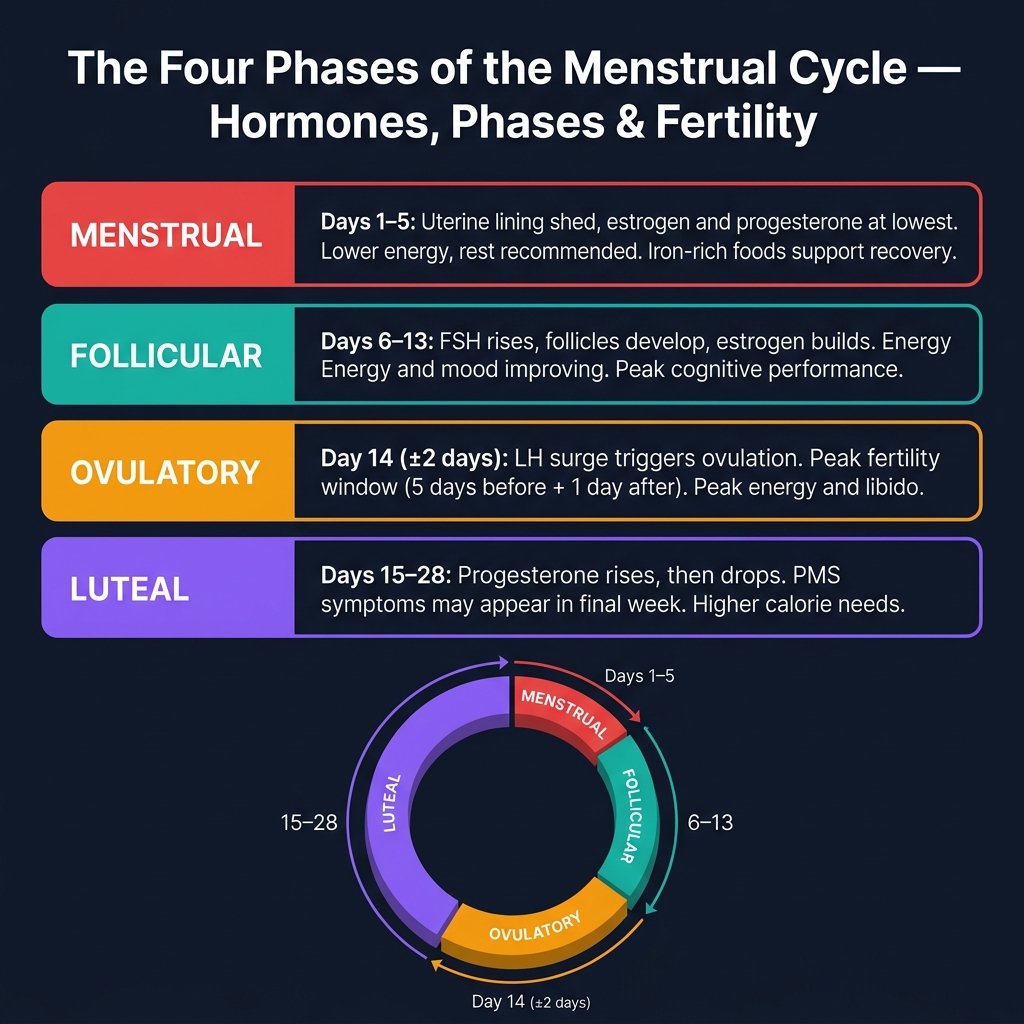
Phase 1: Menstrual Phase (Days 1–5)
Your period begins on Day 1. The uterine lining sheds because both estrogen and progesterone have dropped to their lowest levels. Prostaglandins trigger uterine contractions that expel the lining, causing cramping.
- Hormone profile: Estrogen and progesterone at their lowest
- Physical experience: Bleeding, potential cramping, fatigue, lower back pain
- Nutritional focus: Iron-rich foods (red meat, spinach, lentils), magnesium for cramp relief, anti-inflammatory foods (fatty fish, ginger)
Phase 2: Follicular Phase (Days 6–13)
Follicle-stimulating hormone (FSH) rises and stimulates several ovarian follicles to develop. The dominant follicle produces increasing amounts of estrogen, which rebuilds the uterine lining and gradually improves energy, mood, and cognitive function.
- Hormone profile: Rising estrogen, moderate FSH
- Physical experience: Increasing energy, improved mood, better sleep, skin clearing
- Training tip: Peak time for strength training and high-intensity work — estrogen supports muscle protein synthesis
Phase 3: Ovulatory Phase (Day 12–16, peaks ~Day 14)
A surge in luteinizing hormone (LH) 24–36 hours before ovulation triggers the dominant follicle to release an egg. The egg is viable for 12–24 hours after release — this is when conception is most likely.
- Hormone profile: LH and estrogen surge, then begin to fall
- Physical experience: Increased libido, possible light spotting (mittelschmerz), cervical mucus becomes clear and stretchy (egg-white consistency)
- Fertile window: 5 days before ovulation to 1 day after — sperm can survive 3–5 days in the female reproductive tract
Phase 4: Luteal Phase (Days 15–28)
After releasing the egg, the follicle transforms into the corpus luteum, which secretes progesterone. If no fertilization occurs, the corpus luteum degenerates, progesterone falls, and menstruation begins again.
- Hormone profile: Progesterone dominant, then falling
- Physical experience: PMS symptoms in the final 7–14 days (bloating, breast tenderness, mood changes, food cravings)
- Nutritional focus: Caloric needs increase by 100–300 kcal/day during the luteal phase due to progesterone-driven metabolic increase
Calculating Ovulation Date and Fertile Window
During the luteal phase, your caloric needs genuinely increase — progesterone raises basal metabolic rate. Use our Maintenance Calorie Calculator to understand your cyclical calorie fluctuation and adjust nutrition timing across your cycle for optimal energy management.
How Ovulation Date Is Calculated
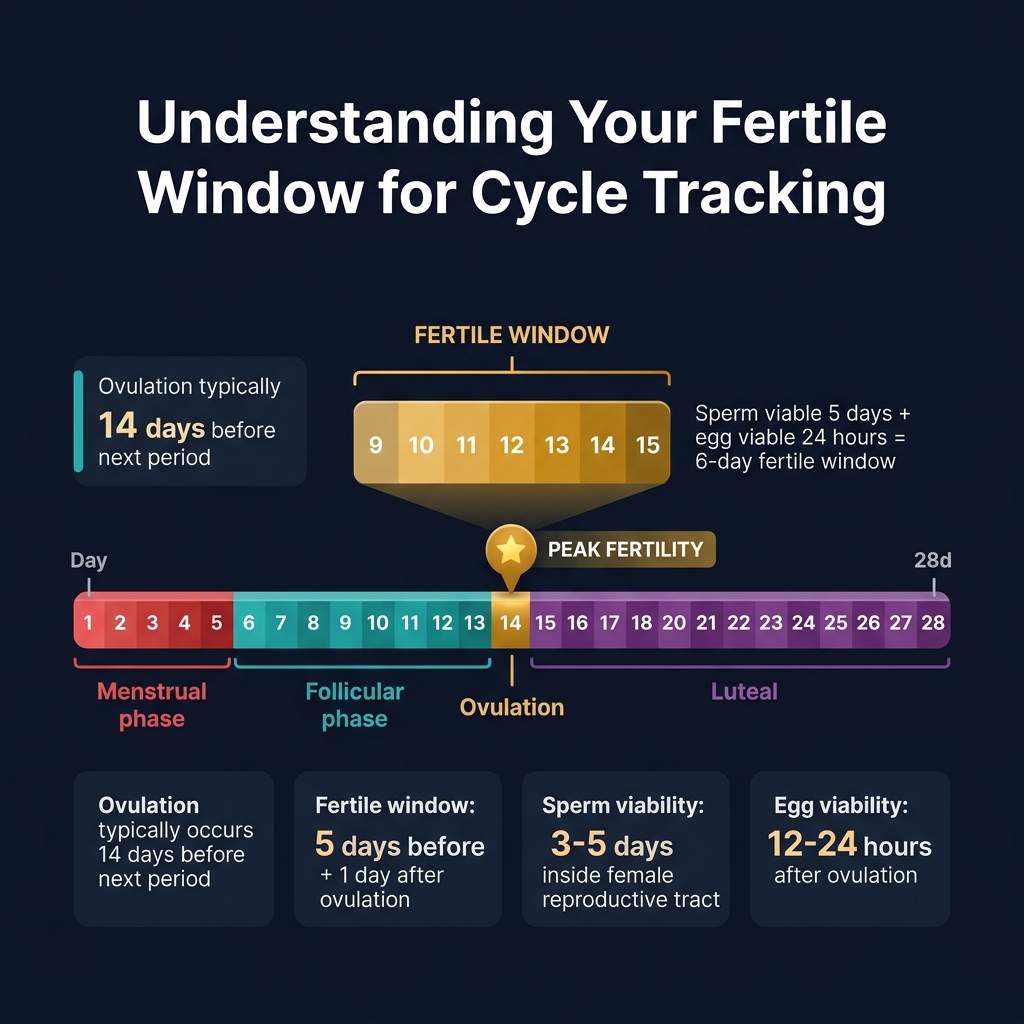
Ovulation typically occurs approximately 14 days before the start of the next period — not 14 days after the last period. This distinction matters significantly for cycles shorter or longer than 28 days:
- 24-day cycle: Ovulation ~Day 10 (not Day 14)
- 28-day cycle: Ovulation ~Day 14
- 35-day cycle: Ovulation ~Day 21 (not Day 14)
The formula: Ovulation Day = Cycle Start Date + (Cycle Length − 14)
Your Fertile Window
The fertile window spans 6 days total: the 5 days before ovulation and the day of ovulation itself. Sperm can survive in the female reproductive tract for 3–5 days — meaning intercourse several days before ovulation can still result in fertilization. The egg is only viable for 12–24 hours after ovulation.
- Fertile window start: Ovulation date − 5 days
- Peak fertile day: Ovulation date − 1 to ovulation date itself
- Fertile window end: Ovulation date + 1 day
Signs of Ovulation
- Basal body temperature (BBT) rise: A slight temperature increase of 0.2–0.5°C occurs after ovulation due to progesterone. Track BBT daily upon waking to confirm ovulation retroactively.
- Cervical mucus changes: Around ovulation, discharge becomes clear, stretchy, and resembles raw egg white — the optimal texture for sperm transport.
- Mittelschmerz: Some women feel a one-sided twinge or ache on the side of ovulation as the follicle ruptures.
- LH tests (OPKs): Ovulation predictor kits detect the LH surge 24–36 hours before ovulation for real-time confirmation.
Tracking Irregular Cycles
An irregular cycle is defined as cycle length varying by more than 7–9 days from month to month. Metabolic stress — including extreme calorie restriction, overtraining, and thyroid dysfunction — is one of the most common causes of irregular cycles. Our Harris-Benedict Calculator can help you assess whether your resting metabolic rate supports healthy hormonal function, particularly if you've been restricting calories aggressively.
Common Causes of Irregular Periods
- Stress: Elevated cortisol suppresses the hypothalamic-pituitary-gonadal (HPG) axis, reducing GnRH pulses and delaying or preventing ovulation
- Low body weight / excessive exercise: Hypothalamic amenorrhea — the body preserves energy by shutting down reproductive function when energy availability is too low
- PCOS (Polycystic Ovary Syndrome): The most common cause of irregular cycles — characterized by high androgens, irregular ovulation, and often metabolic dysfunction
- Thyroid disorders: Both hypothyroidism and hyperthyroidism can disrupt cycle regularity through effects on sex hormone binding globulin (SHBG) and estrogen metabolism
- Perimenopause: Beginning in the early 40s, fluctuating ovarian reserve causes cycle length to become increasingly variable
Tracking Tips for Irregular Cycles
- Log at least 3 consecutive cycles before using any prediction — one cycle is insufficient for pattern recognition
- Use the average of your last 3–6 cycles as your cycle length input
- Combine calendar-based tracking with BBT charts and cervical mucus observations for better ovulation confirmation
- Consider an LH test kit (OPK) if you have irregular cycles and are trying to conceive — they detect the actual LH surge rather than relying on date estimation
What Your Cycle Tells You About Your Health
A healthy menstrual cycle is often described as a fifth vital sign for women's health — like blood pressure, pulse, and temperature, it reflects overall systemic health. BMI outside the healthy range (18.5–24.9) is statistically associated with cycle irregularity. Check our BMI Calculator to see if your weight-to-height ratio may be contributing to hormonal imbalances that affect your cycle.
What a Healthy Cycle Looks Like
- Cycle length: 24–35 days (the WHO definition of normal range)
- Period duration: 3–7 days
- Flow volume: 5–80 mL total blood loss
- Pain level: Mild cramps manageable without medication
- PMS: Mild and predictable symptoms for 1–5 days premenstrually
Signs That Warrant Medical Consultation
- Cycles shorter than 21 days or longer than 35 days consistently
- Period lasting more than 7 days
- Very heavy bleeding (soaking more than one pad/tampon per hour for several hours)
- Severe pain that interferes with daily activities (possible endometriosis, adenomyosis)
- No period for 3 or more months (amenorrhea) in a non-pregnant woman
- Sudden change in cycle pattern after years of regularity
Improving Prediction Accuracy
For comprehensive health monitoring alongside cycle tracking, combine this tool with our Body Fat Calculator to check whether adipose tissue levels may be affecting hormone production, our Maintenance Calorie Calculator to optimize nutrition across cycle phases, and our BMI Calculator for weight status context.
How to Get the Most Accurate Predictions
- Log consistently: Predictions become more accurate as you build a longer tracking history. The algorithm here uses a fixed cycle length — dedicated apps can use weighted averages from recent cycles for better precision.
- Day 1 is always the first day of flow — not spotting. Consistent Day 1 definition is critical for accurate cycle length calculation.
- Monitor cervical mucus: The shift to clear, stretchy egg-white mucus is one of the most reliable physiological ovulation signs — more accurate than calendar prediction alone for women with irregular cycles.
- Combine methods: Calendar tracking (this calculator) + BBT tracking + cervical mucus observation gives a comprehensive fertility awareness method (FAM) with significantly better accuracy than any single method alone.