Ideal Weight Calculator
Calculate your ideal body weight using 5 proven formulas (Devine, Robinson, Miller, Hamwi, Peterson BMI Prime) for both metric and imperial units. Includes...
?????? ?????????
How to Use the Ideal Weight Calculator
This calculator determines your ideal body weight (IBW) using five scientifically validated formulas — Devine (1974), Robinson (1983), Miller (1983), Hamwi (1964), and Peterson's BMI Prime method — then shows you the range and consensus value so you get a realistic picture rather than a single arbitrary number. Enter your height, biological sex, and preferred unit system, then click Calculate.
Ideal weight is only one piece of overall health. For a more complete metabolic picture, pair these results with our BMI Calculator, our Body Fat Calculator, and our Maintenance Calorie Calculator to understand how weight, body composition, and energy needs all interact.
Step-by-Step Instructions
- Enter your height — use centimeters (cm) or switch to Feet & Inches. Measure barefoot on a flat floor for accuracy. Heights below 5 ft (152 cm) are outside the validated range of some formulas; results are shown as estimates.
- Select your biological sex — all five IBW formulas have sex-specific constants. Select based on your biological sex (male/female), as these formulas were derived from sex-stratified population studies.
- Choose your preferred unit — results are shown in both kilograms (kg) and pounds (lbs).
- Read your results — you will see the consensus ideal weight range, individual formula results, your healthy BMI weight range (18.5–24.9), and a color-coded bar showing what weight zones your current weight falls into.
The 5 Ideal Weight Formulas Explained
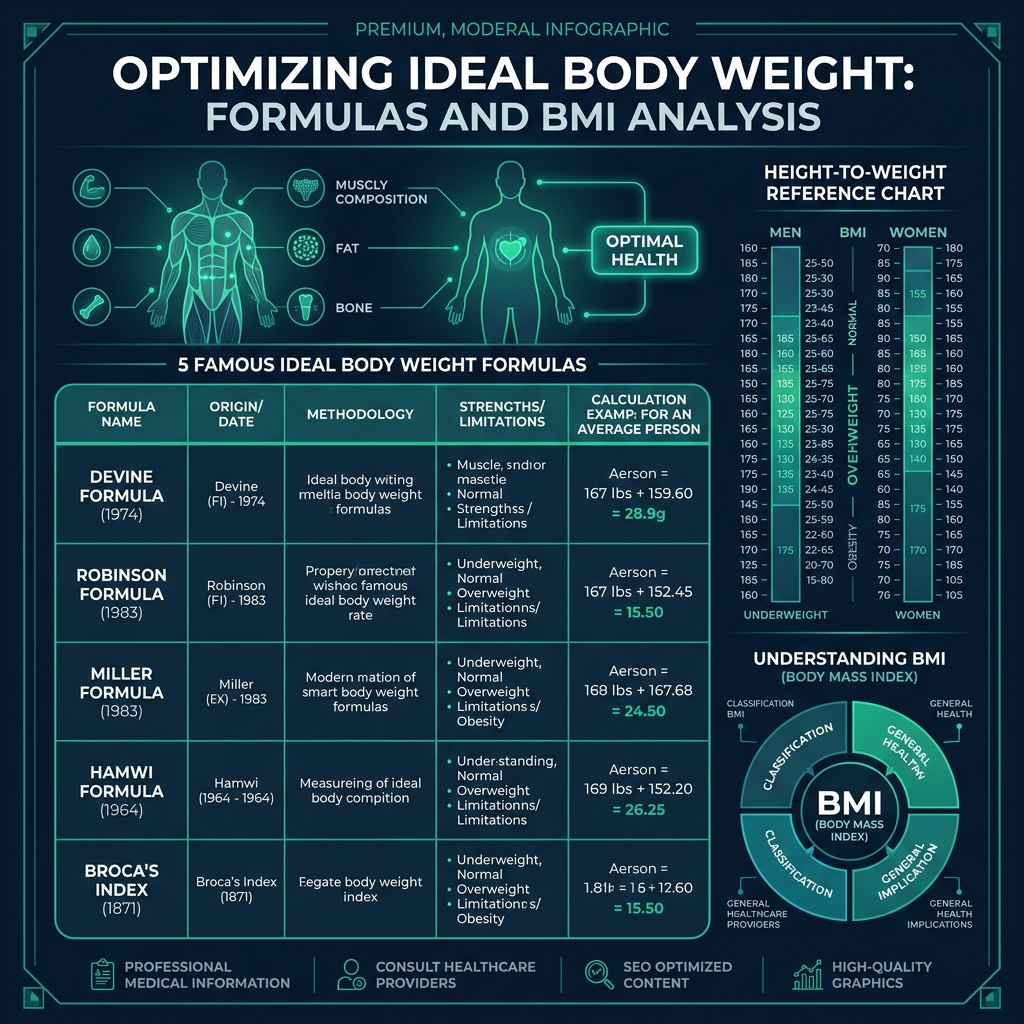
No single IBW formula is universally accepted. Each was developed from different populations for different clinical purposes — primarily for calculating medication dosages and ventilator settings in hospitalized patients, not for fitness goals. Understanding each formula helps you interpret the range meaningfully.
1. Devine Formula (1974) — Most Widely Used Clinically
Developed by Dr. B.J. Devine for drug dosing calculations, this formula became the de facto standard in clinical settings. It remains the most cited IBW formula in pharmacology literature.
- Male: IBW (kg) = 50 + 2.3 × (height in inches − 60)
- Female: IBW (kg) = 45.5 + 2.3 × (height in inches − 60)
Limitation: Tends to underestimate ideal weight for taller individuals and overestimate for shorter individuals. Not validated for heights below 5 ft (152 cm).
2. Robinson Formula (1983)
Published in Nutrition and Parenteral Nutrition, the Robinson formula uses slightly different base weights and per-inch increments than Devine, producing results that many clinicians find more accurate for medium-height individuals.
- Male: IBW (kg) = 52 + 1.9 × (height in inches − 60)
- Female: IBW (kg) = 49 + 1.7 × (height in inches − 60)
3. Miller Formula (1983)
Also published in 1983, the Miller formula uses the lowest base weight of any of the major formulas, particularly for women, and its smaller per-inch increment tends to produce lower IBW estimates — especially at taller heights.
- Male: IBW (kg) = 56.2 + 1.41 × (height in inches − 60)
- Female: IBW (kg) = 53.1 + 1.36 × (height in inches − 60)
4. Hamwi Formula (1964) — The Classic Medical Rule of Thumb
The oldest of the major IBW formulas, developed by Dr. G.J. Hamwi as a simple bedside tool. It uses pounds as its native unit and a 10% adjustment per inch rather than a fixed addend. It remains widely taught in medical and nutrition curricula.
- Male: 106 lbs for the first 5 feet + 6 lbs for each additional inch
- Female: 100 lbs for the first 5 feet + 5 lbs for each additional inch
- Frame-size adjustments: −10% for small frame, +10% for large frame
5. Peterson BMI Prime Method
Rather than using a fixed formula, this approach calculates the weight range that corresponds to a "healthy" BMI of 18.5–24.9, giving you the lower and upper bounds of normal weight for your height. This is the most statistically grounded method, as it derives directly from the BMI classification system used by the WHO and ADA.
- Lower bound: BMI 18.5 × height² (m²)
- Upper bound: BMI 24.9 × height² (m²)
- Midpoint: BMI 21.7 × height² (m²)
For a fuller picture of health metrics including BMI, use our dedicated BMI Calculator which shows your exact BMI value, category, and detailed health implications.
Ideal Weight by Height — Reference Chart
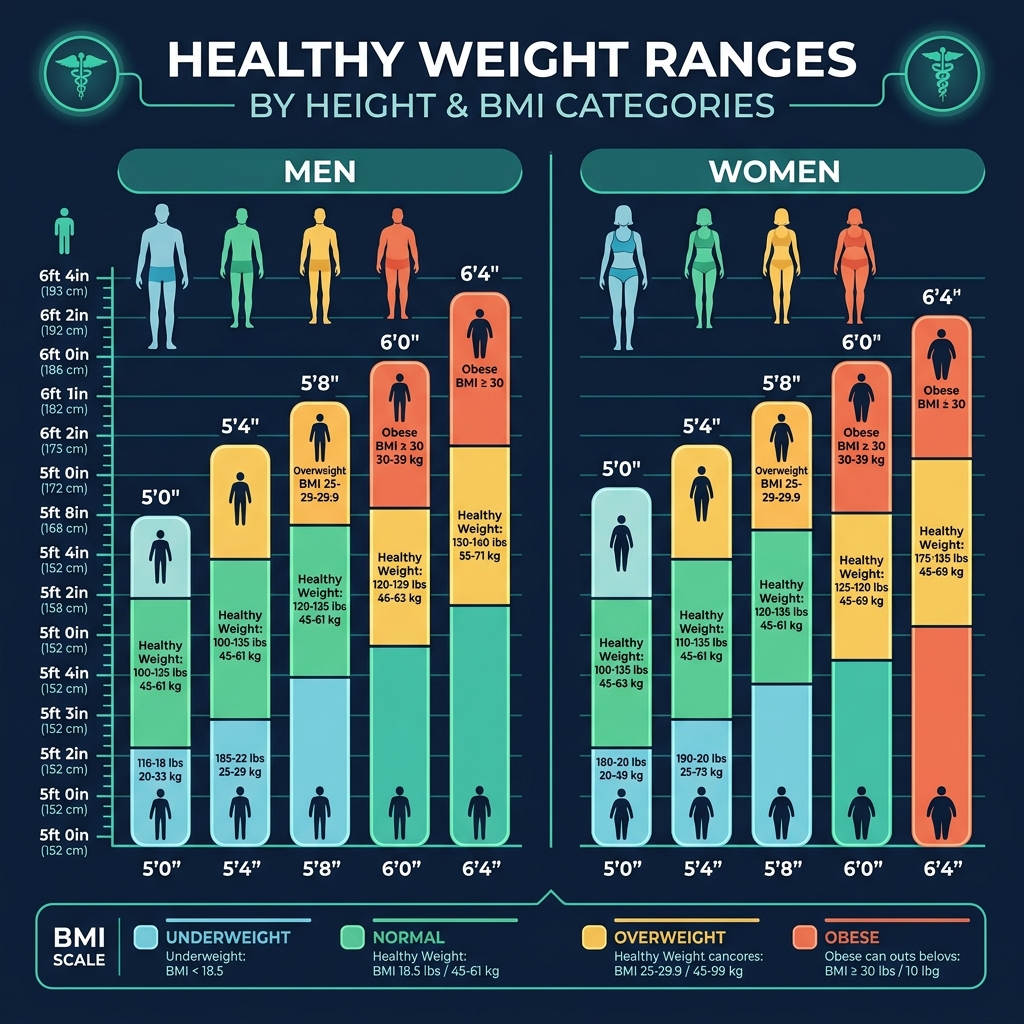
The table below shows the healthy BMI weight range (18.5–24.9) and the Robinson formula IBW for common heights. These are the same values used in the calculator above.
Men — Ideal Weight by Height
- 5'0" (152 cm): Healthy BMI 43–56 kg (94–123 lbs) · Robinson IBW: 52 kg (115 lbs)
- 5'4" (163 cm): Healthy BMI 49–64 kg (109–141 lbs) · Robinson IBW: 59.6 kg (131 lbs)
- 5'7" (170 cm): Healthy BMI 53–72 kg (118–158 lbs) · Robinson IBW: 65.3 kg (144 lbs)
- 5'10" (178 cm): Healthy BMI 58–78 kg (128–172 lbs) · Robinson IBW: 71 kg (157 lbs)
- 6'0" (183 cm): Healthy BMI 62–84 kg (136–185 lbs) · Robinson IBW: 74.8 kg (165 lbs)
- 6'2" (188 cm): Healthy BMI 65–88 kg (144–194 lbs) · Robinson IBW: 78.6 kg (173 lbs)
Women — Ideal Weight by Height
- 5'0" (152 cm): Healthy BMI 43–56 kg (94–123 lbs) · Robinson IBW: 49 kg (108 lbs)
- 5'2" (157 cm): Healthy BMI 46–60 kg (101–132 lbs) · Robinson IBW: 52.4 kg (115 lbs)
- 5'5" (165 cm): Healthy BMI 50–68 kg (110–150 lbs) · Robinson IBW: 57.5 kg (127 lbs)
- 5'7" (170 cm): Healthy BMI 54–72 kg (119–160 lbs) · Robinson IBW: 61 kg (134 lbs)
- 5'10" (178 cm): Healthy BMI 58–78 kg (128–172 lbs) · Robinson IBW: 66.1 kg (146 lbs)
- 6'0" (183 cm): Healthy BMI 62–84 kg (136–185 lbs) · Robinson IBW: 69.9 kg (154 lbs)
Limitations of Ideal Weight Calculations
All IBW formulas share important limitations you should understand before acting on results:
- Body composition is ignored. A person who is 80 kg with 15% body fat is healthier than a person who is 70 kg with 35% body fat, even though the lighter person appears "closer to IBW." IBW formulas cannot distinguish muscle from fat. Use our Body Fat Calculator for body composition assessment.
- Frame size and ethnicity are not accounted for. Asian populations may face metabolic risks at lower BMI and weight thresholds. Large-framed individuals from Northern European backgrounds may be metabolically healthy at weights above classical IBW ranges.
- Age is not factored in. Older adults (65+) may benefit from slightly higher weight — mortality data suggests a BMI of 25–27 may be optimal in the elderly (the "obesity paradox"). The formulas were derived primarily from younger adult populations.
- Height under 5 feet. All formulas except the BMI Prime method were validated only for heights of 5 feet (152 cm) and above.
- These are statistical estimates, not personal prescriptions. A physician, registered dietitian, or sports scientist can provide personalized ideal weight targets that account for metabolic health, athletic goals, and medical history.
Ideal Weight vs. Healthy Weight: What's the Difference?
These terms are often used interchangeably but carry different clinical meanings:
- Ideal Body Weight (IBW) is a calculated estimate from formulas, primarily used by clinicians for drug dosing, ventilator settings, and nutritional support calculations. It is not a personal health target.
- Healthy weight range is the weight range corresponding to a BMI of 18.5–24.9 kg/m² — the category associated with the lowest all-cause mortality risk in large population studies. This is a broader, more statistically defensible range.
- Goal weight is a personalized target set with a healthcare provider, based on medical history, body composition, lifestyle, and health objectives. This may not align with IBW or healthy BMI range — for example, an athlete may have a healthy goal weight well above the IBW formula estimates due to muscle mass.
For weight management goals, understanding your caloric needs is the practical starting point. Our Calorie Deficit Calculator shows how many calories below maintenance you need to eat to lose weight sustainably, while our Maintenance Calorie Calculator tells you exactly how many calories maintain your current weight.
How to Reach and Maintain Your Ideal Weight
Once you know your ideal weight target, the path to reaching it involves three core pillars:
1. Sustainable Caloric Management
Weight change is fundamentally driven by energy balance: calories consumed vs. calories expended. A deficit of approximately 500 kcal/day produces ~0.5 kg (1 lb) of weight loss per week — a rate the evidence supports as sustainable without significant muscle loss. Use the Harris-Benedict Calculator to find your Basal Metabolic Rate (BMR), then apply an activity multiplier to get your Total Daily Energy Expenditure (TDEE). Our Maintenance Calorie Calculator handles this automatically.
2. Resistance Training to Preserve Muscle Mass
When losing weight through caloric restriction alone, approximately 25–30% of weight loss can be lean muscle mass. Resistance training (strength training) combined with adequate protein intake (1.6–2.2g/kg of body weight) significantly reduces this lean mass loss, resulting in a better body composition outcome even at the same weight on the scale. If weight gain with muscle is your goal, our Weight Gain Calculator provides structured guidance.
3. Regular Monitoring and Adjustment
Body weight fluctuates by 1–3 kg daily due to water retention, food volume, and hormonal cycles. Track weight at the same time each day (morning, after bathroom, before eating) and use a 7-day rolling average rather than single-day readings. Plateau-breaking adjustments (reducing calories by 100–200 kcal/day, increasing activity by 20–30 min/week) should only be made when the 7-day average has not changed for 3+ weeks.
Related Health Calculators
For a complete health assessment that goes beyond ideal weight:
- BMI Calculator — full BMI calculation with category classification and health risk interpretation
- Body Fat Calculator — Navy tape method and BMI-based body fat percentage estimate
- Maintenance Calorie Calculator — Total Daily Energy Expenditure to maintain your current weight
- Calorie Deficit Calculator — how many calories below maintenance to lose weight at a chosen rate
- Harris-Benedict Calculator — Basal Metabolic Rate using the revised Harris-Benedict equation
- Weight Gain Calculator — caloric surplus needed to gain weight and muscle
- RMR Calculator — Resting Metabolic Rate, the calories your body burns at complete rest
- Height Calculator — convert height between feet/inches and centimeters
- Blood Sugar Converter — convert blood glucose between mg/dL and mmol/L